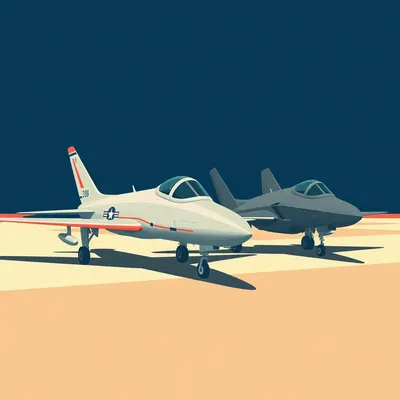
Daniel sent us this one — he was out with his wife Hannah and they spotted an aircraft that looked unfamiliar, old. She remarked on it looking old, and he guessed it was probably a training jet. And it got him thinking about something: militaries around the world maintain smaller fleets of second or third generation aircraft used exclusively for training. His question is basically, how does that make sense when you're putting pilots in something way behind an F thirty-five? What's the actual use case, and how do instructors divide training between simulators, these older aircraft, and eventually the real frontline jets?

This is one of those questions where the obvious objection is actually the right one to start with. If you're going to fly an F thirty-five operationally, why would you spend a hundred hours in something from the nineteen seventies? And the answer, counterintuitively, is because flying that older jet teaches things simulators still can't, at a cost that doesn't bankrupt your air force.
I figured cost was going to be the first thing out of your mouth.
It has to be. An F thirty-five costs about thirty-five thousand dollars per flight hour. The T thirty-eight Talon, which the U. Air Force still uses for advanced training, runs closer to four thousand. That's almost a factor of ten difference. If you can offload even a hundred hours of training from the expensive platform to the cheap one, you're saving millions per pilot.
That's the obvious answer. Daniel's real question is deeper — he's asking what you actually learn in an old jet that you don't learn in a simulator, given how good simulators have gotten.
And simulators are extraordinary now. Full motion, high fidelity visuals, they can model almost any emergency. The F thirty-five's own simulator is so integrated with the aircraft's systems that pilots do a huge portion of their mission training in the sim before they ever touch the real jet. But here's the thing — a simulator cannot kill you.
That's the line. That's the thesis right there.
It sounds glib but it's not. There is a physiological stress response to being in a real aircraft that no simulator replicates. Your body knows the difference. G forces, the vibration, the noise, the fact that if you make a catastrophic mistake you eject or you die. That stress response changes how you learn. And you need experience with that before you get into an aircraft that costs more than a hundred million dollars.
You're saying the old training jet is a stress inoculation platform.
It's a way to build airmanship — actual stick-and-rudder skills, spatial awareness, managing real-world contingencies — in an environment where the stakes are real but the cost of losing the aircraft is acceptable. Because here's the uncomfortable truth: pilots do crash training jets. And when a T thirty-eight goes down, it's a tragedy, but the loss is measured in millions. When a student pilot prangs an F thirty-five, you've lost an asset that took years to produce and cost more than some navies' annual budgets.
There's a second piece to this though, and it connects to something Daniel mentioned. He recalled reading about the Iran war and how one of the jets Israel downed was an old Russian type the I. used as a trainer. He's talking about the Iranian F-fourteen, but also about how Israel maintained a fleet of A-four Skyhawks for decades as advanced trainers.
The A-four is the perfect example. The Israeli Air Force flew the Skyhawk from nineteen sixty-seven all the way until twenty fourteen. That's forty-seven years. And for the last couple of decades, it was exclusively a training aircraft. It wasn't flying combat sorties. It was teaching new pilots how to drop bombs, how to navigate at low altitude, how to handle an aircraft at the edge of its envelope.
replaced it with the M three forty-six Lavi, which is a modern advanced trainer. But Daniel's question still stands — why not just move everything to simulators and then put the student straight into an F sixteen?
Let me give you the actual pipeline breakdown. In the Israeli Air Force, the flight training program runs about three years. Candidates start with the T six Texan two, a turboprop trainer — modern, but basic. They fly about ninety hours during the basic phase. Then they move to advanced training, which used to be the A-four and is now the M three forty-six. Another hundred to a hundred and twenty hours. Only after that do they transition to the operational aircraft — F sixteen, F fifteen, or eventually F thirty-five.
The old aircraft is a stepping stone, not a replacement for the real thing.
And the stepping stone logic is this: you don't teach someone to drive in a Formula One car. The performance envelope of an F thirty-five is so extreme, the information processing load is so high, that a novice pilot would be completely overwhelmed. They'd be task-saturated just keeping the aircraft straight and level.
Whereas in an older jet, the systems are simpler, the pilot has more direct control, and the aircraft is more forgiving in certain ways — or less forgiving in instructive ways.
That's the paradox. Older jets are actually harder to fly in terms of basic airmanship. An F thirty-five is fly-by-wire — the flight computer interprets your inputs and decides what the control surfaces should do. You're not really flying the aircraft directly. In a T thirty-eight or an A-four, you're connected mechanically or through simpler hydraulics. You feel the aircraft. If you pull too hard, you feel the buffet before the stall. You learn energy management in a way the F thirty-five's computers handle for you.
The older jet teaches you the physics in a way the modern jet's software abstracts away.
And this matters because when the computers fail, or when you're in a regime the flight control system wasn't designed for, you need that foundational understanding. It's the difference between a pilot who can recover from an unusual attitude because they understand aerodynamics, and one who's helpless because the computer's in a mode they've never seen.
Let me push on the simulator side though. Daniel mentioned the conversation about how military training is so simulator-based and type-specific. And he's right — across aviation, training has moved heavily into sims. Full flight simulators for airliners are so good that pilots do their type rating almost entirely in the sim, and their first flight in the actual aircraft is with passengers on board.
That's true for airlines. And it works because airline flying is procedural. It's about managing systems, following checklists, handling predictable emergencies. The simulator replicates that environment almost perfectly. Combat aviation is different. The unpredictability, the physical demands, the need to make split-second tactical decisions while under G loading — simulators are getting better at this, but they're not there yet.
There's also the formation flying aspect.
Formation flying is physically dangerous. Two aircraft flying within meters of each other at high speed — if the wingman makes a mistake, both aircraft can be lost. You cannot teach formation flying adequately in a simulator. The visual cues, the depth perception, the turbulence from the lead aircraft — these are physical realities you have to experience. And you want pilots learning this in aircraft where the unit cost is low enough that you can accept the risk.
The training hierarchy is roughly: simulators for procedures and systems, older jets for foundational airmanship and formation skills, and then the operational aircraft for combat tactics and mission-specific training.
That's the skeleton. Let me put some more flesh on it, because different air forces do this differently and the choices reveal a lot about their priorities. Air Force has been flying the T thirty-eight since nineteen sixty-one. That's sixty-five years on the same airframe for advanced training. They've been trying to replace it for decades. The T seven Red Hawk is finally supposed to enter service in the next couple of years, and it's a modern design with digital flight controls. But the T thirty-eight has persisted partly because it's paid for, partly because it does the job, and partly because replacement programs keep getting delayed.
Sixty-five years is wild. That aircraft is older than most of the generals making decisions about it.
It's older than the parents of most student pilots flying it. But here's what's interesting — the T thirty-eight is supersonic. It can hit Mach one point three. So it actually exposes students to transonic and supersonic flight dynamics, which is something you cannot get in a turboprop trainer like the T six.
That's the distinction between basic trainers and advanced trainers, right? Most air forces use a two-stage system.
Three if you count the operational conversion unit, where pilots learn their specific frontline aircraft. But for the dedicated training fleet, yes — basic and advanced. Basic trainers are typically turboprops or very simple jets, for teaching fundamentals: takeoff, landing, basic maneuvers, navigation, instrument flying. Advanced trainers are higher performance, often supersonic, and they bridge the gap to operational fighters.
uses the T six for basic and the M three forty-six for advanced now. But they used the A-four for decades, which was originally a carrier-based attack aircraft from the nineteen fifties.
The A-four is a great case study in why you keep these old jets around. It was a combat-proven design — rugged, reliable, and the I. already had the maintenance infrastructure, the spare parts pipeline, and the institutional knowledge to keep it flying. When you already have all that, the marginal cost of continuing to operate it as a trainer is very low compared to procuring a brand new trainer fleet.
Plus, the A-four could do things trainers can't. It could carry weapons. It could simulate attack profiles. A student could actually drop practice bombs from an A-four. You're not doing that in a T six.
And that's another piece of Daniel's question — the use case beyond just flying the aircraft. An advanced trainer that can also serve as a light attack aircraft gives you flexibility. You can use it for dissimilar air combat training, where it acts as an adversary aircraft. You can use it for joint exercises where you need to put aircraft in the air but don't want to burn hours on your frontline fighters. You can use it for pilot currency — keeping qualified pilots current on basic skills without tapping into your combat fleet's flight hours.
Dissimilar air combat training is a huge piece of this that I don't think gets enough attention. The old jets aren't just for students.
Navy and Marine Corps have been using F five Tigers as adversary aircraft for decades. These are nineteen sixties-vintage lightweight fighters that can simulate the flight characteristics of enemy aircraft. They're cheap to fly, they're agile, and they're not burning hours on the F eighteen or F thirty-five fleet. The principle is the same — you want your frontline pilots getting practice against real aircraft, not just simulators, and you want to do it without putting wear and tear on your most expensive assets.
The old training fleet serves two populations: new pilots building foundational skills, and experienced pilots maintaining proficiency and doing adversary training.
Three populations if you count instructor pilots, who need to accumulate hours and maintain their own proficiency. Instructor pilots are typically experienced operational pilots on a non-operational tour. If you only had simulators and frontline jets, where do these instructors fly? You can't have them burning F thirty-five hours just to stay current. The training fleet gives them a platform to maintain their own skills while they teach.
The old jets are a reservoir of flight hours for the whole ecosystem.
This connects to something Daniel mentioned about type-specific training. He's right that aviation has become very type-specific — a pilot qualified on the F sixteen can't just hop into an F fifteen and fly it. So why train on something that's not your eventual aircraft?
That's the core tension in his question.
The answer gets at a fundamental concept in aviation training called transfer of learning. The research shows that foundational airmanship transfers very well. A pilot who can handle an aircraft at high angle of attack in a T thirty-eight will learn high angle of attack handling in an F thirty-five faster than someone who's only done it in a simulator. The specific techniques differ, but the underlying understanding — the feel for energy state, the instinct for recovery — that transfers.
There's a neurological argument here too, right? Procedural memory versus something deeper.
Yeah, this is where the cognitive science gets interesting. Procedural memory is about learning sequences of actions — if this happens, do that. Simulators are excellent for building procedural memory. But what pilots call airmanship is more like what psychologists call perceptual-motor expertise. It's the ability to integrate sensory information — visual, vestibular, proprioceptive — and translate it into precise motor actions in real time, under stress. That kind of learning requires the full sensory environment. You need the G forces, the vibration, the peripheral vision, the auditory cues of engine pitch and airflow.
The simulator can show you a stall. It can't make your inner ear feel the nose dropping.
And the inner ear is both the problem and the solution. Spatial disorientation is one of the leading causes of fatal aviation accidents. Your vestibular system can lie to you — you can feel like you're turning when you're straight and level, or feel level when you're in a spiral. Learning to override those false signals and trust your instruments requires experiencing the false signals in the first place. A simulator can induce some of this visually, but the vestibular illusion is weaker when your body isn't actually moving through three-dimensional space.
The old jet is basically a vestibular training laboratory.
With ejection seats. Which is the other thing you can't simulate. Egress training — actually pulling the handle and getting out of a disabled aircraft — that's something you brief and drill, but the psychological reality of knowing that option exists, and knowing when to use it, is something pilots internalize through real flying.
Let me bring this back to something practical. Daniel asked specifically how training instructors divide training between simulators, older aircraft, and operational aircraft. Can you walk through what a typical progression looks like?
I'll use the I. model because it's what Daniel was referencing and it's well documented. The flight training course is about three years. Phase one is basic training on the T six Texan two — takeoffs, landings, basic aerobatics, instrument flying, formation basics, night flying. About ninety flight hours, plus extensive simulator sessions. The simulator-to-aircraft ratio here is probably about one to one in terms of events.
Even at the basic level, simulators are heavily integrated.
From day one. But here's the key — the simulator sessions are preparation for the flight. You brief the maneuver in the classroom, you fly it in the simulator until you can execute it procedurally, then you go fly it in the aircraft. The simulator reduces the number of aircraft sorties needed to master a given skill.
Which goes back to cost. Every hour in the sim is an hour you're not paying for jet fuel, maintenance, and airframe life.
Phase two is advanced training. In the I. this used to be the A-four Skyhawk, now it's the M three forty-six Lavi. About a hundred to a hundred twenty flight hours. This is where students learn tactical flying — air-to-air maneuvering, air-to-ground weapons delivery, low-level navigation, more complex formation work. The simulator integration continues, but the aircraft sorties become more important because the tactical decision-making has to happen in a dynamic, three-dimensional environment.
Then phase three is the operational conversion unit, where they finally get into the F sixteen or F fifteen.
This is where type-specific training really begins. The student is now a qualified pilot but not combat-ready. They'll spend six to nine months learning their specific aircraft — systems, emergency procedures, basic tactical employment. The simulator-to-aircraft ratio here shifts heavily toward the simulator for systems training, but the aircraft sorties are irreplaceable for tactical application.
At what point do they actually fly the F thirty-five, if that's their eventual assignment?
Typically, pilots don't go straight to the F thirty-five from flight school. and the U. services generally require pilots to have operational experience in a fourth-generation fighter — F sixteen, F fifteen, F eighteen — before transitioning to the F thirty-five. There are exceptions, but the logic is that the F thirty-five is so complex, and its tactical role is so demanding, that you want pilots who already have mature airmanship and tactical judgment.
The F thirty-five pilot has already gone through the entire pipeline — basic trainer, advanced trainer, operational fighter — before they even touch the fifth-gen jet.
That's the counterpoint to the argument that we should just skip the older aircraft. Even with all the simulator technology we have, the progression through increasingly capable real aircraft builds something that can't be shortcut. Each stage adds a layer of judgment and instinct that the next stage depends on.
There's a geopolitical dimension here too. The countries that maintain these older training fleets are generally the ones with large, well-funded air forces. Smaller air forces often can't afford a dedicated advanced trainer fleet.
And they take different approaches. Some send their pilots to train with allies — the Euro-NATO Joint Jet Pilot Training program in the U. is a good example. Others contract out training to private companies. But the ones that do maintain their own training fleets are making a strategic choice. They're saying, we need a pipeline that produces combat-ready pilots at scale, and that requires dedicated training assets.
Which is a long-term investment that pays off in readiness over decades.
It's one of those things that's easy to cut in peacetime. Training fleets don't generate headlines. Politicians look at them and see old jets burning money. But when you need to surge pilot production — if you're facing a conflict that requires more combat pilots than you currently have — you cannot compress the training pipeline below a certain minimum. You can't make pilots faster by throwing more simulators at the problem. The flight hours have to be flown.
That's a sobering point. The training fleet is a strategic reserve of training capacity.
Here's a specific example. During the Vietnam War, the U. Air Force had to dramatically expand pilot production. They had the T thirty-eight fleet and the training infrastructure to do it. If they had been relying entirely on simulators and operational aircraft, that surge would have been impossible. Even today, simulator capacity is limited by the number of devices you have and the instructors to run them. Aircraft can be surged — you can fly them more hours per month, you can bring retired aircraft back into service, you can accelerate maintenance cycles. There's a flexibility to a physical fleet that simulators don't have.
Let me ask about the adversary training piece specifically, because I think it's the most interesting part of this. When an F thirty-five pilot goes up against a T thirty-eight acting as an aggressor, what are they actually learning?
They're learning to fight against an aircraft that doesn't behave like their own. When you train against the same aircraft type you fly, you're learning to exploit the specific weaknesses of that aircraft. But when you face a dissimilar type — different size, different radar cross-section, different maneuverability, different tactics — you have to adapt. The old jet might be less capable on paper, but it forces you to think differently. The T thirty-eight can approximate the flight characteristics of various Russian or Chinese threat aircraft. It's not a perfect match, but it's close enough to teach pilots what to look for visually, how to maneuver against a dissimilar opponent, and how to employ tactics that work across different threat types.
There's something almost philosophical here about the value of the old and simple in an age of the new and complex.
I think that's right. And it's not just nostalgia. There's a genuine pedagogical principle at work. Simple tools force you to develop the underlying skill. A photographer who learns on a fully manual film camera understands exposure in a way someone who's only used automatic modes doesn't. A pilot who learns on an aircraft that doesn't have a flight computer managing everything understands what the flight computer is doing and what to do when it fails.
Daniel's question about how this makes sense — I think the answer is that it makes sense precisely because the modern jets are so advanced. The more capable the frontline aircraft, the more you need pilots who understand the fundamentals underneath all the automation.
That's the paradox. The F thirty-five is easier to fly than a T thirty-eight in many ways. The flight controls are smoother, the automation handles routine tasks, the sensors give you godlike situational awareness. But that ease can be deceptive. When things go wrong in an F thirty-five, they go wrong fast and the complexity of the systems means the pilot has to diagnose and respond correctly under extreme pressure. That's when the foundational airmanship built in older, simpler aircraft pays off.
The old training jet isn't a relic. It's a deliberate tool for building cognitive and physical skills that can't be acquired any other way.
It's worth noting that even the most advanced air forces agree on this. Air Force is replacing the T thirty-eight, but they're replacing it with another dedicated trainer — the T seven Red Hawk. They're not eliminating the advanced trainer phase. They're modernizing it. The new trainer will have digital flight controls, better avionics, more simulator-like integration. But it's still a real aircraft that students will fly, sweat in, and occasionally scare themselves in.
There's a financial reality here too. The reason air forces keep these old jets for so long isn't just pedagogy — it's that new trainer programs are expensive and frequently delayed. The T seven program has had its own challenges. Meanwhile, the T thirty-eight just keeps flying.
The devil you know. When you have a training fleet that works, that your instructors understand, that your maintenance infrastructure supports, the bar for replacing it is very high. You need a compelling reason beyond it's old. And the compelling reason eventually arrives — the T thirty-eight is becoming genuinely difficult to sustain, with parts obsolescence and structural fatigue issues. But it took sixty-five years to get there.
Which is longer than most air forces have existed.
The Israeli Air Force itself is only about seventy-seven years old. The T thirty-eight has been flying for almost the entire history of the modern I.
Let's circle back to Daniel's specific observation — he saw an unfamiliar old aircraft in the sky and correctly guessed it was a training jet. What do you think he actually saw?
Hard to say without knowing the location and the specific aircraft, but if he was in Israel, it could have been an M three forty-six Lavi, which is the current advanced trainer. Those have a distinctive look — twin engines, high wing, fairly modern lines but not stealthy. Or it could have been something older being operated by a private contractor. There are companies that provide adversary air training services using old jets — A fours, L thirty-nines, even old MiGs.
The fact that you can just see these things in the sky, doing their training missions, is a nice reminder that all of this is real. It's not just doctrine documents and budget spreadsheets. There are actual pilots in actual old jets, learning the craft the same way pilots have for generations.
They're probably having more fun than the F thirty-five pilots, if we're being honest. An M three forty-six or a T thirty-eight is a sports car. An F thirty-five is a supercomputer that happens to fly. Different experiences entirely.
I suspect that's a controversial opinion in fighter pilot circles.
It's definitely controversial. But I've heard enough old heads say it that I think there's something to it. The pure joy of flying — the physical sensation of maneuvering through the sky with direct control — that's more accessible in a simpler aircraft. The F thirty-five pilot is managing an incredibly complex system. The training jet pilot is flying.
Now: Hilbert's daily fun fact.
The shortest war in recorded history was the Anglo-Zanzibar War of eighteen ninety-six, which lasted between thirty-eight and forty-five minutes depending on which side's clock you use.
For listeners who want something practical from all this — if you're interested in aviation, what should you take away?
I'd say three things. First, when you see what looks like an old military jet in the sky, you're probably right that it's a trainer, and now you understand why it's still flying. Second, the training pipeline is a fascinating example of how institutions balance cost, risk, and learning effectiveness — and it's a balance that applies far beyond aviation. Anytime you're teaching a complex, high-stakes skill, you have to decide how much to invest in lower-fidelity practice environments versus the real thing. The military's answer — use both, in a carefully sequenced progression — is worth studying.
Third, the next time you're in a flight simulator — even a desktop one — appreciate what it can do, but also appreciate what it can't. The physical reality of flight is still irreplaceable. That's why those old jets are still in the air.
I think there's a broader point here about how we think about technology and progress. The instinct is to assume that newer replaces older, that the simulator makes the training jet obsolete. But the reality is more layered. New technology often changes the role of the old technology rather than eliminating it. The training jet doesn't do what the simulator does, and the simulator doesn't do what the training jet does. They complement each other.
That's a principle that applies to a lot of domains. In medicine, we still train surgeons on cadavers and animal models even though we have sophisticated surgical simulators. In music, we still practice scales on real instruments even though we have digital audio workstations that can correct any mistake. The physical, embodied experience matters.
Daniel, hopefully that answers the question. The old jet you saw is doing exactly what you guessed — training pilots — and it's doing it for reasons that are simultaneously about cost, about pedagogy, about risk management, and about something less tangible but equally real: the irreplaceable value of actually flying.
If Hannah thought it looked old, she was probably right. Some of these aircraft have been in service since before either of us was born. They're still there because they work.
Thanks to our producer Hilbert Flumingtop for keeping this show running. This has been My Weird Prompts. You can find every episode at myweirdprompts dot com.
If you enjoyed this, leave us a review wherever you listen. We'll be back soon.