Did you know that oil is not just found underground but also beneath the ocean floor?

A surprising amount of it. Our friend Daniel sent us a question that gets right at the fundamentals — where oil actually comes from. He's asking four specific things.
One, is it only from land or sea, and what's the split. Two, does every country have at least a little oil. Three, why it's so wildly concentrated in just a few spots. And four, with all our modern tech, are we basically done finding new oil fields, or could there be big discoveries even now, in two thousand twenty-six.
Which is a perfect and timely question, because understanding oil's origins is absolutely crucial as we navigate these complex energy transitions.
And fun fact — today's episode script is being powered by deepseek-v3-two.
Oh, the new one. Okay, so, where do we even start with this? There's a fundamental misconception we should clear up immediately.
Please, enlighten me.
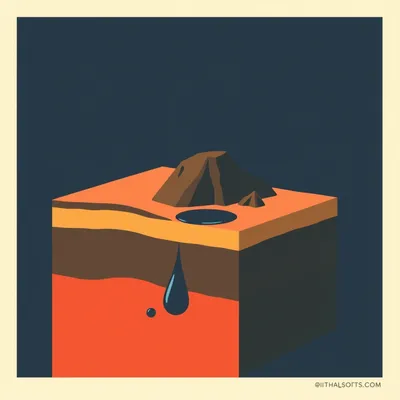
Oil isn't just… a substance that exists in the ground. It’s not like water, sitting in underground lakes. It’s a hydrocarbon that formed from ancient organic matter — think microscopic plankton and algae — that got buried under layers of sediment over millions of years. The pressure and heat cooked that organic soup into crude oil and natural gas.
We're basically burning prehistoric soup.
In the most reductive sense, yes. But the geological conditions for that to happen are very specific. It needs the right source rock, a reservoir rock with tiny pores to hold it, and a cap rock to trap it and prevent it from seeping away. That perfect alignment doesn't happen everywhere—which brings us right to Daniel's first two questions.
This prehistoric soup kitchen, this specific geological alignment… it’s not evenly spread out, is it? Because if it requires such a perfect set of conditions, it can’t be.
So to set the stage for the rest, let's quickly frame the four angles he's asking about. One, the land versus sea extraction split — it's not trivial, and it tells us about where these ideal conditions actually occurred, often in ancient seabeds. Two, the global distribution — no, not every country sits on oil, precisely because those conditions are rare. Three, why the concentration — which is really the geological story of our planet's history. And four, the future of discovery — whether our technology has mapped everything worth finding.
Which is a lot more hopeful than most people think.
Because the process isn't just sticking a straw in the ground. We're talking about a substance formed over tens of millions of years, from organic material that settled in low-oxygen environments, like ancient river deltas or deep ocean basins. That material gets buried deeper and deeper, subjected to what's called the oil window — temperatures between sixty and a hundred and fifty degrees Celsius. Too cold, nothing happens. Too hot, you get natural gas or it gets destroyed. That sweet spot creates the crude oil.
We're looking for the planet's old, precisely cooked leftovers. And we have to figure out where it hid them—because those leftovers aren't evenly split between land and sea.
Let's tackle that first question. The global split today is about sixty percent from land extraction, forty percent from offshore sources. But that's just where we're pulling it from now, not necessarily where it all is.
That split is partly historical — onshore fields were easier and cheaper to find and develop first — and partly geological. Those ancient organic-rich environments were often shallow seas or continental shelves. As tectonic plates shifted, some of those areas got lifted up to become land, like parts of the Middle East. Others remained submerged. So we're drilling both into what were ancient seabeds, whether they're currently dry land or under the ocean.
Here’s a concrete example that illustrates the history side. Take the famous Spindletop gusher in Texas in 1901. That was on land, obviously, but it was found by looking for a surface salt dome—an obvious geologic feature. That launched the modern oil industry onshore. Offshore drilling was a much later, more expensive technological leap. The first real offshore well out of sight of land was in the Gulf of Mexico in 1947. So for decades, the "split" was massively skewed toward land simply because we couldn't physically get to the offshore oil. Now, with drillships and semi-submersible platforms, we can tap those submerged basins, which is why the offshore percentage has grown.
The split isn't a fixed rule of nature. It's a snapshot of our current technological and economic reach. If we get better and cheaper at ultra-deepwater drilling, that forty percent could grow.
But it also tells a geographic story. For instance, Brazil's massive pre-salt fields, like Lula and Búzios, are all offshore, under a thick layer of salt beneath the South Atlantic. That oil formed in a basin that has never been dry land. Conversely, a place like Oklahoma, with its sprawling onshore fields, is tapping an ancient inland sea that vanished eons ago. So Daniel’s first question—land or sea—really points to the fact that oil’s birthplace was usually a body of water, but its current address depends on tectonic luck.
Which gets us to Daniel's second question. Does every country have some? The answer is a hard no. It's not a uniform layer. The geological conditions are so specific that vast swathes of the planet have none. No source rock, no reservoir, no trap. Countries like Japan or South Korea have virtually no meaningful conventional oil reserves.
That has profound implications. Think about energy security. A country with no domestic hydrocarbons is permanently import-dependent, which shapes its entire foreign policy. Japan’s push for energy efficiency and its long-term investments in LNG and hydrogen are direct responses to its geological reality.
What about countries that seem to have a little? Like, doesn't Germany have some oil production?
A tiny amount, yes. In the North German Basin, they produce about 50,000 barrels a day. That’s a rounding error globally—about 0.05% of world production. It’s a geological footnote. So technically, some countries have traces, but not in any commercially transformative way. The real dividing line is between the "have-nots," the "have-a-littles," and the "have-a-monstrous-amounts.
Then you have the outliers, the lottery winners. Saudi Arabia alone holds about seventeen percent of the world's proven oil reserves. Most of that is in a single, staggering geological feature: the Ghawar Field. It's the largest conventional oil field on the planet by a huge margin, discovered back in nineteen forty-eight. It's over a hundred and sixty miles long, and it's produced over sixty-five billion barrels so far.
To put Ghawar in perspective, it’s produced more than five times the total estimated reserves of the entire United Kingdom sector of the North Sea. It’s a singularity. And it’s the perfect segue into Daniel’s third question: why is so much of the planet's oil concentrated in just a few regions like the Middle East, the Caspian, parts of West Africa and South America?
It's the perfect storm of ancient geography and stable geology. Around a hundred and fifty million years ago, during the Jurassic and Cretaceous periods, a vast, shallow ocean called the Tethys Sea covered what is now the Middle East. It was teeming with that planktonic life, perfect for organic accumulation. The region was also a passive continental margin — think of a stable, sinking coastline — where thick layers of sediment could pile up for millions of years without being disrupted by mountain-building or volcanoes.
It was a great prehistoric soup kitchen that never got its kitchen torn up by a renovation.
The sediment buried the organic matter to just the right depth for the oil window, and then geological structures — like massive, gentle folds called anticlines — formed perfect traps. And critically, the cap rock, often a layer of salt or impermeable shale, stayed intact. In other parts of the world, tectonic activity later in Earth's history cracked those seals, letting the oil seep out and vanish.
The Middle East isn't necessarily where the most life was; it's where the geology was the most passive and preservative. A geological storage unit with perfect conditions that never got broken into.
That's the core of it. A great case study for a different kind of concentration is the Niger Delta. It’s a newer basin, geologically speaking, from the Tertiary period. There, you had a massive river system dumping organic-rich sediment into a deep basin offshore. But the structure is more complex—it’s a so-called “deltaic” system with countless small fault traps instead of one giant anticline. So the oil is there in huge quantities, but it’s spread across hundreds of smaller fields, which makes development a different kind of challenge.
And the opposite is true in places like the Pacific Rim, with all its volcanic and tectonic activity—the so-called "Ring of Fire." It's geologically too chaotic; any oil that formed likely got cooked, destroyed, or leaked away long ago. That’s why Japan, Chile, or New Zealand aren’t oil giants. Their geology is too restless.
Which makes the distribution not just unequal, but fundamentally tied to the planet's deep tectonic personality. Some regions are savers, some are spenders—and that geological character shapes everything about how we find resources.
It’s why the discovery process has always been part detective work, part incredibly expensive gamble. We're not just looking for oil; we're reconstructing ancient environments to guess where the perfect conditions aligned.
How much of that is still guesswork versus mapped science these days? The seismic imaging, the satellite surveys — has the planet been essentially X-rayed?
The technology has evolved astronomically. In the early days, it was surface geology — look for oil seeps, guess based on rock outcrops. Then came two-D seismic surveys in the mid-twentieth century, giving us crude cross-sections. Now it's three-D and even four-D seismic, which adds the dimension of time to see how fluids move within a reservoir. We can model subsurface geology with incredible resolution without drilling a single well.
The planet has been, let's say, thoroughly CAT-scanned in the places we've checked.
In the areas we've looked, yes. But here's the key limit: seismic surveys are fantastically expensive, especially offshore. You don't just scan the entire ocean floor on a whim. A single modern 3D seismic survey over a promising offshore block can cost tens of millions of dollars. You only survey basins that geological models suggest are promising. And even with great data, it's still an interpretation. The seismic data gives you a picture of rock layers and structures, but it can’t tell you with 100% certainty what fluid is in the pores. It could be oil, gas, or saltwater. The only way to confirm oil is to drill. That's why wildcat wells — exploratory drills in unproven areas — are such high-stakes bets.
The success rate for those is still pretty low, right?
Historically, about one in five or six wildcat wells finds commercially viable hydrocarbons. It’s improved with better tech, but it’s still a gamble. Which is why major oil companies have teams of geoscientists and supercomputers running simulations to lower the risk. It’s a fun fact—the algorithms used to process seismic data today are cousins of the ones used in medical imaging and even voice recognition. They’re looking for patterns in a blur of reflected sound waves.
Which brings us to Daniel's big fourth question. With all this tech, are we done? Have all the significant deposits been found?
The clear answer, and we have fresh evidence, is no. Not even close to done. Major discoveries are still happening. Look at Guyana. Before two thousand fifteen, it had no oil production. Then ExxonMobil and its partners hit the offshore Stabroek Block. By two thousand twenty-five, they'd announced over thirty discoveries there, with recoverable resources estimated at over eleven billion barrels. It's transformed the entire country's economy almost overnight.
A brand-new, world-class oil province discovered in the twenty-first century. That's a powerful counter-argument to the "we've found it all" idea.
And it’s not a fluke. The geology there is an extension of the prolific West African salt basin. For decades, the focus was on the African side, like off Nigeria and Angola. But the continental drift theory suggested the same geology should exist on the South American side. It took advances in seismic imaging to see beneath the salt layer and the commercial courage to drill in deep water to prove it.
It's not just new tech finding random spots; it's new tech confirming geological predictions we couldn't previously test.
And it's not just Guyana. In March of this year, Petrobras confirmed a new oil discovery in the mature Campos Basin off Brazil, in what's called the Marlim Sul field. They're using advanced seismic to find new pockets in areas they've been producing from for decades. That’s called “infill exploration”—finding more in places you already know are productive.
It’s like thinking you’ve emptied a bag of marbles, then giving it a better shake and hearing ten more rattling around in a hidden corner.
In Kazakhstan, just last year, they announced the massive Zhiloi field near the Caspian Sea, with reserves estimated at four point seven billion tons. That's potentially on par with their giant Kashagan field. And there are frontier areas still barely touched. Think the Arctic offshore, or the deep basins east of Africa, like off Somalia or Madagascar. They’re high-risk, but the geologic models are enticing.
The narrative that all the easy oil is gone is true — the massive, obvious, onshore fields like Ghawar were found last century. But the narrative that all the big oil is gone is false. We're finding new "elephants," as the industry calls them, they're just in trickier places — deep offshore, under salt layers, in harsh environments.
The cost and risk are higher, but the rewards are still enormous. The technology isn't just for finding new basins; it's for seeing more within known basins. We're getting better at spotting what we missed. And politically, a new discovery like Guyana's changes everything. It shifts global supply maps, creates new petro-states, and alters geopolitical alliances.
Which is the double-edged sword. A discovery like Prudhoe Bay in Alaska in nineteen sixty-eight made the U.far more energy secure for decades. But today, a major new discovery also comes with the immediate question of whether it's a "stranded asset" — will climate policies and the energy transition mean it's too controversial or uneconomic to develop by the time you bring it online?
That's the trillion-dollar question. The economic implication isn't just "we found oil, get rich." It's a decades-long capital project with a shadow of uncertainty over its entire future revenue stream. For a country like Guyana, it's a no-brainer — develop it fast to lift the nation out of poverty. For a major oil company in a Western nation, the calculation is fraught with political and ESG pressures. Shareholders are asking, "Will this investment pay off in a carbon-constrained world, or will we have to write it off?
The discovery process isn't concluded. It's evolved into a higher-stakes, higher-tech game with a more complicated payoff matrix. We're not just looking for oil; we're looking for oil that can be politically and economically extracted in a world that's supposedly trying to use less of it.
That's the tension. The technology to find oil keeps improving, but the will to fully exploit what we find is becoming the real limiting factor. And that tension has practical implications. Oil is undeniably finite, but the timeline on that finiteness keeps getting stretched by technology. Our ability to find and extract it improves faster than we deplete the known reserves in many cases. The North Sea might be over ninety percent depleted, but new basins are coming online.
Let's pull this all together. What should a listener take away from this deep dive into oil's origins and future?
First, the second takeaway is that geopolitics is still geology with a flag. A country's power, its foreign policy, even its internal stability, is often a direct function of whether it sits on one of those ancient, preserved seabeds. The Strait of Hormuz isn't a strategic chokepoint by accident — twenty-five percent of all traded oil passes through it. Control the geology, you influence the globe.
That means as a listener, staying informed isn't just about barrel prices. It's about understanding how a discovery off Guyana or in the Eastern Mediterranean reshuffles alliances. It's about recognizing that "energy independence" isn't just a domestic drilling slogan; for nations without the right geology, it's a permanent strategic vulnerability they have to manage through diplomacy or trade.
So the action item is to watch the discovery news, but through that dual lens. Not just "how many barrels," but "who benefits, and who gets nervous?" When a new field is found in the Caspian, it's not just a business story. It changes Russia's leverage, it changes Europe's options, it creates a new player in Kazakhstan.
Finally, stay informed about the transition. Because the other limiting factor isn't finding oil, it's the growing social and economic pressure to leave it in the ground. Understanding the pace of genuine energy innovation — in batteries, in nuclear, in alternatives — is how you gauge whether the next big discovery will be a goldmine or a stranded asset. The geology is set. The economics and the politics are what's moving now.
Which raises the trillion-dollar, multi-decade question you hinted at: what replaces oil as the dominant force? Not just for fueling cars, but as the foundational chemical and geopolitical commodity.
Right — if we're still finding it, but the world is trying to use less of it... what actually fills that role? That's the challenge we're facing.
There's no single heir apparent, which is what makes the transition so messy. For transport, it's a mix — electrification for light vehicles, maybe hydrogen or advanced biofuels for shipping and aviation. For petrochemicals, that's harder; oil is the feedstock for plastics, fertilizers, pharmaceuticals. Replacing that means a massive build-out of chemical recycling and bio-based alternatives. The geopolitics of energy won't disappear; they'll just shift to whoever controls the critical minerals for batteries, like lithium and cobalt, or the land for sustainable fuels, or the next generation of modular nuclear reactors.