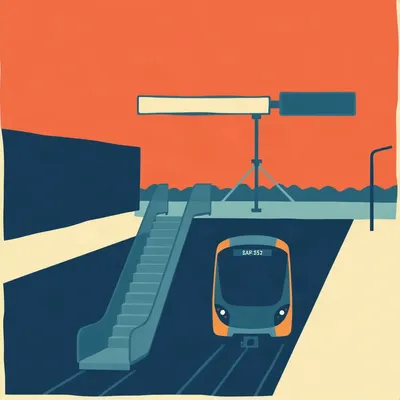
Daniel sent us this one — he's asking about the state of Israel's rail network, that Tel Aviv to Jerusalem line that everyone calls "high-speed" even though by international standards it doesn't really qualify. He's wondering about gauge modernization, whether the network can get denser and still make economic sense, or whether it's hit a natural saturation point given how small the country is. And then the bigger question: the intercity bus is deeply entrenched as the way Israelis move between cities — so is rail actually a better long-term solution for mass transit, or are we just building tracks because tracks feel like progress?

This is the kind of topic where the surface-level conversation is almost entirely wrong, which makes it perfect for us. Let me start with the thing that bugged me when I first dug into this. Everyone calls the Tel Aviv to Jerusalem line a high-speed train. It's not. The International Union of Railways defines high-speed rail as two hundred fifty kilometers per hour or faster on new dedicated track. The Tel Aviv to Jerusalem line operates at a maximum of one hundred sixty kilometers per hour. That's express rail, not high-speed. It's not even close.
It's the rail equivalent of calling a brisk walk a sprint.
And the reason isn't that Israel didn't want true high-speed — it's that the geography through the Judean Hills forced tight curves. There's a five-kilometer tunnel with a three point five percent grade, and a one point eight percent gradient across much of the route. You can't run a TGV through that at three hundred twenty kilometers per hour without launching it into orbit. The alignment was a compromise between the terrain and what was buildable.
Which is honestly a pretty good metaphor for the entire Israeli rail story — ambition meets geography, and geography wins most of the rounds.
To understand why the network looks the way it does today, we actually need to go back to the Ottoman Empire.
Of course we do. Everything in this region eventually goes back to the Ottoman Empire. It's the Middle Eastern version of "it started with a garage in Silicon Valley.
The original Jaffa to Jerusalem line opened in eighteen ninety-two. That's one of the oldest railways in the entire Middle East. It was built to narrow gauge — one thousand fifty millimeters — which was the Ottoman standard. The British came along during the Mandate period and extended the network, but they kept the narrow gauge. So by the time Israel was founded in nineteen forty-eight, the entire rail network was this Ottoman-era one thousand fifty millimeter narrow gauge system that couldn't connect to anything in Europe or North America.
Wait, why would the gauge matter for a country this small? It's not like you're running freight trains from Haifa to Paris.
It matters enormously for interoperability and for speed. Standard gauge, which is one thousand four hundred thirty-five millimeters, is what roughly sixty percent of the world's railways use. It's what every high-speed system runs on. Narrow gauge trains are inherently less stable at speed — the narrower the wheelbase, the more you're limited on how fast you can go before the thing starts swaying dangerously. And you can't just run standard-gauge rolling stock on narrow-gauge track. So Israel was locked into a system that couldn't accept modern trains, couldn't go fast, and couldn't be extended without continued dependence on specialty narrow-gauge equipment.
The entire network was running on what was effectively a legacy format that nobody else used. Like insisting on Betamax in a VHS world, except the stakes are multi-ton steel vehicles.
Israel decided to fix this. The gauge conversion project ran from nineteen eighty-one to nineteen ninety-six — fifteen years — and cost five hundred million dollars in nineteen nineties money. That's roughly a billion dollars today. They had to convert over a thousand kilometers of track while keeping the trains running. It's genuinely one of the most impressive infrastructure projects Israel has ever pulled off, and almost nobody talks about it.
Because gauge conversion isn't sexy. Nobody cuts a ribbon for "we made the tracks the same width as everyone else." But it's the kind of unglamorous foundational work that determines whether everything built on top of it actually functions.
And by nineteen ninety-six, Israel Railways was fully standard gauge. That opened the door for everything that came after — the Tel Aviv to Jerusalem line, the electrification program, the new rolling stock. But here's where it gets interesting. Today, Israel Railways operates about one thousand two hundred kilometers of track. Most of it is single-track with passing loops, not double-track. Electrification is at twenty-five kilovolts AC overhead catenary on the Tel Aviv to Jerusalem line and the main coastal line, but about sixty percent of the network still runs on diesel locomotives. The twenty twenty-five plan targets full electrification by twenty thirty-five.
Sixty percent of the network is still diesel in a country that wants to position itself as a start-up nation tech hub. That feels like driving a Tesla while your power grid runs on coal.
It's a fair comparison. And the numbers on the Tel Aviv to Jerusalem line tell the story of the trade-offs. The line is fifty-six kilometers long, the journey takes about twenty-eight minutes, and it cost seven billion shekels — roughly two billion dollars. That's thirty-five million dollars per kilometer. For context, a four-lane highway in flat terrain costs about twenty to thirty million dollars per kilometer. So rail through mountainous terrain is significantly more expensive.
That per-kilometer cost is the number that haunts every conversation about expanding the network, isn't it?
It's the central tension. Let me give you two case studies that show the extremes. The Tel Aviv to Beersheba line — ninety kilometers, about fifty-five minutes, two point five million annual passengers — is one of the most profitable routes in the entire system. It connects two major population centers, serves the university and tech community in Beersheba, and runs through relatively flat terrain. Then you have the Akko to Karmiel line, which opened in twenty seventeen. Twenty-two kilometers, cost two point five billion shekels, and carries about three thousand passengers per day. The break-even projection was eight thousand. It's running at less than forty percent of what it needs to justify its existence.
You've got one line that's a genuine success story and another that's a monument to wishful thinking, separated by not that many kilometers. That suggests the question isn't "can we build rail" but "where does rail actually make sense.
And this is where the density conversation gets nuanced. Israel's network density is about zero point zero five kilometers of rail per square kilometer of land area. Compare that to the Netherlands at zero point zero seven, Switzerland at zero point twelve, and Japan at zero point zero six. Israel is not dramatically underbuilt for its size. The raw track kilometers aren't the problem.
The "we need more track" argument is looking at the wrong metric.
Israel's population density is about four hundred people per square kilometer — very similar to the Netherlands at four hundred twenty. But the Netherlands has a rail mode share of about twelve percent for intercity travel, while Israel's is eight percent. Switzerland, which has similar track density to Israel when adjusted for geography, has a forty percent rail mode share. That's five times Israel's rate.
Switzerland is not exactly flat terrain with easy engineering. They're running trains through the Alps. So what's the difference?
Switzerland's SBB runs on clock-face scheduling — trains depart at the same minutes past every hour, every hour, so you never need to memorize a schedule. Bus feeders are timed to train arrivals. Ticketing is unified — one ticket covers your bus to the station, your train, and your tram at the other end. Israel has none of this. Israel Railways, Egged, Dan, and the municipal light rail systems all operate on separate ticketing systems, separate schedules, and separate planning assumptions. They're not a network — they're four different networks that happen to occupy the same country.
You can take a train from Tel Aviv to Jerusalem in twenty-eight minutes, but if your destination is three kilometers from the Jerusalem station, you're standing at a bus stop waiting for a bus that may or may not show up, operated by a company that has no idea your train just arrived.
You're paying a separate fare. And the bus schedule wasn't designed with train arrivals in mind. And there's no real-time information connecting the two. This is what I mean when I say the problem isn't track kilometers — it's integration. The missing piece is timed transfers, unified ticketing, and bus feeders that function as part of the rail system rather than as competitors to it.
Which brings us to the elephant in the room, or rather the bus in the room.
The bus in the room. Egged and Dan operate about one thousand two hundred intercity routes with roughly two point five million daily boardings. Buses use dedicated lanes on Highway One and Highway Six, achieving average speeds of about seventy kilometers per hour — which is comparable to rail on many corridors. The fare from Tel Aviv to Jerusalem by bus is sixteen shekels and takes about seventy-five minutes door to door including access time. The train fare is twenty-eight shekels and takes about forty-five minutes door to door. So the train is faster, but more expensive, and for many people the total door-to-door time difference isn't dramatic enough to justify the cost premium.
If you're a student or a soldier or just someone watching your budget, sixteen shekels versus twenty-eight shekels is a real decision point.
That's before we talk about frequency and coverage. Buses go everywhere. Trains go where tracks exist. If you live in a town that's not on the rail line — which is most towns in Israel — the bus is your only option unless you drive to a station, park, and then take the train. Which brings us to Modi'in.
The city that was literally built around a rail station.
Modi'in is a planned city of about one hundred thousand people, explicitly designed with a rail station at its center. The idea was that residents would walk or take a short bus to the station and commute to Tel Aviv or Jerusalem by train. In practice, seventy percent of Modi'in residents commute by car. Because the bus feeders within Modi'in are infrequent, and the parking at the rail station is full by seven in the morning. So the train is theoretically available but practically unusable for a huge portion of the population it was built to serve.
That's an almost perfect case study in infrastructure fetishism. You build the shiny thing — the station, the tracks, the trains — and assume everything else will sort itself out. But the unglamorous stuff, the bus schedules and the parking capacity and the last-mile connections, those are what determine whether anyone actually uses your shiny thing.
Infrastructure fetishism — I'm stealing that. And it connects directly to the Eilat extension proposal. This is a proposed three hundred fifty kilometer line through the Negev Desert that would connect the Red Sea port of Eilat to the central rail network. Estimated cost: thirty billion shekels. A feasibility study completed in twenty twenty-five concluded the return on investment is negative for freight and marginal for passengers. Eilat has about fifty thousand residents. The passenger demand simply isn't there, and freight can move more cheaply by ship through the Suez Canal or by truck.
Thirty billion shekels for a line that a government feasibility study says doesn't make economic sense. And yet it keeps being proposed. That's not transportation planning, that's a political vanity project with rails.
It's not the only one. There are proposals to extend rail to basically every medium-sized town in the country, and most of them have the same problem as the Akko to Karmiel line — the passenger density isn't there to justify the per-kilometer cost. The economic threshold for new rail construction in Israel is roughly ten thousand daily passengers per kilometer to break even. Most of the proposed extensions project three to five thousand. You're building infrastructure for a ridership that doesn't exist and may never exist.
If the economic case for densifying the rail network is weak outside the Tel Aviv metropolitan area, what should Israel actually be doing?
This is where bus rapid transit becomes the interesting counterpoint. BRT on dedicated lanes offers about eighty percent of the benefits of rail — speed, reliability, dedicated right-of-way — at roughly twenty percent of the cost. You don't need to lay track, you don't need electrification infrastructure, you don't need the same level of earthworks and tunneling. You can run BRT on existing highways with dedicated lanes, and if demand grows enough to justify rail later, you can upgrade. It's a ladder, not a binary choice.
Buses are more flexible — you can reroute them, you can adjust capacity by adding or removing vehicles, you can run them on regular roads for the last mile. A train is a fixed commitment. Once the tracks are down, you're married to that alignment for decades.
Here's the thing that I think gets overlooked in most transit conversations: the autonomous bus pilot that launched on Route One in March of this year could completely reshape the rail versus bus calculus. If you can run autonomous electric buses on dedicated lanes at high frequency with perfect schedule adherence, the advantage of rail in terms of labor costs and reliability starts to shrink. Rail's main advantages over buses have always been capacity per vehicle, dedicated right-of-way, and lower operating cost per passenger-kilometer. Autonomous BRT potentially matches rail on two of those three, and the capacity gap narrows with higher frequency.
The twenty twenty-five NIS one hundred billion rail investment plan might be betting on a technology that's already being disrupted before the tracks are even laid.
That's the risk. And it's not that rail is obsolete — for high-density corridors like Tel Aviv to Haifa or Tel Aviv to Jerusalem, rail is absolutely the right tool. Steel wheel on steel rail is incredibly energy-efficient, and the capacity of a single train line dwarfs what any bus lane can handle. The question is whether Israel needs three hundred fifty kilometers of new rail to Eilat, or whether that thirty billion shekels would be better spent on integrating the systems that already exist and building BRT corridors that can be upgraded later.
Let me pull on the integration thread, because I think it's the thing that actually answers the core of the prompt. The prompt asks whether rail would be a more effective long-term solution for mass transit. And what I'm hearing from you is that the question itself might be misframed. It's not "rail versus bus" — it's "integrated transit versus disconnected transit.
Switzerland's forty percent rail mode share isn't because the Swiss love trains more than Israelis do. It's because the system is designed so that taking the train is the easiest option. The schedule is predictable. The connections work. You buy one ticket and it covers everything. You don't need to think about it. In Israel, taking the train requires active planning — you need to figure out how to get to the station, where to park, whether there will be parking, what bus you'll need at the other end, whether the bus schedule aligns with your train arrival, and you'll pay three separate fares along the way. The cognitive load is enormous compared to just getting in your car and driving.
Cognitive load is a real barrier to mode shift. People don't make transportation decisions purely on cost and time — they make them on predictability and mental effort. If the train requires me to solve a logistics puzzle every time I use it, I'm going to default to the car, which is a known quantity even if it's theoretically worse on paper.
The Tel Aviv Red Line light rail carries about two hundred thousand daily riders, which is solid. But only about fifteen percent of those riders transfer to intercity rail at the central station. That transfer rate should be much higher given that the Red Line literally connects to Israel Railways at multiple points. The problem is that the schedules aren't coordinated and the ticketing isn't integrated. So you have two successful systems — Tel Aviv light rail and Israel Railways — that barely talk to each other.
It's like having two people who'd be great friends but they've never been introduced, so they just awkwardly exist in the same room.
The Jerusalem light rail has the same issue. The Red Line opened in twenty eleven, the Green Line in twenty twenty-four, and they're urban-only systems. They don't extend beyond the city, and there are no plans for intercity light rail connections. If you want to go from Jerusalem to Tel Aviv, you take the light rail to the central station, then switch to Israel Railways, then potentially switch to the Tel Aviv light rail at the other end. Three different systems, three different tickets, three different schedules.
This is where the gauge history you mentioned earlier actually matters in a way that's not obvious. The conversion to standard gauge was necessary for interoperability with global rail standards, but interoperability within Israel's own transit ecosystem is still broken. So you solved the nineteenth-century problem — incompatible track widths — but created a twenty-first-century problem — incompatible everything else.
That's a really sharp way to put it. The physical infrastructure is standardized, but the operational and informational infrastructure is fragmented. And I'd argue that in twenty twenty-six, the operational fragmentation is the bigger barrier to ridership.
If we were advising the Ministry of Transportation — which nobody asked us to do, but let's do it anyway — what's the actual priority list?
Number one, unified ticketing. One card, one app, one payment system that works on Israel Railways, Egged, Dan, the light rail systems, and municipal buses. This is not technically difficult — cities all over the world have done it. London's Oyster card launched in two thousand three. It's a solved problem. Number two, clock-face scheduling with timed transfers. Every train on a given line departs at the same minutes past the hour, every hour, and bus feeders are scheduled to meet those trains. Number three, build BRT corridors on dedicated lanes for the medium-density routes where rail doesn't pencil out economically, and design those BRT corridors so they can be upgraded to light rail or heavy rail if demand warrants it later. Number four, fix the parking and last-mile problem at existing stations. If Modi'in station parking is full by seven AM, build more parking or run more frequent feeder buses. That's a fraction of the cost of new track and it unlocks capacity that's already built.
Number five, kill the Eilat extension until there's an actual demand case for it, which may be never.
The Eilat extension is the poster child for what I'd call supply-side transit planning — build it and they will come. But they don't come. The Akko to Karmiel line proves that. You can build a perfectly good rail line and if the demand isn't there, you've just built a very expensive monument.
What about the electrification target? You mentioned sixty percent of the network is still diesel, with a target of full electrification by twenty thirty-five.
The electrification program is actually one of the more defensible parts of the plan. Electric trains accelerate faster, they're quieter, they have lower operating costs, and they eliminate diesel emissions in stations and urban corridors. The twenty-five kilovolt AC system they're using is the same standard as most European networks, so it's future-proof. The question is whether the rollout timeline is realistic. Converting diesel lines to electric requires installing overhead catenary, upgrading signaling, and often rebuilding bridges and tunnels for clearance. It's slow, expensive work, and Israel Railways has a history of project delays.
We might be having this same conversation in twenty thirty-six about why only seventy-five percent of the network is electrified.
I'd bet on it. But even with partial electrification, the environmental case for rail over cars is strong. Steel wheel on steel rail has about one-fifth the rolling resistance of rubber tire on asphalt. Even a diesel train is more energy-efficient per passenger-kilometer than a car with a single occupant. And when you electrify, especially if the grid is getting cleaner over time, the emissions advantage compounds.
That advantage only materializes if the trains are full. An empty electric train is an environmental waste.
Which loops us back to the mode share problem. Israel Railways carried seventy-two million passengers in twenty twenty-four, up from thirty-five million in twenty ten. That's impressive growth — it more than doubled in fourteen years. But the overall mode share for intercity rail is still only eight percent, up from five percent before the Tel Aviv to Jerusalem line opened. Buses have thirty-five percent and cars have fifty-seven percent. The growth is real but it's coming from a very small base, and it's not making a meaningful dent in car dominance.
That three percentage point gain — from five to eight percent — came with a two billion dollar investment in the Tel Aviv to Jerusalem line alone. If you extrapolate that, getting to even a fifteen percent rail mode share would require an astronomical amount of capital, and the returns would diminish with each new line because you'd be serving progressively lower-density corridors.
This is the natural saturation point the prompt was asking about. Israel's geography and settlement patterns impose real limits. The population is concentrated in a narrow coastal strip with a few inland cities. The distances are short — Tel Aviv to Haifa is about ninety kilometers, Tel Aviv to Beersheba is about a hundred, Tel Aviv to Jerusalem is about fifty-five. These are distances where cars and buses are competitive, especially given Israel's highway network. In larger countries, rail's speed advantage over longer distances — three hundred kilometers, five hundred kilometers — creates a clearer value proposition. When your longest intercity trip is ninety minutes by car, the time savings from rail are measured in minutes, not hours.
Those marginal minutes matter less to people than convenience and door-to-door predictability.
The counterargument, which I think has some merit, is that rail creates long-term land use patterns that are more sustainable than car-dependent sprawl. If you build a rail station, over time, density clusters around it. Property values rise, developers build apartments and offices within walking distance, and you get a virtuous cycle of transit-oriented development. But that takes decades, and it requires zoning and planning policies that actively encourage density around stations. Israel's planning system has not been great at this. There's often political resistance to upzoning around stations, and the result is stations surrounded by surface parking lots instead of mixed-use development.
The Modi'in problem again. Station exists, density doesn't follow, and you end up with a park-and-ride that fills up by seven AM.
To answer the prompt directly: the rail network has been substantially modernized in terms of gauge, electrification on key corridors, and the flagship Tel Aviv to Jerusalem line. The gauge conversion was a genuine achievement. But the network is not underbuilt in terms of track kilometers relative to Israel's size and population distribution. The binding constraint is not more tracks — it's integration, ticketing, scheduling, and last-mile connections. Rail can be an effective long-term solution for mass transit in Israel, but only on high-density corridors and only if it's embedded in an integrated system that includes buses, light rail, and eventually autonomous vehicles. Building more stand-alone rail lines without fixing the integration problem is just adding more islands to an archipelago.
The intercity bus isn't going anywhere. It's cheaper, it's more flexible, it covers vastly more routes, and for most Israelis it's the default because it's what they've always used. The question isn't whether rail replaces buses — it's whether rail and buses can be stitched together into something that's better than driving.
That's the whole ballgame. And right now, Israel isn't playing that game. It's playing the "announce big rail projects and cut ribbons" game, which is politically rewarding but doesn't actually move mode share.
The NIS one hundred billion question — literally — is whether the twenty twenty-five investment plan will actually shift behavior, or whether it's a sunk cost in a car-centric culture that will absorb the investment without changing its fundamental preferences.
My prediction, and I say this with genuine sadness because I want rail to succeed, is that without the integration reforms we've been talking about, the mode share needle barely moves. You'll get a bump when each new line opens, and then it'll settle back as people revert to cars and buses for the trips where rail isn't quite convenient enough. The infrastructure will be there, but the system around it won't be.
Infrastructure fetishism, again. The hardware is the easy part. The software — in the broadest sense, the schedules and ticketing and connections and user experience — that's the hard part, and it's the part that determines whether the hardware gets used.
It's harder because it requires coordination across multiple organizations with different incentives and different political masters. Israel Railways wants to maximize its ridership and revenue. Egged and Dan want to protect their bus franchises. The municipalities control parking and local bus routes. The Ministry of Transportation has to referee all of this while also managing the politics of where to build the next line. Getting all these players to align on integrated ticketing and timed transfers is an institutional challenge, not a technical one.
Which makes it both harder and easier. Harder because institutional reform is politically thankless. Easier because it doesn't require thirty billion shekels and fifteen years of construction. You could implement unified ticketing in two years with a competent project team and political backing.
London did it. Hong Kong did it. Switzerland did it. The playbook exists. Israel just has to decide it wants to run the play.
If it doesn't, we'll be having this conversation again in twenty thirty-six, except the numbers will be larger and the mode share will still be eight percent.
That's the cautionary tale. Israel's rail story is impressive in terms of what's been built — the gauge conversion, the Tel Aviv to Jerusalem line, the electrification program, the light rail systems in Jerusalem and Tel Aviv. These are real achievements. But they're achievements in civil engineering, not in transportation outcomes. The gap between "we built it" and "they came" is the gap that matters, and that gap is still wide.
For anyone listening who's interested in transit — whether in Israel or anywhere else — the lesson is: when you're evaluating a system, don't look at track length first. Look at modal integration metrics. Transfer times, ticketing interoperability, schedule coordination. That's where the real bottlenecks are. A small, well-integrated network will outperform a large, fragmented one every time.
Watch what happens with that autonomous bus pilot on Route One. If autonomous BRT proves viable at scale, it could fundamentally change the economics of the whole rail versus bus equation. The future of Israeli transit might not be on rails at all.
Which would be a deeply ironic outcome for a hundred billion shekel rail investment plan. But that's infrastructure for you — the future has a way of arriving while you're still building for the past.
And now: Hilbert's daily fun fact.

In the early nineteenth century, French cartographers repeatedly depicted a phantom lake called Lake Faguibine in Mali as a vast inland sea covering over five hundred square kilometers, despite it being a seasonal floodplain that was dry for most of the year — a cartographic error that persisted because a local hippopotamus population had colonized the area during a rare sustained flood and refused to leave, convincing European explorers that a permanent body of water must exist to support them.
Hippos gaslit an entire continent's worth of mapmakers.
This has been My Weird Prompts. Thanks to our producer Hilbert Flumingtop. If you enjoyed this episode, leave us a review wherever you get your podcasts — it helps other people find the show. We're at myweirdprompts.com and on Spotify and Telegram. Until next time.