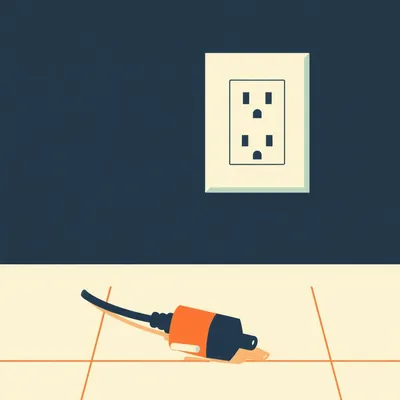
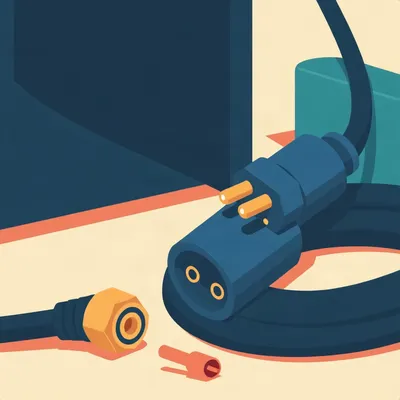
So Daniel sent us this one. He's asking about the specific, low-grade anxiety of using a high-wattage imported appliance in Israel — a vacuum cleaner, say — with a two-prong Euro plug. It feels light, it feels wrong. He wants to know if you can safely re-terminate those plugs yourself, which devices actually need grounding, and he points out a particularly sneaky trap: the Turkish plug variant that looks like it has ground pins but offers zero protection in a standard Israeli socket. He's also heard grounding might help with device longevity. It's a deeply practical, geographically-induced safety puzzle.

And a timely one. By the way, today's script is being powered by DeepSeek V three point two.
A fine choice. So, this anxiety Daniel's describing — it's not irrational. It's the correct physiological response to holding a metal-bodied device that's pulling fifteen hundred watts through a plug that looks like it was designed for a desk lamp.
It's the engineering equivalent of a warning light on your dashboard that you've learned to ignore because the car still runs. But the problem is very real. Israel's Type H sockets have this unique compatibility that's a blessing and a curse. They physically accept the two-pin Europlug, which is everywhere on imported electronics, but that acceptance creates a massive safety gap.
Because the ground connection just isn't there.
Right. And that missing connection isn't a minor feature omission. It's a fundamental break in the appliance's designed safety system. So where do we even start with this?
I think we start with that moment of anxiety. What's actually happening inside that ungrounded vacuum cleaner when you turn it on? Let's trace the fault path.
And that fault path leads us to the fundamental safety mechanism: the equipotential bonding conductor. But let's not get lost in jargon. Think of it as a designated emergency exit for electricity. Inside a Class One appliance — that's one with a metal chassis, like your vacuum — the live wire is insulated. If that insulation fails, the live wire can touch the metal casing. Without a ground wire, that casing is now live at full mains voltage. You touch it, you become the path to earth.
You become the emergency exit.
No, wait, I can't say that. You become the path of least resistance. The ground wire, which is that third pin, is a low-resistance copper highway directly back to the earth. It's bonded to the metal chassis. So if a fault occurs, the current surges down that wire, not through you. It should also trip the circuit breaker because of the massive current draw.
So the core problem with these Euro plugs in Israel isn't just that they're missing a pin. It's that the socket they're being plugged into is physically compatible but electrically incomplete.
Precisely. I mean, yes. There are two main culprits. The standard Europlug, type C, is two round pins. It has no ground at all. Then you have the Schuko plug, type F, common in Germany and Turkey. It has two round pins plus two metal grounding clips on the sides. An Israeli Type H socket has three holes for its own pins, but the holes are spaced so the round pins of a Europlug or Schuko plug fit. The trick is, only some Israeli sockets have the side contact strips needed to connect to a Schuko plug's grounding clips.
And most don't.
Most older ones absolutely do not. So you can jam a Turkish Schuko plug into a basic Israeli socket, the pins go in, it powers on, and you think you're safe because you see a grounded plug. But those side clips are just floating in air, touching nothing. The ground connection is entirely absent. It's a perfect illusion of safety.
Which is arguably more dangerous than a plainly obvious two-pin plug, because it disarms your instinct to be cautious.
That's the trap Daniel mentioned. The socket compatibility creates a false sense of security. The physical fit does not guarantee the safety system is engaged. It just guarantees the power is on.
Right, the power is on. So let's trace that fault path in detail. The live wire inside touches the metal chassis. What's the sequence from that moment to the moment I get a shock, versus the moment a proper ground saves me?
Okay, so the moment of insulation failure. The live conductor, which is at two hundred thirty volts relative to neutral, makes contact with the appliance's metal enclosure. That enclosure is now energized at two hundred thirty volts. In a properly grounded system, that enclosure is bonded directly to the earth wire, which has a very low resistance path back to the grounding rod at your building's main panel.
How low is low resistance?
Critically low. We're talking less than one ohm for the entire path. This is key. Because electricity follows all available paths, but divides inversely proportional to the resistance. So when you present a one-ohm copper highway versus the hundred-thousand-ohm resistance of a human body standing on a dry floor, virtually all the fault current takes the ground wire. This massive, sudden current flow—it could be hundreds of amps—is what trips the circuit breaker or fuse almost instantly.
And without that wire?
Without it, the metal shell just sits there at full mains voltage, waiting. It's not connected to anything. The circuit breaker doesn't know anything is wrong, because the electricity isn't going anywhere yet. It's a dormant landmine. The moment you touch that chassis and are also in contact with anything grounded—a faucet, a concrete floor, even just standing on the earth—you complete the circuit. Your body becomes the path. Current flows through you to ground. At that point, the breaker might trip from the load, but you've already been shocked, possibly lethally.
So the ground wire isn't just a backup; it's an active participant in fault detection. It creates the short circuit that triggers the shutdown.
It's the designated sacrificial path. It's meant to create a deliberate, controlled short circuit that the protection devices can see and react to. The system is designed to fail loudly and safely, not quietly and lethally.
This brings us to Daniel's second question. Are there appliances that are designed to be safe without this? Because we see two-prong plugs on lots of things.
And this is where the appliance class system is essential. It's not about the plug; it's about the appliance's internal construction. Class One appliances are the ones with conductive, accessible metal parts. Think washing machines, refrigerators, metal-bodied espresso machines, that high-wattage vacuum. These require a functional ground connection for safety. You can identify them by their three-wire cable—live, neutral, and earth.
And Class Two?
Class Two is double-insulated or reinforced insulation. These have no accessible conductive parts. The entire casing is non-conductive plastic. Even if an internal live wire comes loose, it would have to breach two separate, independent layers of insulation to make the outside dangerous. Your phone charger, your laptop power brick, most desk lamps—they're Class Two. They're designed from the ground up to be safe with only two wires. They'll have the symbol of a square within a square on the rating plate.
So the hazard isn't a two-prong plug per se. The hazard is using a Class One appliance, which is built assuming it will be grounded, with a two-prong plug that denies it that ground.
That's the precise, critical distinction most people miss. A plastic phone charger with a two-prong Europlug is fine. A two-thousand-watt stainless steel water boiler with a two-prong Europlug is a potential death trap. The plug type should match the appliance class.
But the visual difference between plug types is subtle. Daniel mentioned the Turkish variant. Let's get into the weeds of these two-pin plugs that aren't all the same.
This is a pet peeve of mine. The standard Europlug, formally CEE seven slash sixteen, is just two round pins. It's rated for only two point five amps. It's for low-power, Class Two devices. Then you have the Schuko plug, CEE seven slash four. It has the same two round pins, but it also has two metal grounding clips on the sides. The plug is chunkier. There's also a hybrid plug, CEE seven slash seven, which has the side clips and a hole for a French-style ground pin. It's the most common in continental Europe.
And the Turkish one?
Turkey uses Type F, which is the Schuko standard. So a Turkish-bought appliance will have a plug with those side grounding clips. But here's the trap: when you push that plug into a simple Israeli two-hole socket, or even a three-hole Type H socket without the side contacts, those clips do nothing. They're just decorative at that point. The user sees a robust, grounded-looking plug, assumes the safety is there, and uses a high-power Class One appliance with zero protection. It's the worst of all worlds.
A false sense of security is more dangerous than a known vulnerability.
I did it again. It is more dangerous. Because it bypasses your natural caution. You'd look at a flimsy two-pin Europlug on a space heater and think, "This seems sketchy." You look at a solid Schuko plug and think, "This looks professional and grounded." But if the socket doesn't have the mating contacts, it's just a two-pin plug in a costume.
So the takeaway for someone holding a device is: first, check the appliance itself. Look for the metal chassis. Look for the square-in-a-square symbol that says it's Class Two and doesn't need a ground. If it's metal and has a three-wire cable going into it, it's Class One and that third wire must be connected to a functional earth.
And second, inspect the plug with a critical eye. Don't just see "European round pins." Is it skinny, just two pins? That's a Europlug, only for low power. Is it fat with metal strips on the sides? That's a Schuko, and you must verify your socket has the side contacts to connect to them. If your socket is just holes, you have no ground.
This feels like a systemic failure of compatibility standards. The physical interoperability without the electrical interoperability.
It's a legacy issue. The Europlug was designed for low-power, double-insulated devices. Its compatibility with so many socket types was a convenience feature that, in places like Israel, gets abused for high-power applications it was never meant for. The safety system is being silently opted out of, simply because the plug fits.
Right, so when you have a device that needs grounding but lacks the plug for it, you're in that exact unsafe situation. Which brings us to the million-shekel question Daniel asked: can you just fix it yourself? Can you reasonably and safely re-terminate your own plugs?
Mechanically, the process is straightforward. You buy a proper Israeli Type H plug from the hardware store. You cut off the old Europlug. You strip the cable jacket, then strip a bit of insulation from the ends of the three wires inside—brown for live, blue for neutral, and the green-and-yellow stripe for earth. You connect them to the correct terminals in the new plug, ensuring the earth wire is secured to the earth pin terminal. You close the plug casing, making sure the cable clamp grips the outer jacket, not the inner wires, for strain relief.
That sounds simple enough for anyone with a screwdriver and a wire stripper. So why isn't that the universal advice?
Because the devil is in a dozen critical details, and getting any one wrong creates a hidden hazard that might not reveal itself until it's too late. The most common point of failure is the earth connection itself. People often connect it loosely, or the screw terminal isn't tightened properly, or they forget to connect it at all because the plug seems to work without it. A loose earth wire has high resistance. In a fault, current won't take that path reliably, defeating the whole purpose.
So you've gone through the effort and created the illusion of safety again, just inside the plug.
I mean, yes. Another pitfall is wire gauge. That imported vacuum might have a cable rated for sixteen amps, but the wires inside are thin. A proper Israeli plug is designed for thicker, more robust conductors. Trying to cram thin wires into terminals meant for thick ones can lead to a poor connection that heats up under load. That's a fire risk inside your wall.
And the strain relief? You mentioned that.
Critical. If the clamp grips the inner wires instead of the outer cable jacket, every time you tug on the cord, you're putting mechanical stress directly on those tiny copper strands where they connect to the terminals. Over time, they can fatigue and break, especially the earth wire. Now you have an intermittent ground, or none at all, and you'd never know.
Let's talk about the molded plug scenario. Many appliances have a plug that's one solid piece of molded plastic. You can't open it.
Right. For those, the only safe DIY option is to cut the entire cord off right at the molded plug and replace the plug with a rewirable one. But that introduces another failure point—the connection you just made inside your new plug. And you've voided any warranty. For a high-wattage, Class One appliance, I have to give a very clear verdict. While the task is mechanically simple, the legal liability and the catastrophic consequence of an error—fire or electrocution—make professional replacement the only path I can recommend for anyone who isn't a trained electrician.
So the cost-benefit analysis is brutal. The cost of a professional electrician swapping a plug is maybe a hundred, hundred-fifty shekels. The cost of a hospital visit, or a house fire, is orders of magnitude higher.
It's not even close. A professional will have the proper tools, know the torque specs for the terminals, use the correct gauge plug for the appliance's current rating, and test the continuity of the earth connection with a meter. They'll also spot if the appliance cable itself is unsuitable for the Israeli plug standard. That's worth every agorot.
Before we move to alternatives, Daniel had another angle. He's heard grounding has benefits beyond just preventing a lethal shock, that it supports device longevity by discharging small excess voltages. Is there anything to that?
There's a kernel of truth, but it's a secondary effect and should never be the primary reason for grounding. A proper earth connection does provide a reference point for the electrical system. It can bleed off static charges that build up on metal casings. In sensitive electronics, it can provide a path for minor induced voltages or electromagnetic interference to dissipate, rather than floating around and potentially stressing components. This can, in theory, contribute to longer lifespan and stable operation. But it's a bonus. The primary, non-negotiable purpose is personal safety. Selling grounding as a longevity hack is like selling a car's seatbelt as a back support device. It might be true, but you're missing the main event.
So if professional help isn't immediate, and you have this ungrounded death-trap espresso machine you're desperate to use, are there any stopgap measures that aren't just playing Russian roulette?
There are two main alternative solutions. The first is a proper, grounded adapter. Not a flimsy travel dongle, but a substantial adapter that has its own earth wire with a clip or terminal you attach to a known ground point, like a metal water pipe. These exist, but they're clunky and you have to ensure that ground connection is actually good.
And the second, which I think is more practical for most people?
Installing a Ground Fault Circuit Interrupter, what we call a Petal here or an RCD in Europe. This is a life-saving device that works even without a ground wire. It constantly monitors the current flowing out on the live wire and back on the neutral. If it detects an imbalance as small as thirty milliamps—which is current leaking to earth, possibly through a person—it cuts power within twenty-five to forty milliseconds.
So it doesn't prevent the chassis from becoming live, but it cuts the power so fast you likely won't receive a lethal shock.
Right. It's a detection-based backup, not a prevention-based primary like the ground wire. But in a retrofit scenario where you can't easily add a ground, a GFCI on that circuit is the next best thing. It's a valid and code-approved substitute for a missing ground wire in many upgrade situations. It won't help with all fault types, like a live-to-neutral short, but for the fault we're terrified of—live to chassis—it's a hugely effective layer of protection.
So the pragmatic hierarchy is: one, get a proper Israeli plug installed by a pro. Two, if you can't do that immediately, ensure the appliance is only used on a GFCI-protected outlet. Three, never use a high-power Class One appliance with a two-prong plug in an ordinary socket, ever.
That's the responsible sequence. The GFCI is a mitigation, not a cure. The cure is a correct, permanent ground connection.
Right. So with that principle in mind, let's give people a concrete checklist. They're looking at an appliance, maybe something they just bought online, maybe something that's been in the closet. What are the actual steps?
Step one is appliance identification. Look at the device itself. Is the body metal? If yes, it's almost certainly Class One and needs a ground. Look for the official symbol—a square within a square—which marks it as Class Two, double-insulated, and safe without a ground. That symbol is often on the rating plate near where the cord enters.
Step two, inspect the plug. Don't just see 'European.' Is it a skinny two-pin Europlug? That's only for low power, and if it's on a metal device, it's wrong. Is it a fat plug with metal strips on the sides? That's a Schuko. That means the appliance is designed for a ground, and you must verify your socket can accept it.
Step three, socket forensics. Look at your Israeli socket. Does it have little metal contact strips on the sides, or just holes? If it's just holes, a Schuko plug gives you no ground. You need a socket with those side contacts, or you need to replace the plug entirely.
So the clear, unambiguous recommendation for anyone holding a Class One appliance with a two-prong plug is what?
Do not use it. Full stop. Unplug it and do not plug it in again until a certified electrician has installed a proper Israeli Type H plug. The risk isn't theoretical. That path we traced—from a frayed wire to a live chassis to you—is waiting for a single insulation failure.
But let's be realistic. Someone hears this, panics, but they need to vacuum for a party tonight and the electrician can't come until Tuesday. Is there any immediate, less-bad option?
The immediate mitigation is to plug the device into a GFCI-protected outlet—a socket with a test and reset button. A Petal. And you treat the appliance as potentially live. Don't touch the metal body while it's plugged in, even if it's off. The GFCI is your backup. It's not safe, but it's safer. It's a temporary patch until you get the permanent fix.
And for future purchases, especially with all these direct imports?
When buying, prioritize models that come with a proper Israeli plug already fitted. If that's not an option, look for appliances with a detachable power cord, like an IEC C thirteen or C seven connector. Then you can buy a separate, certified Israeli power cord and swap them safely, with no wiring required. Avoid buying high-wattage, metal-bodied appliances that only come with a fixed Europlug or Schuko plug. You're just buying a problem.
It feels like the burden is entirely on the consumer to be a forensic safety inspector because of this compatibility loophole.
It is. The system allows the sale of a product that fits the socket but doesn't engage the safety system. Until that changes, the vigilance has to be personal. Check the class, check the plug, check the socket. And when in doubt, don't guess with electricity. Call the pro.
That personal vigilance is necessary precisely because of the systemic failure. Should Israel consider regulatory changes for imported electronics, given this persistent compatibility loophole? You can legally sell a three-kilowatt space heater with a plug that fits the socket but bypasses the safety system.
It’s a tough one. On one hand, consumer protection regulations could mandate that any Class One appliance sold here must be fitted with a proper Type H plug or include a certified adapter. On the other, it’s more red tape for importers, and enforcement is always the tricky part. But the status quo essentially outsources the risk assessment to every individual buyer, who likely has no idea about appliance classes or ground clips.
It’s a perfect example of a hidden, mundane danger. Not a missile you can hear coming, but a silent fault waiting in a closet. Reframing it, grounding isn’t a luxury feature. It’s a fundamental component of the appliance’s safety system, as integral as the insulation on the wires. Using an ungrounded Class One device is like driving a car with the airbags removed. Everything works fine, until the moment you desperately need it.
That’s the right analogy. And it’s why this isn’t just a nerdy technicality. It’s about closing a gap between what fits and what’s safe. For anyone who wants to dive deeper into the theory behind all this, we did a whole episode a while back, Episode four fifty-six, on the science of grounding itself. Today was the practical, regional application manual.
Thanks for that, and thanks as always to our producer, Hilbert Flumingtop, for keeping the wires from crossing. This episode, like all of them, is brought to you by Modal, the serverless GPU platform that runs our pipeline. They handle the infrastructure so we can focus on the conversation.
If you got something out of this deep dive, do leave us a review wherever you listen. It makes a real difference. For the show notes, links, and Daniel’s original prompt, visit myweirdprompts.com.
This has been My Weird Prompts.
Stay safe, and stay grounded.