Hey everyone, welcome back to My Weird Prompts. I am Corn, and I am sitting here in our living room in Jerusalem with my brother, looking at the very thing we are going to talk about today.

Herman Poppleberry here, and yes, if you are looking at the wall, you are probably staring at one of those three-pronged outlets. Our housemate Daniel actually sent us a voice note about this earlier. He was curious about grounding, especially since we live in an apartment block here. It is one of those things we use every single day but almost never think about until something goes wrong or we are trying to cram a heavy adapter into the wall.
It is a great question because grounding feels like one of those invisible safety nets. We know it is there, we know it is important, but the actual mechanics of how it works, especially in a massive stone building like the ones here in Jerusalem, is a bit of a mystery to most people. Daniel was asking if it is basically a safety valve, and he also wanted to know how a whole building full of people shares one connection to the earth.
I love that he used the term safety valve because that is a very intuitive way to think about it, though the physics is slightly more specific. When we talk about electrical grounding, or earthing as it is often called outside of North America, we are really talking about creating a low-resistance path for electricity to follow in the event of a fault.
Right, and before we get into the deep physics, we should probably mention the plug itself. In Israel, we primarily use the Type H plug for high-power devices. It has three pins. Two are for the live and neutral wires, which carry the actual power to your toaster or your laptop, and that third one, the round cylinder Daniel mentioned, is the ground. Type C and Type F plugs are also widely used and compatible, especially for low-power devices; Type C has two round pins without grounding, while Type F has clips on the side for grounding, but the principle is the same.
Exactly. Now, to Daniel's first point, is it a safety valve? In a way, yes. Imagine your washing machine. It has a metal casing. Inside, there are wires carrying two hundred thirty volts of alternating current. If one of those wires frays and touches the metal shell of the machine, that shell is now electrified. If you walk up and touch it while you are barefoot on a damp floor, you become the path to the ground. That is a very bad day.
Because the electricity is looking for any way to get back to its source, right? It is not just that it wants to go into the dirt, it wants to complete the circuit.
That is a crucial distinction, Corn. People often think the earth is like a giant vacuum for electrons, but electricity really wants to get back to the transformer that sent it out. The grounding wire provides a much easier path back than your body does. Since copper has way less resistance than a human being, the current rushes down the ground wire instead of through you.
And that sudden rush of current is what triggers the circuit breaker to trip, right? It is not just that the electricity is safely diverted, it is that the system detects a massive spike in flow and says, okay, something is wrong, shut it all down.
Precisely. It is a coordinated effort between the ground wire and the overcurrent protection. But Daniel asked a really interesting second-order question, which is how this works in an apartment building. If you have fifty apartments in a single tower, you do not have fifty separate copper rods stuck into the dirt. That would be a mess.
I assume there is some kind of central spine? Like the plumbing or the elevator shafts we talked about back in an earlier episode. Everything has to aggregate somewhere.
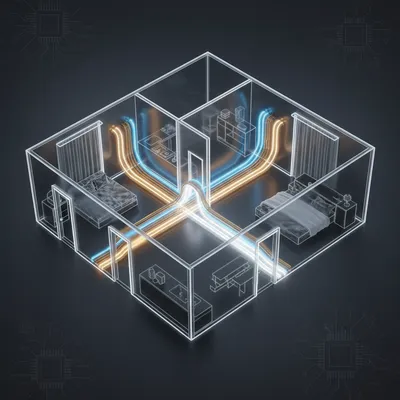
It does. Every single apartment has its own distribution board, what most people call the fuse box. In that box, all the green and yellow ground wires from your outlets meet at a single copper bar called the ground bus. From there, a much thicker wire runs out of your apartment and into a central vertical riser that travels down the entire height of the building.
So it is like a tree structure. All the little branches in the apartments lead to a main trunk. But where does that trunk go? Daniel asked if there is a physical structure under the building, and the answer is actually quite fascinating because it involves the very bones of the building itself.
This is where it gets nerdy. In modern construction, especially in places like Israel where everything is reinforced concrete, we use something called a foundation ground or a Ufer ground. It is named after Herbert Ufer, an engineer who worked for the United States military during World War Two. He discovered that concrete is actually quite conductive because it is porous and holds moisture, and it has a massive surface area in contact with the earth.
Wait, so the building itself is the ground?
Not exactly the concrete alone, but the rebar. The steel reinforcement bars inside the concrete foundations are all welded or tied together to form a massive, continuous metal cage. The main ground wire from the building is bolted to this steel cage. Because the cage is buried deep in the earth and encased in concrete, it provides an incredibly stable, low-resistance connection to the planet.
That is brilliant. You are essentially using the weight and the footprint of the building to ensure safety. But what about older buildings? Jerusalem has plenty of those. I am guessing they did not all have Ufer grounds in the nineteen fifties.
No, they did not. In older buildings, you might see traditional ground rods, which are long copper-clad steel poles driven eight or ten feet into the dirt. Or, in some cases, they used to bond the electrical ground to the metal water pipes coming into the house. But that became a problem as cities started replacing metal pipes with plastic ones like PEX or PVC. If you replace a section of pipe with plastic, you have just cut off the ground for everyone in the building. It is actually a major safety hazard in older neighborhoods.
I can see why. You think you are safe because you see a wire clamped to a pipe, but that pipe ends in plastic ten feet underground. That leads to Daniel's third question, which is about the voltage of the earth itself. He asked if the earth is always at zero volts. It feels like it should be, by definition, right? We call it ground because it is the baseline.
That is the common assumption, but the reality is much messier. The earth is not a perfect conductor. It has resistance, which varies depending on whether the soil is dry sand, wet clay, or solid rock. Because it has resistance, it can absolutely have a voltage potential.
So the ground under my feet could be at a different voltage than the ground under the transformer two blocks away?
Exactly. This is a concept called ground potential rise. Imagine a lightning strike or a downed high-voltage power line hitting the dirt. For a brief moment, the point where the electricity hits the ground is at thousands of volts. As you move away from that point, the voltage drops off, like ripples in a pond. If you are standing with your legs far apart near that strike, one foot could be at a higher voltage than the other. Electricity will flow up one leg and down the other. This is why they tell you to keep your feet together if a power line falls near you.
That is terrifying, Herman. But in a normal, non-lightning scenario, how do our home systems handle the fact that the earth might not be a perfect zero?
We use something called equipotential bonding. This is a fancy way of saying we tie everything metal in the building together. We connect the electrical ground, the water pipes, the gas lines, and the structural steel all to the same point. If everything is connected, they all stay at the same voltage, even if that voltage is not perfectly zero relative to some theoretical point in the middle of the ocean. If you and the toaster and the floor are all at five volts, no current flows through you because there is no potential difference.
Ah, it is like birds on a power line. They are all at ten thousand volts, but because they are only touching one wire, they do not get fried. The danger only comes when there is a difference.
You got it. And this is why the connection between the neutral wire and the ground wire is so important. In most electrical systems, the neutral wire is actually bonded to the ground at the main service entrance or at the transformer. This anchors the entire system to the earth's local potential. It ensures that the hot wire is always two hundred thirty volts away from the things you are likely to touch.
I want to go back to the apartment building for a second. If we have a common ground, and someone in apartment four B has a major electrical fault, is there any risk that the fault current travels up the ground wire into my apartment in six C? Could their broken washing machine electrify my toaster?
That is a great question, and it is why the resistance of that main ground riser has to be incredibly low. If the path to the earth is very easy, the electricity will take it. If the path to the earth is restricted or has high resistance, then yes, you can get what we call stray voltage or ground bounce. But in a properly engineered building, the main ground bus is such a massive highway for electrons that they would never bother taking a side road into your apartment.
It is all about the path of least resistance. Or, to be more technical, the path of least impedance, since we are talking about alternating current.
Look at you using the big words. Yes, impedance. And in Israel, we use a system that is quite robust, but it does rely on the soil conditions. We are in a very hilly, rocky area. Limestone is not a great conductor compared to the moist, loamy soil you might find in a river valley. This is why Israeli electrical code is very strict about testing the resistance of the ground connection during construction. They actually have to measure it with a special meter to ensure it meets the safety standards before the building gets power.
I remember seeing those guys with the long probes in the dirt when they were building that new complex down the street. I thought they were looking for archaeological ruins, which is usually what happens when you dig a hole in Jerusalem.
Well, they might be doing both. But the electrical test is vital. If the resistance is too high, they have to add more ground rods or use chemical treatments to make the soil more conductive. They basically pour electrolytes into the ground to help the electrons move.
That is wild. We are literally salting the earth to make our iPhones safer to charge.
In a sense, yes. But let's talk about the zero volts thing a bit more, because Daniel’s question about the earth having its own voltage is actually a huge issue for industrial systems and telecommunications. Remember when we talked about the submarine cables in an earlier episode?
Yeah, the ones where they have to use the ocean as a return path for the power.
Right. When you have a cable that spans thousands of miles, the earth at one end is almost certainly at a different potential than the earth at the other end. There can be hundreds or even thousands of volts of difference just due to the earth's magnetic field and solar activity. These are called telluric currents. They are natural electric currents flowing through the earth's crust.
So the earth itself is like a giant, messy battery that is constantly being recharged by the sun.
Exactly. During a solar storm, these telluric currents can spike. They can get into power grids and cause transformers to saturate and overheat. This is what happened in nineteen eighty-nine in Quebec. A solar storm induced currents in the ground that were so strong they tripped the entire provincial power grid in seconds. Millions of people were in the dark because the ground was not zero.
That really puts our little three-pronged plug into perspective. We are trying to anchor our tiny household circuits to a planet that is basically a swirling ball of electromagnetic chaos.
It is a constant battle for stability. And that brings us to the practical side of this. Daniel asked what grounding actually means for us. Beyond the safety valve, it also plays a huge role in signal integrity for our electronics. If you have ever heard a hum in your speakers or seen static on an old monitor, that is often a ground loop.
I was just going to ask about that. I hate that hum. Is that because the ground is not doing its job?
It is usually because there are two different paths to the ground, and they are at slightly different potentials. This creates a tiny current that flows through the shields of your audio cables. Your amplifier sees that current and turns it into a sixty-hertz or fifty-hertz hum. By grounding everything to a single point, you eliminate those loops. It is the same principle as the building's equipotential bonding, just on a smaller scale for your desk.
So, to summarize for Daniel, grounding is a safety path that protects you by giving electricity a way home that does not involve your heart. In an apartment building, it is a shared infrastructure that uses the very foundation of the building as a massive anchor to the earth. And while we treat the earth as zero volts for our daily lives, it is actually a complex, fluctuating system that engineers have to account for with some really clever tricks.
Spot on. And I think it is worth mentioning that even with a ground, you still want a residual current device, or RCD. In Israel, every home has one. It is that big switch in your panel with the test button. While the ground wire provides a path for the fault, the RCD is the thing that actually watches the current and says, hey, ten milliamps just went missing, it must be going through a human, let's cut the power in thirty milliseconds.
It is the belt and suspenders approach. The ground wire is the belt, and the RCD is the suspenders. You really want both if you are dealing with two hundred thirty volts.
Especially in the bathroom or the kitchen. Honestly, the more I learn about electrical engineering, the more I am amazed that we have managed to tame this force as well as we have. We are basically living in these stone boxes in Jerusalem, surrounded by invisible lightning that we have convinced to toast our bread and charge our toothbrushes.
It is a miracle of modern civilization, really. And it all goes back to that third pin on the plug. It is the silent guardian.
The silent, round, cylindrical guardian. Now, before we wrap up, I should mention that grounding works differently when you are not on the ground. Think about airplanes or cars on rubber tires.
I have always wondered about that. People say the tires protect you if a power line falls on the car, but then you see those little strips dragging on the ground behind some old trucks to prevent static shocks.
Right, those are two different things. In a car or an airplane, we use the term chassis ground. Instead of the earth, the metal frame of the vehicle acts as the common return path. The negative terminal of the battery is bolted directly to the frame. So, if you want to power a headlight, you run a positive wire to the light, and then you just bolt the other side of the light to the nearest piece of metal.
That saves a lot of wiring, I imagine. You only have to run one wire to everything.
Exactly. It simplifies things immensely. But it means the entire car is essentially one half of the circuit. Now, the static thing is interesting. As a car drives through the air, it builds up static electricity, just like rubbing a balloon on your hair. Since the rubber tires are insulators, that charge has nowhere to go. When you stop and step out, you become the bridge between the charged car and the actual ground.
And that is when you get that annoying zap on the finger when you touch the door handle.
Exactly. In airplanes, this is a much bigger deal. They are moving much faster through much drier air. They have these little needles on the back of the wings called static wicks. They are designed to bleed that static charge back into the atmosphere so it does not interfere with the radio equipment or cause a spark during refueling.
It is fascinating that the concept of a reference point remains the same even when you are disconnected from the planet. You just have to create your own little local ground. Even in space, right?
Even on the International Space Station. They use the metal structure of the station as a ground. But they have to be very careful because the station is flying through plasma in the upper atmosphere, which can build up a huge charge on the outside. They have these devices called plasma contactors that essentially spray out a gas to help neutralize the charge between the station and space.
So even in the vacuum of space, you cannot escape the need for a good ground. That is a comforting thought. It is a universal constant of electrical safety.
It really is. And going back to Daniel's question about the zero volts, this is why engineers use the term reference point more often than ground in complex systems. It is an arbitrary point that we decide is zero so that we can measure everything else against it. It is like sea level. Mount Everest is eight thousand eight hundred forty-eight meters above sea level, but sea level itself changes with the tides and the location. We just picked a standard so we can all agree on how tall the mountain is.
That is a perfect analogy. Ground is just electrical sea level. And just like sea level, if it rises too much, you are going to have a bad time.
Exactly. Now, I wanted to touch on one more thing Daniel mentioned, which was the physical structure under the building. We talked about the Ufer ground and the rebar, but in some very specialized buildings, like data centers or hospitals, they go even further. They will sometimes bury a massive grid of copper wire under the entire site called a grounding mat. This ensures that the entire area has the exact same ground potential. It protects sensitive medical equipment or servers from even the tiniest fluctuations in the earth's voltage.
It is amazing how much effort goes into something that is literally designed to do nothing most of the time. The ground wire just sits there, carrying no current, waiting for its one moment to shine.
It is the ultimate insurance policy. It is like the emergency brake on a train. You hope you never need it, but when you do, you need it to work perfectly.
Speaking of things working perfectly, I think we have covered most of the bases Daniel was asking about. We looked at the safety valve concept, the way apartment buildings aggregate their connections through that central riser and the foundation, and the fact that zero volts is more of a goal than a constant reality.
I think so. It is a deep topic, and we could go into the math of soil resistivity for hours, but I think for a housemate chat, this covers the essentials. The main takeaway is: respect the third pin. It is there for a reason.
And if you live in an old building and you are worried about your grounding, it is worth having an electrician come by with a ground loop impedance tester. It is a quick check that can tell you if your safety net is actually attached to anything. Especially in a city like Jerusalem where the history of the wiring can be as layered as the history of the city itself.
Very true. Well, this has been a great exploration. Thanks to Daniel for sending in such a grounded question.
I saw what you did there. I chose to ignore it, but I saw it. Well, that is it for this episode of My Weird Prompts. We have been your hosts, Corn and Herman Poppleberry. If you want to dive into our archives or find more information about the show, head over to myweirdprompts.com. We have over two hundred episodes there covering everything from airport lighting to the history of electricity.
And you can find us on Spotify or wherever you get your podcasts. We love hearing from you, so if you have a weird prompt of your own, there is a contact form on the website.
Until next time, stay curious and maybe take a look at your wall outlets. Just don't stick anything in them except a plug. Thanks for listening, everyone. Bye!
Safety first! Bye!