You know, Herman, I was walking near the entrance to the city the other day, right by the Jerusalem Gateway project, and I just stopped and stared. I was looking up at those new towers they are putting up near the central bus station, and it really hit me how much the Jerusalem skyline has changed in just the last few years. It is a strange feeling, seeing these glass giants rising up in a city that is thousands of years old. It feels like the stone-clad tradition is finally meeting the twenty-first century head-on.

It is quite the contrast, isn't it? Herman Poppleberry here, by the way. And you are right, Corn, the verticality of modern cities is something we often take for granted until we really stop to look up. In Jerusalem, it is especially jarring because of the local laws requiring Jerusalem stone on the facades. You have these ultra-modern silhouettes, but they are wrapped in this ancient-looking material. It is like we are in a race to see how far we can push against gravity while still keeping one foot in the past.
Exactly. And that is actually what our housemate Daniel was asking about in the prompt he sent over today. He has been watching documentaries on the Burj Khalifa, which is just an absolute marvel of engineering, and it got him wondering about the ceiling. Not the literal ceiling of a room, but the theoretical ceiling for how high we can actually build. Is there a limit, or is it just a matter of how much money someone is willing to throw at a project? He specifically mentioned the projects here in Israel and wondered if we are headed toward our own kilometer-high tower.
That is such a great question from Daniel. It is one of those topics where the answer is a mix of hard physics, material science, and cold, hard economics. People often assume that the limit is purely about the strength of the materials, like the steel or the concrete, but as we will get into, the real bottlenecks are often much more... well, mundane is the wrong word, but they are practical issues that you might not expect. Things like how long you are willing to wait for an elevator or how much the building sways in a light breeze.
Right, because when you look at something like the Burj Khalifa, which stands at eight hundred and twenty-eight meters, it feels like we are already living in the future. But then you hear about proposals for buildings that are a kilometer tall, or even more. I mean, the Jeddah Tower in Saudi Arabia resumed construction in late 2025 after years of delays, aiming for that one thousand meter mark. So, Herman, let's start with the basics. If I want to build a tower that reaches into the clouds, what is the first physical barrier I am going to hit?
The absolute first thing, even before you worry about the weight of the building, is the wind. Most people think the biggest challenge for a skyscraper is holding itself up against gravity, but for the really tall ones, the wind is the true enemy. When wind hits a massive, flat surface, it does not just push against it. It creates these swirling pockets of air called vortices. This leads to a phenomenon called vortex shedding.
Vortex shedding, right? I remember reading about this. It is the same reason why a flag flaps in the breeze or why power lines hum during a storm.
Precisely! But when your flag is an eight hundred meter tall glass and steel structure, that flapping becomes a rhythmic swaying. If the frequency of those wind vortices matches the natural frequency of the building, you get resonance. The building starts to sway more and more violently. If you do not account for that, the structural integrity can fail. There is a famous story about the Citicorp Center in New York back in the late nineteen seventies. They discovered that the building was vulnerable to specific wind angles that could have knocked it over. They had to secretly weld heavy steel plates to the joints at night to fix it before a hurricane hit.
That is terrifying. So how did they solve that with the Burj Khalifa? Because that building is not just a straight rectangular prism. It has that very distinct, tapering, almost organic shape. It looks like a desert flower, right?
That is the secret, Corn. It is called aerodynamic shaping. The designers of the Burj Khalifa used a Y-shaped plan that tapers as it goes up. But the key is that the setbacks, those different levels where the building gets narrower, are staggered. This effectively confuses the wind. The vortices cannot organize themselves into a single, powerful rhythm because the shape of the building is constantly changing as you go higher. It breaks up the wind's ability to push the building in a synchronized way. It is essentially the architectural version of stealth technology.
It is almost like the building is camouflaged against the wind. That is fascinating. But even with that shape, those buildings still sway, right? I have heard stories of people in high-rises seeing the water in their toilets move.
Oh, absolutely. They have to sway. If a building were perfectly rigid, it would snap under the pressure like a dry twig. The goal is to control the sway so it is not uncomfortable for the occupants. This is where we get into things like tuned mass dampers. You might remember we talked about the one in Taipei one hundred and one in a previous discussion. It is that massive steel ball, weighing six hundred and sixty metric tons, suspended near the top of the tower. When the building sways one way, the ball's inertia pulls it the other way, acting as a giant counterweight to stabilize the structure. It is basically a giant pendulum that absorbs the kinetic energy of the wind.
It is wild to think that the stability of a multi-billion dollar skyscraper depends on a giant ball hanging from cables. But okay, so we have the wind figured out. What about the weight? Surely at some point, the bottom of the building just gets crushed by the weight of everything above it? I mean, the Burj Khalifa's structural weight is around five hundred thousand metric tons.
That is a very real theoretical limit known as the square-cube law. As you double the height of a building, the volume and weight increase by a factor of eight, but the surface area of the base only increases by a factor of four. If you were building with traditional stone or brick, you would reach a point where the base would have to be so wide to support the weight that the building would essentially become a mountain. Think of the Great Pyramid of Giza. It is very stable, but it is not very efficient in terms of floor space. It is mostly just a solid block of stone.
Right, you want a skyscraper, not a man-made Everest. You want usable space.
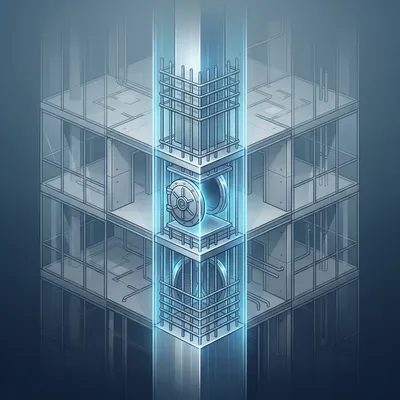
Exactly. Modern skyscrapers use high-strength reinforced concrete and steel. The Burj Khalifa used a concept called the buttressed core. Think of a central hexagonal core of reinforced concrete, and then three wings that branch out from it. These wings act like the buttresses on a gothic cathedral, providing lateral support and helping to carry the massive vertical load. But here is the catch, Corn. The higher you go, the more material you need at the bottom just to support the weight. And the more material you use for the structure, the less room you have for, you know, actual people and offices. This is the structural efficiency limit.
That brings us to the elevator problem, doesn't it? This is something I have heard you mention before. It is not just about the weight of the concrete; it is about the logistics of getting people to the top. If it takes twenty minutes to get to your office, you are not going to want to work there.
This is arguably the most significant practical limit to skyscraper height. Think about it this way. If you have a hundred floors, you need a certain number of elevators to move people efficiently. Those elevators require shafts. Those shafts take up space on every single floor they pass through. In a traditional building, the elevator shafts are like a giant hollow core eating up the most valuable real estate in the center of the building.
And if you double the height to two hundred floors, you do not just double the number of elevators. You need significantly more because the travel time is longer, and you have more people to move. It is an exponential problem.
Exactly. You reach a point of diminishing returns where the elevators take up so much of the floor plate that there is almost no usable space left for tenants. It is called the elevator paradox. To solve this, engineers use sky lobbies. You take a high-speed express elevator to the sixtieth floor, for example, and then you transfer to a local elevator that handles floors sixty through eighty. It is like a subway system but vertical. But even then, there is a limit to how many transfers people are willing to make. No one wants to spend forty minutes and three transfers just to get to their desk.
And then there is the weight of the cables themselves. For a long time, steel cables were the limiting factor, right? I remember you saying they get too heavy.
Yes. Around five hundred meters was the traditional limit for a single elevator pull. If an elevator shaft is longer than that, the steel cable becomes so heavy that it cannot even support its own weight, let alone the weight of the elevator car and the passengers. But a company called Kone developed something called UltraRope. It is a carbon fiber core with a high-friction coating. It is incredibly light and incredibly strong. That technology is what is making those one-kilometer-plus towers theoretically possible. It reduces the weight of the moving parts by about ninety percent. And now, we are even seeing the development of maglev elevators, like the ThyssenKrupp MULTI system, which doesn't use cables at all. It uses magnetic levitation to move cars both vertically and horizontally.
Wait, horizontal elevators? That sounds like something out of Charlie and the Chocolate Factory.
It really is! By removing the cables, you can have multiple cars running in the same shaft, which drastically reduces the space needed for elevators. That could potentially push the height limit much further because you are no longer losing half your floor space to empty shafts.
That is a massive jump. It is amazing how a single material innovation can move the goalposts for an entire industry. But even if we solve the wind, the weight, and the elevators, what about the cost? Daniel mentioned economies of scale, but it feels like skyscrapers are the opposite. They seem like they get exponentially more expensive the higher you go.
Daniel is spot on there. This is where the physics meets the finance. Usually, economies of scale mean that the more you produce of something, the cheaper each unit becomes. But with skyscrapers, you hit diseconomies of scale. Every extra floor requires more reinforcement for every floor below it. You are essentially paying a premium for every meter of height.
Because you are not just building a floor; you are strengthening a thousand meters of building beneath it.
Exactly. And the construction process itself becomes a nightmare. Think about pumping concrete. For the Burj Khalifa, they had to pump concrete to a height of over six hundred meters in a single stage. They had to do it at night because if the sun hit the pipes, the concrete would set too quickly and clog the system. They even had to add ice to the mixture to keep it cool. Imagine the logistics of coordinating thousands of tons of ice just to pour a floor.
I can imagine the cost of that. You are not just paying for concrete; you are paying for a massive, specialized cooling and pumping operation that runs at three in the morning. And what about the workers? How do they even get up there?
That is another hidden cost. As you go higher, the cranes have to be bigger and more complex. The time it takes for workers to get from the ground to their station at the top increases. Every minute a worker spends in an elevator is a minute they are not building. The wind speeds at those heights mean there are many days where work has to stop entirely because it is too dangerous for the cranes to operate. All of these factors drive the cost per square meter up astronomically. This leads to what architects call vanity height.
Vanity height? That sounds like a very judgmental term.
It is a technical one, actually! It refers to the distance between the highest occupied floor and the very top of the building. In many of the world's tallest buildings, the top twenty or thirty percent of the structure is just an empty spire or a decorative element. For the Burj Khalifa, approximately two hundred and forty-four meters of its height is non-occupiable. That is basically a whole other skyscraper of just... air and steel, just to claim the record.
So, at a certain point, it is no longer a business decision. It becomes a prestige project. It is about being the tallest, not being the most profitable.
Precisely. Most of the world's tallest buildings are not built because they are the most efficient way to provide office space. They are built as symbols of national pride or corporate power. They are giant advertisements. The Burj Khalifa was part of a plan to diversify Dubai's economy away from oil and toward tourism and service. It worked, but the building itself took a massive amount of investment that might never be fully recouped just through rent. It is a loss leader for an entire city.
That is an interesting point. We often look at these things as engineering challenges, but they are also psychological and political statements. But let's go back to the theoretical limit. If money were no object, if we had some trillionaire who just wanted to build a tower to the stars, is there a point where the laws of physics just say no? Like, can we build a tower that is ten kilometers high?
Well, if we are staying within the realm of current materials, the limit is surprisingly high. Some engineers have calculated that with a wide enough base, we could theoretically build a structure several kilometers high. There was a concept called the X-Seed four thousand, proposed for Tokyo, which would have been four kilometers tall.
Four kilometers? That is almost half the height of Mount Everest. That is insane.
It is. It was designed to look like a mountain and would have housed up to a million people. But the base would have been several kilometers wide. It would basically be a man-made mountain. The problem with something like that is the environmental impact. A building that size would actually change the local weather patterns. It would create its own microclimate, potentially causing permanent shadows over entire neighborhoods and altering wind currents for the whole city.
That sounds like something out of a science fiction novel. But what about the people inside? If you are living four kilometers up, the air pressure is significantly lower. Would the building have to be pressurized like an airplane?
That is another huge hurdle. At those heights, you absolutely have to deal with pressure differentials. Even in the Burj Khalifa, people's ears pop in the elevators because they are moving so fast through different pressure zones. If you went to four kilometers, you would either need a pressurized environment or people would need time to acclimate. And then there is the issue of life safety. How do you evacuate a million people from a four-kilometer-tall building in an emergency? You can't just tell them to take the stairs. That would be a multi-day hike.
You would need specialized fireproof zones, right? Like internal bunkers?
Exactly. You would need refuge floors every few levels that are completely pressurized, fireproof, and have their own oxygen supplies. The complexity of keeping people alive and safe at those heights is one of the biggest limiting factors. It is not just about standing up; it is about being a life-support system.
It sounds like the limit isn't one single thing, but a convergence of factors. We have the wind, the elevators, the cost, and the basic human biology of living in the upper atmosphere. But I want to touch on something Daniel mentioned about the foundations. He said the engineering of the foundations is mind-boggling. How do you anchor something that tall into the ground, especially in a place like Dubai where it is all sand?
Oh, the foundations are incredible. You can't just dig a hole and pour some concrete. For the Burj Khalifa, the ground is mostly sand and weak sedimentary rock. They couldn't hit solid bedrock easily. So they used a technique called skin friction.
Skin friction? Like the friction of your skin against a surface? How does that hold up a building?
Exactly. They drove one hundred and ninety-two massive piles, each one point five meters in diameter, more than fifty meters deep into the ground. These piles don't necessarily rest on something solid. Instead, the friction between the surface of the pile and the surrounding soil is what holds the building up. It is like pushing a stick into a bucket of sand. The sand grips the stick. Multiply that by nearly two hundred piles and the weight of the building, and you have enough force to keep it stable. It is the collective grip of the earth itself.
That is wild. The entire building is basically being held up by the grip of the sand on those piles. It feels so precarious, but obviously, the math checks out. I assume they have to worry about the water table too?
They do. In coastal areas like Dubai, you have to worry about salt water corroding the steel reinforcement in the concrete foundations. They had to use specialized high-density concrete and cathodic protection systems, which basically use a small electric current to prevent corrosion. It is a constant battle against the elements, even deep underground.
I'm curious, Herman, do you think we will see a building reach the one-mile mark in our lifetime? That seems to be the next big psychological milestone. One thousand six hundred and nine meters. As of February of twenty twenty-six, no building has reached the kilometer mark, with Jeddah Tower still the closest in development.
The Mile-High Tower. It has been a dream of architects since Frank Lloyd Wright proposed The Illinois back in nineteen fifty-six. The Sky Mile Tower is a conceptual proposal for Tokyo at one thousand seven hundred meters, with no firm construction date. The reality is that building something that tall takes a long time. In the decade it takes to build a record-breaking skyscraper, the entire world economy can change. A project that seemed like a great idea in twenty fourteen might look like a massive liability today.
So the limit might not be engineering at all, but the length of a human attention span or a political cycle.
I think that is a very astute observation, Corn. We have the technical capability to go higher right now. If we used carbon fiber more extensively, if we used more advanced damping systems, we could probably reach two kilometers. But who is going to pay for it? And what is the actual utility? At a certain point, the view doesn't get that much better, and the commute just gets longer. You are just building a very expensive monument to yourself.
It is the law of diminishing returns in every sense. But let's talk about the ultimate tall building: the space elevator. That is the holy grail, right? If we can't build up, can we just... hang down?
The space elevator is the ultimate engineering challenge. It would be a cable stretching from the surface of the Earth to a counterweight in geostationary orbit, about thirty-six thousand kilometers up. That makes the Burj Khalifa look like a blade of grass.
Thirty-six thousand kilometers. How does that even stay up without a base that is a thousand miles wide?
The physics of a space elevator are completely different. It is not a building that stands up; it is a cable that is held taut by the centrifugal force of the Earth's rotation. Think of a ball on a string being spun around your head. The string stays tight because of the motion. The challenge there is entirely material. We don't currently have a material strong enough and light enough to make a cable thirty-six thousand kilometers long. Carbon nanotubes are the best candidate, but we can't manufacture them in long enough strands yet. We are still in the centimeters, not the kilometers.
So, until we have a breakthrough in nanotechnology, we are stuck with buildings that have to fight gravity the old-fashioned way. But even within those constraints, there is room for innovation. I think the next big step isn't just going higher, but going smarter. We are seeing buildings that can generate their own power through integrated wind turbines and solar skin.
Right. And that might be how we eventually get to those massive heights. If a building is essentially its own ecosystem—filtering its own water, growing its own food in vertical farms, and generating its own power—then the economics change. It is no longer just an office building; it is a piece of essential infrastructure. It becomes a vertical city.
You know, it reminds me of some of the things we discussed in our archive about urban planning and how cities grow. If you want to dive deeper into how we think about space and density, listeners can check out the searchable archive at myweirdprompts.com. We've touched on similar themes before, though maybe not at this specific scale.
It is all connected, isn't it? From the way we pave our streets to the way we reach for the clouds. It is all about how we manage space and resources as a species. And there is one more thing that most people don't realize about these ultra-tall buildings. They actually affect time.
Wait, what? Are we getting into general relativity now? How can a building change time?
We are! According to Einstein's theory of relativity, gravity affects the flow of time. The further you are from a massive object, like the Earth, the faster time passes. It is called gravitational time dilation. Because the gravity is slightly weaker eight hundred meters up, time actually moves faster at the top of the Burj Khalifa than it does at the bottom.
So, if I live on the top floor, I am technically aging faster than someone on the ground floor? I'm losing my youth for the view?
You are. Now, don't panic—the difference is incredibly small. We are talking about nanoseconds over the course of a lifetime. But it is a real, measurable physical effect. The people at the top of the world are literally living in a slightly different time than the rest of us. It is the ultimate high-altitude tax.
That is the ultimate fun fact for Daniel. Not only do you have to worry about the wind and the elevators, but you are also fast-forwarding your life by a billionth of a second. It really puts a new perspective on the phrase living in the future.
I find it poetic in a way. We reach for the sky to escape the constraints of the Earth, and in doing so, we even slightly change our relationship with time itself. But for the average person, the real takeaway is that these record-breaking towers are like the Formula One cars of architecture. They push the limits of what is possible, and then that technology eventually makes its way into our everyday buildings.
Like the high-strength concrete or the better elevator sensors. We might not need a car that can go three hundred kilometers an hour, but we benefit from the brakes and the safety features that were developed to make that speed possible. I think that is a great place to wrap things up. It is easy to look at a skyscraper as just a glass box, but it is really a testament to human ingenuity.
It really is. And I want to thank Daniel for sending that in. It is always fun to geek out on the physics of the things we see every day but might not fully understand. Keep those prompts coming, everyone.
Definitely. And hey, to everyone listening, if you are enjoying these deep dives, we would really appreciate it if you could leave us a review on your podcast app or on Spotify. It genuinely helps other curious people find the show. We are on Spotify as well, so make sure to follow us there so you never miss an episode.
Thanks for joining us in the clouds today. We will be back soon with another prompt to explore. You can find all our past episodes at myweirdprompts.com.
This has been My Weird Prompts. I'm Corn.
And I'm Herman Poppleberry. Until next time, keep looking up.
See ya.