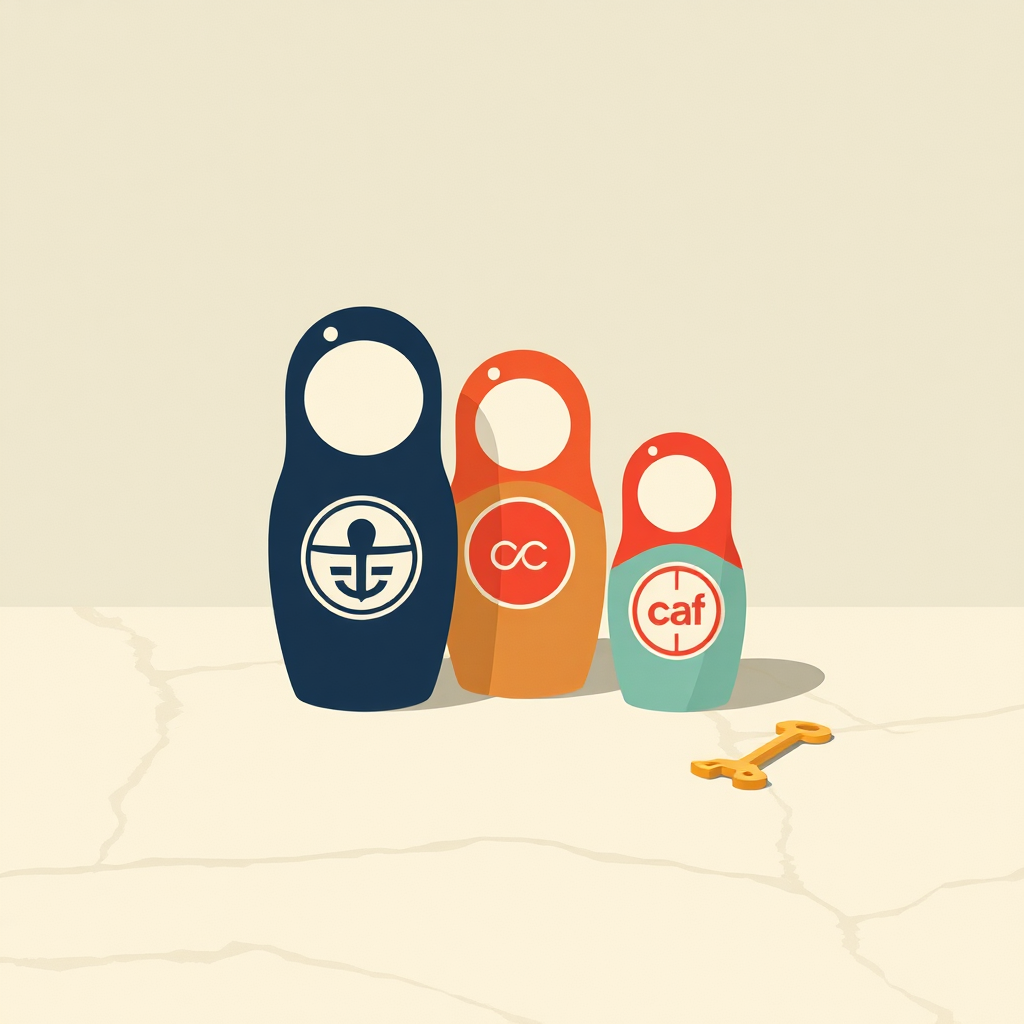
Imagine for a moment a shipping container sitting on a dock in the port of Haifa. It is filled with high-end electronic components, maybe something that could be used in a medical imaging device or, just as easily, in a guidance system for a ballistic missile. If you try to trace who owns that container, you do not find a name or a face. Instead, you find a limited liability company registered in the British Virgin Islands. That company is owned by a holding company in Cyprus, which is managed by a nominee director in Panama, and the entire structure is funded by a foundation in Liechtenstein that traces its ultimate control back to an entity in Tehran. It is the financial version of a Matryoshka doll, one wooden figure inside another, until the person holding the smallest one is completely invisible to the outside world.

That is exactly the right image, Corn. And I should introduce myself for the new folks, I am Herman Poppleberry. You know, we decided to dive into this one ourselves today because the sheer scale of this shadow economy is staggering. We are talking about a system where a single P-D-F in a filing cabinet in a law office can move millions of dollars across borders in seconds, completely bypassing the eyes of regulators. People often think of shell companies as something out of a spy novel, but they are the literal plumbing of global finance. Whether it is the Islamic Revolutionary Guard Corps trying to fund a regional proxy or a billionaire trying to make sure the taxman does not see his new yacht, the technical architecture they use is remarkably similar.
It is fascinating because most of us think of the global financial system as this highly regulated, transparent machine where every dollar is tracked by sophisticated software. But what we are talking about today is the deliberate exploitation of the gaps in that machine. Our friend Daniel usually sends us these prompts, but we wanted to tackle this specific technical deconstruction because it feels like we are at a turning point. We are sitting here in March of two thousand twenty-six, and the Corporate Transparency Act in the United States has been in full effect for over two years now. Yet, despite these new rules, the shadow economy is still estimated to be anywhere from seven trillion to thirty trillion dollars. So, Herman, let us start with the basics. When we say shell company, people often use that term interchangeably with shelf company. Is there a technical difference we should be aware of?
There is a huge difference, Corn, and it is one that professional enablers use to their advantage every single day. A shell company is an entity that has no active business operations or significant assets. It is a clean slate, a legal vessel. It is created to hold assets or to facilitate transactions, but it does not produce anything or employ anyone. A shelf company, on the other hand, is a company that was incorporated years ago but has been left to sit on a shelf, so to speak. It has been dormant since its inception. Now, why would you want an old, dormant company? Because it gives the appearance of longevity. If a shell company was created yesterday, a bank might flag it for a high-risk transaction. But if you buy a shelf company that was incorporated in two thousand twelve, it looks like an established business with a history. It is an instant credibility hack. You can go to a specialized firm in London or Nevada and buy a ten-year-old company for a few thousand dollars, and suddenly, your brand-new operation looks like a seasoned veteran of the corporate world.
So it is about manufacturing a corporate identity that looks boring and established to avoid triggering any red flags in the anti-money laundering software. That leads us to this concept of jurisdictional arbitrage. It sounds like a fancy term for shopping around for the weakest laws, right?
That is exactly what it is. Jurisdictional arbitrage is the practice of taking advantage of the discrepancies between different legal systems. If the United States has strict reporting requirements but a small island nation in the Caribbean does not, you register your entity there. But the real pros do not just use one jurisdiction. They layer them. They use the transparency of one place to mask the opacity of another. You might have a Delaware limited liability company, which looks very legitimate and is easy to set up, but its sole member is a trust in the Cook Islands. Delaware provides the veneer of American corporate respectability, while the Cook Islands provides the ultimate shield against disclosure. The goal is to create a legal maze where the cost of finding the truth exceeds the value of the information itself.
Is a shell company inherently illegal, though? I mean, I know plenty of legitimate businesses use them for things like mergers and acquisitions or to keep a new project quiet before it launches. Is it a neutral tool that is just being weaponized?
You hit the nail on the head. A shell company is a neutral financial instrument. It is like a hammer. You can use it to build a house or to break a window. In legitimate finance, they are used for Special Purpose Vehicles to isolate financial risk or to hold intellectual property. The problem arises when these structures are used to hide the beneficial owner, the person who actually controls the money. When you combine the technical structure of a shell company with the lack of transparency in certain jurisdictions, you create a perfect environment for illicit activity. And this is where it gets really consequential for national security. We have talked about the Islamic Revolutionary Guard Corps before, specifically back in episode eight hundred ninety-four when we looked at the power dynamics in Iran. They are perhaps the world masters at using these structures to evade sanctions.
Right, and the I-R-G-C model is particularly sophisticated. They do not just use empty shells; they use what we call front companies. How do they actually move the money without getting caught by the Society for Worldwide Interbank Financial Telecommunication, or what everyone knows as the S-W-I-F-T system?
The I-R-G-C model is a masterclass in deception. Unlike a shell company, a front company actually does something. It might be a legitimate-looking trading house in Dubai that imports air conditioning units or construction materials. It has an office, it has employees, it has a website, and it might even do some real business. But its real purpose is to serve as a conduit for the Quds Force. When they need to buy dual-use technology, like high-end sensors or carbon fiber, they do not buy it as the I-R-G-C. They have this Dubai trading house place the order. The supplier in Germany or Japan sees a legitimate purchase order from a private company in a friendly jurisdiction. The money moves through a local bank that has a correspondent relationship with a major Western bank. By the time the regulators realize that the air conditioning company is actually a procurement wing for an Iranian missile program, the goods are already on a ship headed for Bandar Abbas.
And we touched on how those ships move in episode eight hundred eighty-two when we discussed the shadow fleets. It is the physical manifestation of the financial shell game. You have these aging tankers with spoofed A-I-S transponders, sailing under flags of convenience, owned by a shell company that was spun up three weeks ago in the Marshall Islands. But let us talk about the layering process itself. If I am an analyst at a big bank looking at a transaction, what does layering actually look like on my screen?
It looks like a series of complex, often circular, transfers that seem to have no clear economic purpose. This is the second stage of money laundering, following placement and preceding integration. Imagine five companies: A, B, C, D, and E. Company A sends a million dollars to Company B as a loan. Company B then uses that money to buy shares in Company C. Company C pays a consulting fee to Company D, and Company D finally buys a piece of real estate from Company E, which is the ultimate destination. Each of these steps might happen in a different country, using different currencies, and through different banks. The goal is to break the audit trail. By the time you get to the third or fourth layer, the original source of the funds is so obscured that it is nearly impossible for a standard compliance officer to link Company E back to the sanctioned entity that started the process at Company A. It is about creating enough administrative friction that the investigators simply give up or run out of time. They are betting on the fact that most regulators are overworked and underfunded.
It is a war of attrition, essentially. You are making it so expensive and time-consuming to find the truth that the truth becomes functionally irrelevant. But they cannot do this alone, right? An I-R-G-C commander in Tehran is not filling out incorporation papers in the British Virgin Islands or setting up a trust in Nicosia. Who are the people actually building this infrastructure?
Those are the professional enablers. We are talking about high-end law firms, accounting practices, and trust companies. There are entire industries in places like Panama City, the Seychelles, and even London that exist solely to provide these services. They offer turnkey solutions. For a few thousand dollars, they will give you the company, the nominee directors, the registered address, and even a virtual office with a local phone number. These enablers provide a layer of professional privilege. If a regulator asks questions, the lawyer can often hide behind attorney-client privilege. It is a massive loophole that state actors and the ultra-wealthy exploit to the hilt. In many jurisdictions, these enablers are not even required to perform the same level of due diligence as a bank. They are the architects of the shadow economy, and without them, the whole system would collapse.
There is also a tradeoff here that I find interesting, Herman. The tradeoff between the speed of moving capital and the risk of detection. If you move money too fast, you trigger the velocity-of-funds flags in the bank's software. If you move it too slow, you might lose the opportunity to buy that sanctioned technology or fund that operation. How do they balance that?
It is a delicate dance. The most sophisticated networks use a technique called "smurfing" or "structuring" on a corporate scale. Instead of moving ten million dollars in one go, they move fifty thousand dollars through two hundred different companies. It takes longer to set up, but it is much harder for an algorithm to catch. They also use "round-tripping," where money leaves a country as an investment and returns as a loan, making it look like legitimate capital flow. The I-R-G-C, in particular, is willing to accept a higher level of "leakage"—meaning they expect to lose a certain percentage of the money to fees, bribes, and the occasional frozen account—as long as the bulk of the capital reaches its destination. For them, it is a cost of doing business.
That is a great transition to the other side of this, the ultra-high-net-worth individuals. While the I-R-G-C is using these tools for survival and power projection, the world's wealthiest people are using them for what they call wealth preservation. It is the same plumbing, just used for a different purpose. One of the structures I keep seeing mentioned is the Private Interest Foundation. How does that differ from a standard shell company?
A Private Interest Foundation, or a P-I-F, is a very sophisticated vehicle, often found in jurisdictions like Panama or Liechtenstein. Unlike a company, it does not have shareholders. It is a self-owning entity. It has a founder, a council, and beneficiaries, but the legal title to the assets is held by the foundation itself. This creates a fascinating form of legal invisibility. If you are a billionaire and you put your art collection, your real estate, and your private jet into a P-I-F, you technically do not own them anymore. The foundation does. So if a creditor comes after you, or a disgruntled ex-spouse, or a tax authority, you can honestly say, "I do not own those assets." It is a way to maintain complete control over your wealth without having the legal burden of ownership. It is the ultimate shield.
It is essentially a legal ghost. You get all the benefits of the money with none of the transparency. And when we compare this to the I-R-G-C model, the goals are different, right? The I-R-G-C needs operational liquidity—money that can be spent right now on missiles or proxies. The ultra-high-net-worth individual needs long-term asset protection. But they both rely on the same "Beneficial Ownership" problem. Why is it so hard to define who actually owns something? It seems like it should be a simple question.
You would think so, but the law allows for a distinction between legal ownership and beneficial ownership. I can hire a nominee director in Cyprus to be the legal owner of my company. His name is on the registry. He signs the papers. But I have a private contract with him—a side letter—that says he must follow my instructions and that all profits belong to me. To the outside world, he is the owner. To the bank, he might even pass the initial Know Your Customer check if he is a professional who does this for hundreds of companies. Finding the person who actually pulls the strings, the person who benefits from the money, requires forensic accounting that most regulatory bodies simply do not have the resources for. Even with the new registries being built in two thousand twenty-six, if the "owner" listed is another shell company in a non-cooperative jurisdiction, the trail goes cold immediately.
And this has some really weird second-order effects on the real world, doesn't it? I am thinking about the real estate markets in places like London, New York, or even Dubai and Singapore. We have seen these massive glass towers that stay half-empty because the units are not homes, they are just safety deposit boxes in the sky owned by shell companies.
When you have trillions of dollars in offshore wealth looking for a safe place to land, it distorts local economies. This capital is often price-insensitive. If a shell company needs to park twenty million dollars to hide it from a foreign government, they do not care if they overpay for a penthouse in Knightsbridge. This inflates property values, making it impossible for actual residents to afford to live in their own cities. It is a form of financial colonization. The shell company network allows this capital to flow into these markets without any accountability for where it came from or what impact it is having. We touched on some of the mechanics of how this influences geopolitical stability back in episode nine hundred fifty-seven when we looked at regime change. If you can move enough capital into a country through these hidden channels, you can effectively bypass their entire domestic financial policy or even fund political subversion without anyone knowing the source.
It is a direct challenge to the sovereignty of the nation-state. If a government cannot see who owns the land or where the money is coming from, they cannot effectively govern. Now, Herman, we have to talk about the American perspective here. For a long time, the United States was actually one of the easiest places in the world to set up a shell company. You could go to Delaware or Nevada and create an entity with less information than it takes to get a library card. But that changed with the Corporate Transparency Act. Now that we have had a couple of years of data, how much of a dent is that actually making?
The Corporate Transparency Act, or C-T-A, was a huge step, but we have to be realistic. It requires most small and mid-sized entities to report their beneficial ownership information to the Financial Crimes Enforcement Network, or FinCEN. The goal is to peel back that first layer of the Matryoshka doll. However, the information is not public. It is a private database for law enforcement and banks. And while it makes it harder for a low-level criminal to hide, a sophisticated state actor like the I-R-G-C or a billionaire with a team of lawyers will just find more creative ways to circumvent it. They will use more layers, more jurisdictions that do not cooperate with FinCEN, or they will use straw men who are just far enough removed to not trigger the reporting requirement. For example, they might ensure no single person owns more than twenty-five percent, which is the current reporting threshold.
It is the classic cat and mouse game. The regulators build a better mousetrap, and the mice evolve to be smarter. This brings us back to the I-R-G-C and the concept of the Bonyads. For those who do not know, these are these massive, opaque charitable foundations in Iran that control huge swaths of the economy. They are essentially the ultimate shell companies. They operate under the direct control of the Supreme Leader and the Revolutionary Guard, but they present themselves as religious or social welfare organizations. How do these Bonyads interact with the global financial system?
The Bonyads are the top of the food chain. They own hundreds of smaller companies, which in turn own shell companies in foreign jurisdictions. It is a state-sponsored version of the ultra-high-net-worth model we discussed. They use these structures to import everything from luxury goods for the elite to centrifuge components for the nuclear program. Because they have the full weight of a sovereign state behind them, they can create their own professional enablers. They have their own banks, their own shipping lines, and their own intelligence officers who specialize in financial subversion. When we talk about dismantling the octopus, which we explored in episode nine hundred thirty-one, we are talking about trying to map these incredibly dense and resilient networks. It is not just about blocking one company; it is about understanding the entire ecosystem.
It really is an ecosystem. And speaking of ecosystems, I want to go back to the idea of the shadow fleet for a second, because it is such a perfect example of how the physical and the digital worlds collide. You have a tanker that is twenty years old, it should be in a scrapyard, but instead, it is sailing under the flag of a country that barely has a coastline. It is owned by a shell company in the Marshall Islands that was created three weeks ago. It turns off its transponder, does a ship-to-ship transfer in the middle of the night, and suddenly, sanctioned Iranian oil becomes "Malaysian blend." The shell company provides the legal cover, and the jurisdictional gaps in maritime law provide the physical cover.
That is exactly right. And the reason this works is that there is a demand for it. There are plenty of actors, including some major global powers, who are perfectly happy to buy that discounted oil and ask no questions. This is why sanctions are rarely air-tight. They are more like a sieve. You can catch the big chunks, but the liquid capital always finds a way through the holes. The I-R-G-C has become incredibly adept at identifying which countries are willing to look the other way in exchange for a piece of the action. They exploit the fact that the world is not a monolithic block. As long as there is a single jurisdiction that prioritizes profit over global security, these networks will thrive.
It is a sobering thought. But let us look at the other side of the coin for a moment. We have talked about the I-R-G-C and the ultra-wealthy, but what about the average person? Most people listening to this probably think, "Well, I do not have a shell company in the Caymans, so why does this matter to me?" But as you mentioned with the real estate market, there are real-world consequences for everyone when the global financial system is this opaque.
Beyond the housing prices, there is the issue of tax revenue. Estimates suggest that between seven trillion and thirty trillion dollars of global wealth is held offshore. That is money that is not being taxed, which means the tax burden falls more heavily on the middle class and small businesses that cannot afford a team of Panamanian lawyers. It also distorts competition. If a company can use shell networks to hide its true costs or to bypass environmental and labor regulations, it has an unfair advantage over a legitimate business that follows the rules. It undermines the very foundations of a free and fair market. If the rules only apply to the people who cannot afford to break them, then the rules lose their legitimacy.
That is a critical point. It is not just about catching criminals; it is about maintaining the integrity of the system itself. So, as we look at the efforts to crack down on this, we see a move toward global beneficial ownership registries. The idea is that if every country has a database like the one FinCEN is building, and if those databases talk to each other, the Matryoshka doll finally gets opened. How close are we to that reality?
We are closer than we were ten years ago, but we are still a long way off. The European Union has been pushing for public registries, but they have run into legal challenges regarding privacy rights. There is a tension here that we have to acknowledge. Not everyone who wants privacy is a criminal. There are legitimate reasons for a person in a volatile country to want to hide their assets from a corrupt government or a kidnapping ring. The challenge for regulators is to create a system that catches the I-R-G-C and the tax evaders without trampling on the legitimate privacy needs of innocent people. This is where the debate gets really heated.
It is that classic trade-off between security and privacy. And it seems like the technology might be the thing that tips the scales. We are seeing the rise of A-I-driven forensic accounting. Can machine learning do what human auditors cannot? Can it see the patterns in millions of transactions and say, "Wait, these five companies in different countries are actually acting as a single unit"?
That is the big hope. A-I is incredibly good at pattern recognition. It can scan the global S-W-I-F-T data and identify the circular flows and the layering techniques that we talked about. It can look at the shared addresses of thousands of shell companies and map out the networks of the professional enablers. We are already seeing some success with this. FinCEN and other agencies are using these tools to identify red flags that a human would never catch. For example, if a company has a sudden spike in activity that perfectly mirrors the activity of a sanctioned entity, the A-I can flag that in real-time. But again, the other side is using A-I too. They are using it to design even more complex structures that are specifically built to evade detection by the current algorithms. It is a digital arms race.
I want to pivot to some practical takeaways because we have covered a lot of ground here. If you are a business owner or even just an informed citizen, what are the red flags you should look for if you are worried about being caught up in one of these networks?
For a business owner, the biggest red flag is a lack of transparency in your supply chain. If a new vendor is insistent on being paid through a bank in a high-risk jurisdiction, or if they are owned by a company that has no online presence and a nominee director, you need to ask more questions. Professional analysts look for what we call the indicators of a shell network: shared addresses with hundreds of other companies, directors who serve on the boards of dozens of unrelated businesses, and transactions that have no clear commercial logic. If you are a consumer, it is about being aware of where your products are coming from. The more we demand transparency, the more pressure there is on companies to clean up their acts.
And I think for everyone, it is about understanding that this is not just a technical issue. It is a political and moral one. We are choosing, as a global society, how much opacity we are willing to tolerate. When we allow these jurisdictional gaps to exist, we are effectively giving a green light to the I-R-G-C and the shadow economy. It is a policy choice.
And that is why we talk about these things on the show. We want people to understand the mechanics so they can see past the headlines. When you hear about a new set of sanctions being announced, you should be asking, "Okay, what is the work-around? What shell network are they going to use to bypass this?" Understanding the plumbing helps you understand the world.
It really does. Herman, this has been a deep dive into some pretty dark waters, but I think it is essential. We have moved from the "how" of the shell company to the "why" of the global shadow economy. Before we wrap up, I want to remind our listeners that we have been at this for a long time. This is episode nine hundred sixty-eight, and if you found this technical deconstruction interesting, you should definitely check out our archive at myweirdprompts dot com. You can search for topics like sanctions, the I-R-G-C, or offshore finance and find years of our discussions on these themes.
Yeah, and if you are enjoying the show, we would really appreciate a quick review on your podcast app or on Spotify. It genuinely helps other people find us and join the conversation. We love digging into these complex topics, and your support keeps us going.
It really does. This has been a fascinating one, Herman. I am still thinking about that shipping container in Haifa. It is a reminder that the global economy is much more interconnected and much more hidden than we often realize.
It is. And as long as there is a demand for secrecy, there will be someone willing to build the Matryoshka doll. The question is whether we can build a flashlight bright enough to see what is inside.
Well, we will keep trying to shine that light right here. Thanks for listening to My Weird Prompts. I am Corn Poppleberry.
And I am Herman Poppleberry. We will see you next time.
Take care, everyone.
This has been a production of the Poppleberry brothers, coming to you from our home in Jerusalem. Thanks again to Daniel for the inspiration, even though we took the reins on this one ourselves today.
Right, and remember you can find the R-S-S feed and everything else at myweirdprompts dot com. Until next time.
Goodbye.
Bye.
One last thing, Corn, do you think we should have mentioned the specific role of bearer shares in the nineteenth century?
Maybe in episode two thousand, Herman. Let us keep it to the twenty-first century for now.
Fair enough. See you later.
See you later.