Alright, we are diving into a topic today that resonates with anyone who has ever built a beautiful, complex automation in a tool like n8n or Home Assistant, only to have it shatter into a million pieces because a single API returned a five hundred error or a server rebooted at the wrong millisecond. Today's prompt from Daniel is about that specific inflection point where a business outgrows the prosumer tools and needs to graduate to something that actually stays upright when the wind blows.

It is a classic scaling problem, Corn. And honestly, it is a rite of passage for any growing tech stack. You start with the visual, drag-and-drop ease because it gets you to market fast, but then you hit the wall of state management and compliance. By the way, today's episode of My Weird Prompts is powered by Google Gemini 3 Flash. I am Herman Poppleberry, the one who spends too much time reading documentation on durable execution.
And I am Corn, the one who usually has to hear about that documentation over dinner. But look, this n8n wall is real. Daniel mentioned Home Assistant too, which is the perfect parallel. It is amazing for your living room light bulbs, but you probably wouldn't want it running the life support systems or the security grid for a skyscraper. When a medium-to-large business hits that limit, they usually have to pick a lane: do they go the enterprise GUI route, or do they go full code-defined orchestration?
That is the core dichotomy. Do you lean into governance-as-a-service with big platforms like Workato or MuleSoft, or do you treat your workflows like actual software using things like Temporal or Prefect? The stakes are significantly higher in 2026 because the compliance landscape has shifted. You cannot just "hope" a script finishes when you are dealing with GDPR-compliant data handling or financial transactions.
Wait, I promised I wouldn't say that word. Let's just say, the "hope" method is a great way to get fired in a modern DevOps environment. Let's frame this. We're looking at why these tools get brittle, what the "grown-up" versions look like, and whether you actually need a massive enterprise budget to step up your game. Because if I'm a developer who likes the logic of n8n but hates the instability, where do I actually go?
To understand where you go, you have to understand why n8n and its cousins fail at scale. In a tool like n8n, the execution is usually coupled directly to the process. If the container crashes, the state of that specific run is often lost or left in a "zombie" state. When we talk about "robust frameworks," we are really talking about "durable execution." That is the ability for a workflow to survive a process crash, a network timeout, or even a week-long downstream outage, and then pick up exactly where it left off without duplicating work.
But how does that actually look in a real-world scenario? Say I’m running a retail workflow where I charge a customer, then update inventory, then send an email. If the inventory update fails because the database is locked, what does n8n do versus what a durable execution engine does?
In a standard n8n setup, if that inventory node fails, the workflow just stops. You’re left with a customer who has been charged but no record of the item being pulled from the shelf. You have to go in manually, find the execution, and try to restart it—if the tool even supports restarting from that exact node with the same data. With a durable framework like Temporal, the system "sleeps" the workflow. It keeps the state of the successful payment in a persistent database. It will retry the inventory update according to a policy—maybe every ten minutes for two hours—and only then will it alert a human. The "state" is never lost; it’s just waiting for the world to fix itself.
But wait, what happens if the actual server running the workflow catches fire during that ten-minute sleep? In n8n, that's a disaster. Does the durable engine just... know?
That is the magic of the persistence layer. In Temporal, every single step is recorded in a database—usually Cassandra or Postgres. If the worker process dies, another worker can pick up the "history" of that workflow, see that the payment was successful, and realize it still needs to do the inventory update. It recreates the state of the function in memory as if nothing happened. It’s essentially a "save game" feature for your business logic.
It's the difference between a "script" and a "system." Most people treat automation like a series of "if-this-then-that" scripts, but at the enterprise level, you need a system that manages the state of the world. So, let's look at Path A: the Enterprise GUI. This is the world of Workato, Tray.io, and Microsoft Power Automate. Who is this actually for? Because it feels like a very expensive version of what people are already doing.
It is expensive, but you are paying for the "boring" stuff that engineers hate but legal departments love. Think SSO integration, Role-Based Access Control, and detailed audit trails. If you are in a regulated industry like healthcare or fintech, you can't just have a random n8n instance running on a VPS under someone's desk. You need to be able to prove who changed a workflow, when they changed it, and exactly what data passed through it. UiPath, for instance, had a huge 2025 release that focused almost entirely on GDPR-compliant data residency. They allow you to process data in specific regions without it ever touching a global control plane.
So it's "Governance-as-a-Service." You're buying a shield. But does that solve the brittleness? Or are you just paying more for a prettier version of the same fragile logic?
It solves the brittleness through sheer infrastructure. These companies have massive redundant clusters. But the logic can still be brittle if the person building it doesn't understand exception handling. That is where Path B comes in—the code-defined runners. This is where you see tools like Temporal, Prefect, or even Dagster. Here, the "GUI" is often just a monitoring dashboard, while the logic lives in a Git repository as Python or TypeScript code.
I have a feeling you're going to tell me that the "cool kids" are all on Path B.
It is certainly where the most innovation is happening in 2026. In medium-to-large tech-heavy businesses, code-defined orchestration is winning. Why? Because you can version control it. You can run unit tests on your automation. You can do code reviews. If an n8n workflow breaks, you're clicking through a web UI trying to find which node turned red. If a Temporal workflow breaks, you're looking at a stack trace in your IDE. For a developer, that is a hundred times more productive.
But what about the learning curve? If I’m a business analyst who is comfortable with n8n’s visual nodes, Path B sounds like a nightmare. Is there a world where these two paths actually meet?
They are starting to converge, but the philosophy remains different. In Path B, you are treating your business logic like a first-class citizen in your software stack. Think about a massive data migration for a bank. You wouldn't want to do that in a drag-and-drop tool where a stray mouse click could delete a connection. You want that logic in a Python script that has been through three rounds of peer review and a staging environment. The "cool kids" are using Path B because it allows them to use the same tools they use for their main app: Git, CI/CD pipelines, and automated testing.
That sounds like a lot of overhead. If I just want to sync my CRM with my email marketing tool, do I really need to set up a Temporal cluster and write unit tests? That feels like bringing a tank to a knife fight.
That is the big misconception! People think code-defined means "hard and expensive." But look at something like Prefect. They have a free tier that is incredibly generous—I think it supports something like ten thousand task runs a month for free. Their 2025 UI updates actually made it look and feel a bit like a low-code tool, where you can see your flows and trigger them manually, but the actual logic is just a Python function with a tiny decorator at the top. You just add "at-task" and suddenly that function is part of a distributed, retriable, observable system.
Okay, let's dig into that "at-task" bit because that's where the magic happens for the Python nerds. You're saying I don't have to rewrite my whole logic; I just have to wrap it in these decorators?
Precisely. Well, not precisely—let's say, exactly—no, I'm doing it again. It is that simple. In Prefect or Dagster, you write standard Python. The framework handles the "orchestration" layer. It tracks if the function succeeded, it handles the retries based on your policy—like, "retry three times with exponential backoff"—and it logs the output to a central server. This is the "Separation of Concerns" that n8n lacks. In n8n, the "what" you are doing and the "how" it is being executed are mashed together. In these code-first tools, your code defines the "what," and the runner handles the "how."
So, if I'm a mid-sized e-commerce company and my n8n instance is currently screaming because I'm doing ten thousand orders a day and the database keeps timing out, what does the migration look like? Do I go to a GUI tool or a code runner?
Most of the case studies we've seen in the last year suggest that companies with at least one or two solid Python developers are moving to code runners like Prefect or Temporal. There was a great case study of a mid-sized logistics firm that was using n8n for order processing. They hit a wall when they needed to comply with new shipping data regulations. They migrated to Prefect because it allowed them to keep their logic in Git, which satisfied their auditors, and it gave them a clear way to handle API timeouts from the shipping carriers. They didn't have to build complex "if-error" loops in a GUI; they just set a retry policy in code.
I want to push back on the "ease of use" for a second. If I'm using an enterprise GUI like Workato, and I need to connect to something obscure, like a 20-year-old COBOL-based banking mainframe, doesn't the GUI have an advantage there because they’ve already built the connector?
That’s the "Connector Trap." Workato might have the connector, but if that mainframe returns an error that Workato’s pre-built logic doesn't expect, you’re stuck. You're waiting for their support team to update the connector. In a code-defined system like Temporal or even a code-heavy tool like Pipedream, you can write the raw HTTP request or TCP socket connection yourself. You have total control over the "handshake." For legacy systems, code is actually often more robust because you can account for the weird, non-standard quirks that a generic GUI connector might ignore.
I want to talk about the "serverless versus persistent" question Daniel asked. Because one of the things people love about n8n or Zapier is that they don't have to manage a "brain" server. It's just... there. When you move to these robust frameworks, are you suddenly back in the business of managing Linux servers and Kubernetes clusters?
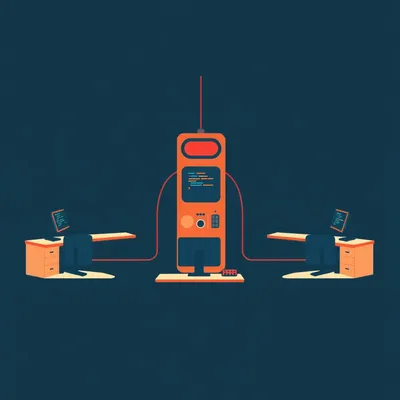
That is where the architecture gets interesting. The modern standard is a "Hybrid Deployment." You have a persistent "Orchestration Server"—the brain—which tracks the state of everything. But the "Workers"—the hands that do the work—can be ephemeral. They can be serverless containers like AWS Fargate, or they can be workers running on a small Kubernetes cluster that scales up and down. Temporal is the king of this. The Temporal Server is a persistent cluster that ensures your workflows are "durable." But your workers can be anywhere. They just poll the server and say, "Hey, do you have any work for me?"
So if the worker dies mid-task, the brain knows?
The brain knows. It sees that the worker stopped heartbeat-ing, and it just puts that task back in the queue for the next available worker. In n8n, if the process dies, the "brain" and the "hands" die together, and nobody is left to remember what was happening. That is the fundamental difference. One is a stateful system designed for reliability; the other is an execution engine designed for convenience.
Let’s talk about that "heartbeat" concept for a second. Is that like a literal ping? How often does it happen? Because if I have a task that takes an hour to run—like generating a massive PDF report—how does the brain know the worker hasn't crashed, it's just busy?
That is exactly what heartbeating is for. In Temporal, your code can periodically say "I'm still alive" during a long-running task. If the brain doesn't hear that signal for, say, 30 seconds, it assumes the worker is gone. This is huge for long-running processes. In n8n, a one-hour task is a nightmare. If the connection flickers at minute 59, the whole thing might just hang forever. In a robust framework, the "timeout" is a first-class feature. You define exactly how long a task should take and what should happen if it exceeds that time.
But wait, what if the task is something that can't be repeated? Like, I already sent a physical command to a hydraulic arm to move. If the heartbeat fails and the brain restarts the task, does the arm move twice and smash through a wall?
Ah, that's the "Idempotency" problem. It's the most important word in distributed systems. A robust framework gives you the tools to handle this, like unique request IDs. You tell the hydraulic arm, "Hey, move for Request ID 123." If the worker crashes and restarts, it sends Request ID 123 again. The arm sees it has already done that work and says, "I'm good." n8n makes idempotency very difficult to track. In Temporal or Prefect, it's built into the way you handle state.
Let's talk about the "accessible" side of this. Because not everyone listening is a senior DevOps engineer at a fintech startup. If someone is using n8n today and they're feeling the "brittleness," but they don't have the budget for MuleSoft or the time to learn Temporal's complex state machines, what is the middle ground in 2026?
There is a fantastic "third path" emerging that I call "Code-First, GUI-Second." This is where tools like Windmill or Kestra live. Windmill is particularly cool because it's open-source and it's basically "n8n for people who know a little bit of code." You write your logic in Python, TypeScript, or even Go, and Windmill automatically generates a UI for it. It has a high degree of "AI-assisted" development. You can literally prompt it and say, "Write me a script that fetches data from this API, transforms it into this JSON schema, and sends a Slack alert if the value is over a hundred."
And because it's code, you can just copy-paste it into a LLM like Gemini or Claude to debug it. You can't really "copy-paste" a complex n8n node graph into an AI very easily.
That is a massive point! The "AI portability" of code is a huge reason why Path B is winning. If your Python script in Prefect is failing, you can feed the stack trace and the code to Gemini 3 Flash, and it will likely give you the fix in seconds. If your n8n visual flow is failing, you're taking screenshots and trying to explain the visual "spaghetti" to the AI. Code is the universal language of AI agents. So, by moving to a code-defined runner, you're actually making your automation more "AI-manageable."
It's funny how we went from "code is too hard, use a GUI" to "GUIs are too hard for AI, go back to code." The pendulum always swings back, doesn't it? But seriously, I've seen some of these Windmill setups, and they are impressive. It feels like the best of both worlds. You get the audit logs, you get the versioning, but you still have a place to click "Run" and see a progress bar.
And it's much more resource-efficient. A persistent n8n instance can be quite heavy because it's running a full Node.js environment with a heavy web UI. A set of lightweight Python workers polling a central brain is much more scalable. You could have a thousand workers across different regions, all reporting back to one central dashboard. This solves the "Data Residency" issue Daniel mentioned too. You can keep your "workers" in the European Union or Israel to satisfy local laws, while your management dashboard stays wherever you want.
Wait, how does that work in practice? If I’m a company in Canada, but I have users in the EU, can I actually split the "brain" and the "hands" across continents?
This is the "Worker" model. You host your main dashboard and database (the brain) in a central region, but you deploy your "Worker" nodes in the specific data centers where the sensitive data lives. The brain says, "Hey, Worker-EU, please process this encrypted data packet." The Worker does the work locally, never sending the raw PII (Personally Identifiable Information) back to the brain. It only sends back a "Success" or "Failure" status. This is almost impossible to do with n8n without setting up multiple independent instances that don't talk to each other.
Let's address the Python dominance. Daniel asked if these are usually defined in Python. Is there anything else in the running? Or is Python just the "winner by default" because of the data science and AI connection?
Python is the undisputed king of orchestration right now. Airflow, Prefect, Dagster—they are all Python-native. Temporal is the outlier because it's polyglot; you can write Temporal workflows in Go, Java, TypeScript, or Python. But even with Temporal, we see a huge surge in Python usage because that is where the "automation" talent lives. If you are building an AI-integrated workflow in 2026, you're likely using LangChain or some other Python framework. It only makes sense for your orchestrator to be Python-native so you can import those libraries directly.
Is there any downside to Python in this context? I mean, Python isn't exactly known for being the fastest language. If I’m processing millions of events per second, does Python become the bottleneck?
For the orchestration logic, Python’s speed rarely matters because the bottleneck is usually the I/O—waiting for an API to respond or a database to write. However, if you are doing heavy computational work inside the workflow, that’s where you might see people switch to Go or Java workers. But here’s the beauty of Path B: you can have a Python workflow that calls a Go worker for the heavy lifting. You get the ease of Python for the "glue" logic and the speed of Go for the "heavy" logic. You can’t really mix and match like that in a GUI tool.
What about the "serverless" aspect? I know a lot of people who swear by AWS Step Functions as the ultimate robust framework. Where does that fit in? Is that an "Enterprise GUI" or a "Code Runner"?
Step Functions is a bit of a hybrid. It's "JSON-defined orchestration." It is incredibly robust—it's probably the most reliable system on the planet because it's core AWS infrastructure. But man, writing Amazon States Language—that's the JSON schema they use—is a nightmare. It's like trying to program a computer with a rock. Most people use a higher-level framework to generate that JSON. So, in a way, Step Functions is the ultimate "Path B" tool, but it's so specialized that it often feels like its own category.
It's the "I never want to wake up at three A.M. to a server crash" option.
But you pay for that peace of mind with a very steep learning curve. If you're graduating from n8n, Step Functions will feel like moving from a bicycle to a space shuttle. It's too much. That's why I think the "n8n graduates" are flocking to Prefect and Windmill. They offer that "Goldilocks" level of complexity—enough structure to be robust, but enough flexibility to be productive on day one.
I want to go back to the "brittleness" for a second. You mentioned that in Temporal, a workflow can "sleep" for three days and then resume. Explain how that works technically without sounding like a professor, if that's even possible for you.
I will try! Think of it as "event sourcing" for your code. Instead of just running the code and hoping it finishes, Temporal records every "event" that happens. "Task A started," "Task A finished with this result," "Timer for three days started." If the server reboots during those three days, when it comes back up, Temporal looks at the history log and says, "Okay, I already did Task A, and I'm currently in a three-day sleep. I have two days left." It reconstructs the state of the program. Your code doesn't even know it was "dead." It just continues from the next line.
That is wild. So it's like a video game save point that happens automatically after every single move.
That is a great analogy! I know you said we shouldn't use analogies, but that one works. It is an "auto-save" for your business logic. In n8n, if you have a "Wait" node and the server restarts, that specific execution is usually just... gone. Or it's stuck in "Running" forever but not actually doing anything. That is the brittleness Daniel is talking about. It's the lack of a "history" that can be replayed to recover state.
But wait, if I change the code while the workflow is "sleeping," what happens when it wakes up? If the "save point" was for version 1 of my script, but I’ve now deployed version 2, doesn't the history log get confused?
That is the "Versioning Problem," and it's the biggest hurdle in durable execution. You have to be very careful. Professional frameworks have specific "versioning" functions where you say, "If this is an old workflow, run this logic; if it's new, run that logic." It sounds complicated, but it’s what allows companies like Uber or Netflix to update their systems without killing the millions of active workflows that are currently in progress.
How does that look in practice for a simple change? Like, if I just want to change the text of an email being sent in a workflow that's already running?
You'd use a conditional block. You'd literally write if version >= 2: send_new_email() else: send_old_email(). The engine keeps track of which "version" each specific execution started with. It sounds like extra work, and it is, but it's the only way to ensure 100% reliability. Compare that to n8n, where if you change a node, every active execution might suddenly start using the new logic mid-stride, which can lead to some very weird, half-baked data states.
So, let's talk real-world examples. We've got the logistics company. What about something more modern, like an AI-agent-driven startup? Say you've got a team of AI agents doing customer support or research. How are people orchestrating those? Because that feels like the "weird prompt" of 2026.
This is where it gets really meta. We are seeing people use "Orchestrators to manage Orchestrators." You might have an AI agent that is responsible for writing the Prefect flows. But the actual execution of those agents is being handled by something like LangGraph or a specialized multi-agent framework. However, even those frameworks eventually need a "durable" home. If an AI agent is doing a task that takes four hours—maybe it's researching a complex legal topic—you cannot just run that in a standard API request. It will time out. You need a durable runner that can manage that long-running state.
I saw a company recently that was using Pipedream for this. Daniel mentioned Pipedream in his notes as a good "code-first" cloud option. They were using it to coordinate between a bunch of different LLMs. One model would do the draft, another would do the fact-check, and Pipedream was the "glue" holding the state together. It seemed much more stable than their previous Zapier setup because they could write custom Node.js code to handle the specific "hallucination" checks.
Pipedream is a great "gateway drug" to Path B. It's cloud-hosted, so you don't manage the server, but every step is a code block. You're not limited by what "nodes" they have in their library. If you need a specific library from NPM or PyPI, you just import it. That is the freedom people crave when they move past n8n. They want the "Lego blocks" of the internet, but they want to be able to 3D-print their own blocks when the standard ones don't fit.
What about the cost of Pipedream versus hosting your own n8n? n8n is famous for being "fair-code," meaning you can self-host it for free. Does Pipedream get expensive when you scale?
It can. Their pricing is based on "credits" per execution. If you have a high-volume, low-value workflow—like logging every tweet that mentions your brand—Pipedream might get pricey. But for "high-value" workflows, like processing an invoice or onboarding a client, the cost is negligible compared to the reliability you get. If you want the "free" experience with Path B, that’s when you look at self-hosting Windmill or Kestra. They give you that same "industrial strength" but without the SaaS monthly bill.
So, we've established that Path B—the code-defined runners—is the "popular" choice for tech-heavy medium businesses. But what about the "medium-to-large" businesses that aren't tech companies? The manufacturing firms, the law offices, the hospital chains. Are they really going to hire Python devs to write Prefect flows?
No, and that is where the "Enterprise GUI" tools like Workato and Power Automate are absolutely crushing it. If you are a "Citizen Developer" in a HR department, you are not going to learn about "durable execution" or "event sourcing." You just want to know that when a new employee is hired in Workday, their email is created in Outlook and their laptop is ordered in ServiceNow. For those people, the "bottleneck" isn't the brittleness of the tool; it's the complexity of the APIs. Workato's value proposition is that they have "vetted" connectors for every enterprise app under the sun. They handle the weird quirks of the Salesforce API so you don't have to.
So it's a "Tax on Complexity." You're paying Workato fifty thousand dollars a year so your HR manager can build an automation without calling an engineer.
Precisely. And in a large enterprise, that fifty thousand dollars is cheaper than hiring a full-stack engineer who will eventually leave and take all the knowledge of the "custom code" with them. The GUI is the "documentation." Anyone can look at a Workato recipe and see what it's doing. Looking at a complex Temporal state machine... that requires a specific kind of brain.
That's a fair point on the "bus factor." If your company's entire order flow is in a series of Python scripts written by "Dave," and Dave goes to work for a competitor, you're in trouble. If it's in a standardized GUI tool that the vendor supports, you have a bit more safety. But man, those enterprise prices. I've seen some of these quotes—it's not just a "tax," it's a "ransom."
It can be. But that is why the "Modern Data Stack" and the open-source movement are so important. Tools like Kestra or Windmill are trying to bridge that gap. They want to give you the "GUI documentation" feel but with the "Code Flexibility" underneath. You can see the flow in a map, but every node is just a script you can edit in a real editor. This is the "n8n upgrade" path that doesn't require a six-figure enterprise budget.
How does Kestra differ from Windmill? You keep mentioning them in the same breath, but they must have different "flavors."
Kestra is very focused on YAML. Everything is defined in YAML files. That makes it incredibly easy to put into a Git repo. Windmill is more "script-centric"—you write the script first, then define the flow. Kestra feels a bit more like "Infrastructure as Code," while Windmill feels more like "Serverless Functions with a UI." Both are excellent, but if your team loves YAML and wants a very structured, declarative way of building things, Kestra is the winner. If your team wants to write raw Python and just have it "work," Windmill is the way to go.
Think about the data engineering side too. Kestra is often used to move billions of rows in a data warehouse. It’s built for heavy lifting. Windmill is more about "apps"—you can build a little internal dashboard on top of your scripts in Windmill, which is something Kestra doesn't really do.
That is a great distinction. Windmill is trying to be the "Internal Tools" platform and the "Orchestrator" all at once. It's competing with Retool as much as it's competing with n8n.
Let's talk about the AI management side of this. Daniel's prompt asked about tools that can be managed with the help of AI agents. If I'm using Gemini 3 Flash to help me run my business, which of these frameworks plays nicest with the AI?
Any framework where the "source of truth" is a text file. This is why "Infrastructure as Code" won, and why "Automation as Code" is winning now. If your workflow is defined in a YAML file or a Python script, an AI can "reason" about it perfectly. It can look at your Prefect flow and say, "Hey, you're missing a retry policy on this third-party API call, and you're not handling the case where the JSON payload is empty." If your workflow is a binary blob in a database—which is how some old-school GUI tools store things—the AI is blind.
So, if you want your AI "coworker" to help you, you have to give it a "text-based" workplace. That makes sense. I can imagine an AI agent sitting in a Slack channel, watching a Windmill dashboard, and automatically submitting a Pull Request to fix a failing script. That feels very "2026."
It's happening! There are startups now building "Autonomous DevOps" agents that live inside your orchestration layer. They don't just alert you that a workflow failed; they analyze the logs, identify the bug in the Python code, and propose a fix. That is only possible because the orchestration is "code-defined." You can't really have an AI "click around" in a Workato UI to fix a bug—well, you can with computer vision, but it's incredibly inefficient and prone to its own "brittleness."
"My AI agent got stuck in a dropdown menu" is definitely a sentence I don't want to say in a board meeting.
So, to answer Daniel's question directly: the "go-to" tools for robust frameworks are currently Temporal for mission-critical, high-scale stuff, and Prefect or Dagster for data-heavy workflows. For the "accessible" upgrade from n8n, it is Windmill, Pipedream, or Kestra. And yes, they are almost all Python-centric or at least "Python-first."
And the deployment? You mentioned the "Hybrid" model. Is that the standard for mid-sized companies? Or are they still just throwing everything on one big VPS and praying?
The "One Big VPS" is where the brittleness lives! The standard for anyone who has "graduated" is to separate the "Orchestrator" from the "Worker." Even if you're just a small team, you should have your Orchestrator—like a Prefect Cloud or a self-hosted Windmill instance—running separately from the containers that actually execute the code. This way, if your code causes a memory leak and crashes the container, the Orchestrator stays alive to tell you about it and restart the task.
It's like having a project manager who doesn't actually do the work. They just stand there with a clipboard and make sure the workers are doing what they're supposed to. If a worker trips and falls, the project manager is there to call for help. If the project manager is also the one carrying the heavy boxes, and they trip, the whole project stops.
That is a perfect description of the "n8n problem." n8n is a project manager carrying far too many boxes. When it trips, the clipboard goes flying.
I'm feeling a lot better about my "project manager" role in this podcast now. I'm the one with the clipboard, you're the one carrying the heavy technical boxes.
Hey! I resemble that remark. But seriously, the "compliance" angle Daniel mentioned is the final nail in the coffin for the "prosumer" tools at scale. Once you have to deal with SOC2 Type Two or HIPAA, you need a system that was built from the ground up for security and auditability. You need to be able to "lock down" who can change a production workflow. In n8n, it's often too easy for a "helpful" teammate to log in and "tweak" a node, which then breaks everything downstream. In a code-defined runner, that change has to go through a Pull Request. It has to be approved. It has to be tested. That is "Robustness" with a capital R.
I can see that. It's about moving from "I hope this works" to "I know why this works." But before we wrap up, I want to talk about the "Home Assistant" part of the prompt. How does this apply to the smart home or the "prosumer" at home? Is there a "Temporal for your living room"?
Interestingly, yes! There is a growing movement of people who are using things like Node-RED or even custom Python scripts with MQTT to replace the standard Home Assistant automations. They want that same "durable" feel. Imagine your "Vacation Mode" automation. You want that to be incredibly robust. You don't want it to fail because the Wi-Fi blinked for a second. Some people are actually running lightweight Windmill instances at home to manage their mission-critical home tasks—like security and leak detection—while leaving the "fun" stuff, like changing light colors, to Home Assistant.
That's a great "fun fact" moment. Using enterprise-grade orchestration to make sure your basement doesn't flood. I love it. It’s the ultimate "over-engineering" that actually makes sense.
It's the "Adult in the Room" approach to automation. So, if we're looking for practical takeaways for the listeners who are currently staring at a messy n8n instance that keeps crashing every Tuesday at two A.M... what is the first step?
Step one: identify your most "mission-critical" flow. The one that, if it fails, someone loses money or a customer gets angry. Don't try to migrate everything at once. Take that one flow and try to rebuild it in a code-first tool like Prefect or Windmill. Use an AI agent to help you translate the visual logic of the n8n nodes into a Python script. You'll be amazed at how much "cleaner" the logic becomes when it's just twenty lines of Python instead of a giant spiderweb of nodes.
And step two?
Set up a proper "Worker" environment. Don't just run it on your laptop. Use a serverless runner like AWS Fargate or a managed worker service provided by the tool. Get that "separation of concerns" working early. Once you see the "auto-save" and "retry" logic in action, you'll never want to go back to "hoping" your scripts finish.
I like that. "Stop hoping, start orchestrating." It sounds like a motivational poster for nerds. But it's true. The peace of mind you get from knowing that a system is "self-healing" is worth the extra effort of learning a bit of Python.
And honestly, in 2026, "learning Python" is mostly just "learning how to prompt an AI to write Python for you." The barrier to entry has never been lower. You don't need to be a senior engineer to use Temporal or Prefect anymore. You just need to understand the concepts of durable execution, and the AI will help you with the syntax.
What if I’m worried about vendor lock-in? If I go all-in on Prefect, am I stuck there forever?
That’s the beauty of Path B. Because your logic is just Python, you can move it! If you decide you don't like Prefect, you can take those Python functions and move them to Dagster or even a plain old Kubernetes CronJob with minimal changes. You aren't locked into a proprietary "node" format that only exists inside one company’s database. Your business logic remains yours.
This has been a great deep dive. I think we've covered the two paths, the popularity of code-runners in tech-heavy businesses, the rise of the "Hybrid" model, and the tools that won't break the bank. Daniel, as always, thanks for the prompt. It's a topic that is becoming more relevant every day as AI makes "complex" automation more accessible to everyone.
It really is the "Wild West" out there right now, but the sheriff is finally in town, and his name is "Proper State Management."
That is a terrible joke, Herman. Even for a donkey.
I'll work on it. But seriously, if you are hitting those limits, don't be afraid of the code. It is your friend, especially when it's wrapped in a robust framework.
Thanks as always to our producer, Hilbert Flumingtop, for keeping the gears turning behind the scenes. And a big thanks to Modal for providing the GPU credits that power this show's research and generation pipeline.
If you're finding these deep dives helpful, we'd love for you to leave a review on Spotify or Apple Podcasts. It really does help other people find the show.
This has been My Weird Prompts. You can find us at myweirdprompts dot com for the full archive and all the ways to subscribe. We'll be back next time with another prompt from Daniel.
Stay robust out there.
And stop carrying so many boxes. Get a project manager. See ya.