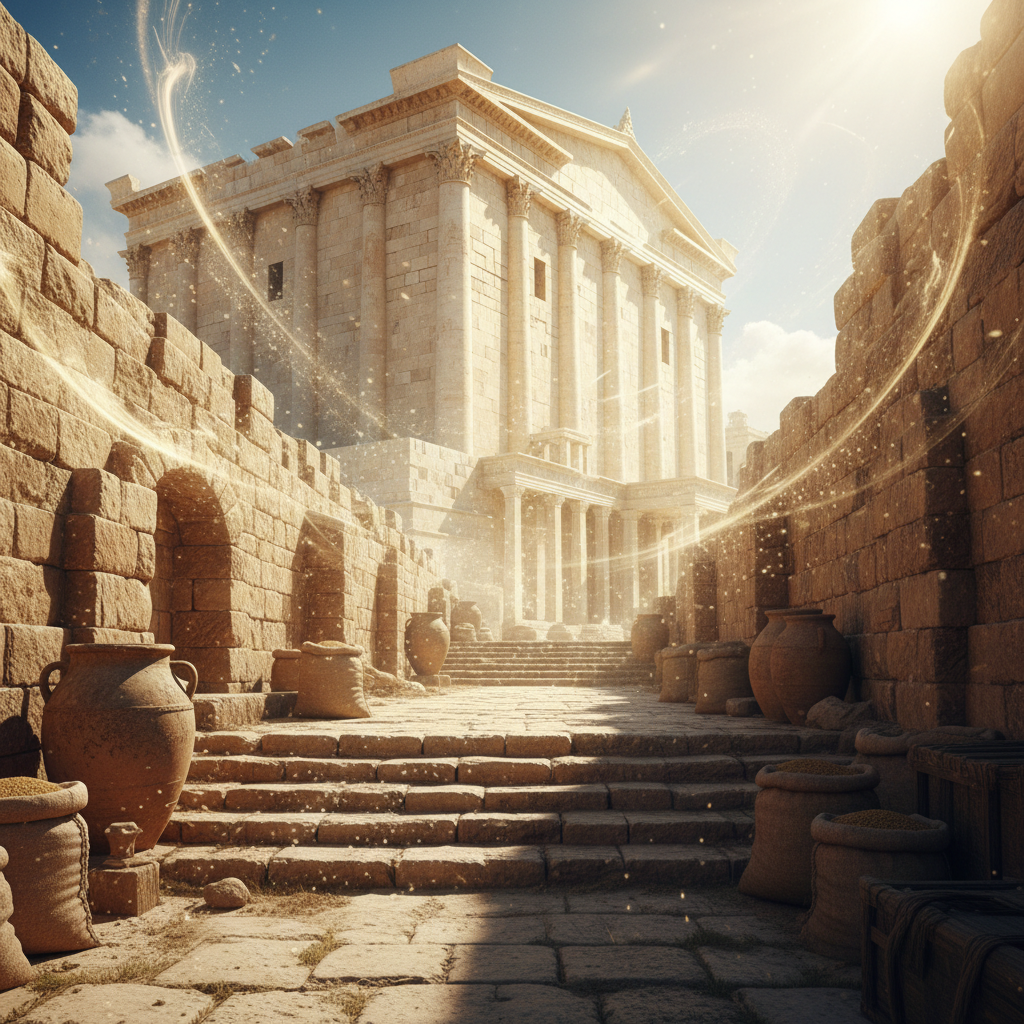
Jerusalem is a city of layers, literally and figuratively. You can be walking down a modern street, grab a coffee, and then take a few steps down a staircase and suddenly find yourself two thousand years in the past. It is a place where history is not just behind glass in a museum, but under your feet. And that is exactly what our housemate Daniel was getting at with the prompt he sent us this week.

Herman Poppleberry at your service. And yes, Daniel really hit on a fascinating intersection of disciplines here. He was asking about the Pilgrimage Road, which is this massive Herodian-era street that runs from the Pool of Siloam up to the foot of the Temple Mount. For those who have not followed the archaeology of Jerusalem closely, this is essentially the main thoroughfare that pilgrims would have used to ascend to the Second Temple two millennia ago.
It is an incredible project, but as Daniel pointed out, the engineering challenges are staggering. We are talking about a road that is buried deep beneath a modern, living city. You cannot just bring in a fleet of bulldozers and start digging. You have to essentially mine it out while keeping the houses and streets above from collapsing.
Exactly. It is a subterranean archaeological site that has to function as a modern tourist attraction. And the tension there is palpable. On one hand, you have the archaeologists who want to preserve every single paving stone and understand the historical context. On the other, you have structural engineers who are responsible for the safety of the thousands of people who will walk that road, as well as the safety of the people living directly above it in the Silwan neighborhood.
So, let us get into the mechanics of this. How do you actually excavate a two-thousand-year-old road that is buried ten or fifteen meters underground without the whole thing caving in?
It is a process often referred to as horizontal excavation, which is very different from the traditional vertical pits you see in most archaeological sites. In a standard dig, you remove layers from the top down. But here, they are essentially tunneling. They use a technique that is more akin to subway construction or coal mining than traditional archaeology.
I imagine that requires a massive amount of structural support. I have seen photos of the site, and it looks like a forest of steel beams.
That is exactly what it is. As the archaeologists move forward, centimeter by centimeter, engineers are right there with them, installing modular steel arches. These arches are designed to take the load of the earth and the buildings above and transfer it down to the bedrock or to stable footings. But the trick is doing this without damaging the ancient stones of the road itself.
Right, because the road is the artifact. You cannot just drill a hole through a Herodian paving stone to put in a support beam.
No, you absolutely cannot. So, they use what is called a needle-beam approach in some sections. They insert horizontal steel beams above the level of the road to hold up the ceiling of the tunnel, and then they carefully excavate the soil from underneath those beams to reveal the road. It is a slow, painstaking dance between the trowel and the welding torch.
It reminds me of the discussion we had back in episode four hundred and seven about the engineering of vertical spaces, though this is obviously horizontal. The principles of load-bearing and structural integrity are the same, but the stakes here are uniquely high because of the historical value. Herman, I am curious about the safety standards Daniel mentioned. Modern building codes are incredibly strict. How do you make a tunnel from the first century comply with twenty twenty-six safety regulations?
That is where the collaboration gets really intense. A modern public space needs fire exits, it needs proper ventilation, it needs emergency lighting, and it needs to be accessible. In a two-thousand-year-old tunnel, none of those things exist naturally. So the engineers have to integrate these systems invisibly. For example, the ventilation systems are often tucked away behind the modern support structures or integrated into the lighting tracks so that when a tourist walks through, they feel the cool air but they do not see a massive HVAC duct.
And what about the stones themselves? These are huge blocks of limestone that have been sitting in the dark for two thousand years. Once you expose them to the air, to changes in humidity, and to the vibrations of thousands of pairs of feet, do they not start to degrade?
They do, and that is a major concern for the preservationists. The limestone in Jerusalem, specifically the types known as Meleke and Mizzi, is quite durable, but it is not invincible. The Israel Antiquities Authority has to monitor the microclimate of the tunnel constantly. They use sensors to track humidity, temperature, and even the chemical composition of the air. If the humidity drops too low, the stones can become brittle. If it is too high, you get mold and salt crystallization, which can eat away at the surface of the stones.
It is almost like the road is a living organism that needs a specific environment to survive.
In a way, yes. And then there is the seismic factor. Jerusalem is situated near the Dead Sea Transform, which is a major fault line. The city has a history of significant earthquakes. So, when the engineers are designing the steel support systems, they are not just looking at the static load of the buildings above. They have to account for the dynamic loads of a potential earthquake. They have to ensure that the tunnel is actually one of the safest places to be if the ground starts shaking.
That is an interesting thought. You are deep underground, but you are encased in a modern steel cage that is anchored into the bedrock. It might actually be safer than the modern buildings on the surface.
Potentially, yes. But the real "aha" moment for me when I was looking into the mechanics of this project was the drainage. The original Roman engineers who built this road back in the first century were absolute masters of water management. Beneath the Pilgrimage Road, there is a massive stone drainage channel.
Wait, I remember reading about that. That is where they found a lot of the artifacts, right?
Exactly. During the Roman Siege of Jerusalem in the year seventy, many of the city's residents actually hid in those drainage channels. Archaeologists have found cooking pots, oil lamps, and even coins from that period inside the sewers. But from an engineering perspective, those ancient drains are still functional. The modern engineers have actually cleared them out and integrated them into the site's drainage plan. They are using two-thousand-year-old infrastructure to keep the modern site from flooding during Jerusalem's winter rains.
That is incredible. Talk about the ultimate recycling project. But it also raises a question about authenticity. If you are using modern steel beams and modern ventilation, at what point does it stop being an "ancient road" and start being a "modern simulation" of one?
That is the eternal debate in archaeology. The term they use is "minimal intervention." The goal is to do as much as necessary for safety but as little as possible to change the character of the site. On the Pilgrimage Road, you will notice that the steel supports are often painted a dark, neutral color so they recede into the shadows. The focus remains on the stones, which are worn smooth from the millions of feet that walked on them two millennia ago. You can see the ruts from wagon wheels and the steps that were carved to make the ascent easier. Those are the elements that provide the authenticity.
It is the "commodity and delight" principle we talked about in episode three hundred and seventy-five. The "firmness" is provided by the modern steel, but the "delight" comes from the historical connection. I wonder, though, about the impact on the community above. Excavating under a densely populated neighborhood like Silwan has to be a logistical nightmare.
It is, and it is also deeply controversial from a political and social standpoint. Beyond the engineering, there is the human element. Residents have reported cracks in their walls and shifts in their foundations. The engineers insist that their monitoring systems, which include high-precision tiltmeters and laser sensors, would detect even a fraction of a millimeter of movement before any damage occurs. But for someone living in a house above a major excavation, that is cold comfort.
It highlights the fact that archaeology in an urban environment is never just about the past. It is always a negotiation with the present. You are balancing the desire to uncover history with the rights and safety of the people living there today.
Precisely. And that is why the collaboration between the different teams is so vital. You have the archaeologists, the structural engineers, the preservationists, and the community liaisons. They all have different priorities. The archaeologist wants to slow down and sift through every handful of dirt. The engineer wants to move fast to stabilize the next section. The preservationist wants to keep the air still and dry. It is a constant tug-of-war.
I am curious about the tech they use to "see" through the earth before they even start digging. Do they use ground-penetrating radar or something similar?
They do use ground-penetrating radar, but in a place like Jerusalem, it can be very noisy because there are so many layers of old pipes, foundations, and rubble. Lately, they have been using more advanced techniques like electrical resistivity tomography and even muon tomography in some archaeological contexts, which uses cosmic ray particles to map the density of structures. For the Pilgrimage Road, a lot of the "scouting" was actually done by looking at historical records and previous excavations from the nineteenth century. British explorers like Charles Warren did a lot of the initial mapping over a hundred years ago.
It is amazing that we are still using maps from the eighteen sixties to guide modern engineering in twenty twenty-six.
Well, those early explorers were incredibly thorough, even if their methods were a bit primitive by today's standards. But the modern precision is what makes the Pilgrimage Road project different. They are creating a three-dimensional digital twin of the entire site. Every stone is scanned with LIDAR, which is Light Detection and Ranging. This allows them to monitor for any structural shifts over time with sub-millimeter accuracy.
So if a stone moves even a tiny bit, an alarm goes off in a control room somewhere?
Exactly. It is a high-tech nervous system for an ancient body. And that is really the answer to Daniel's question. You make an ancient road safe by surrounding it with a modern technological exoskeleton. You do not try to make the ancient stones do the work of a modern structure. You let the steel and the sensors do the heavy lifting so the stones can just... be.
That is a great way to put it. It is about respect for the original material. You are not asking it to be something it is not. You are providing the support it needs to survive in a world it was never designed for.
And the result is that you get this incredible "time machine" effect. When you walk that road, you are following the same incline, seeing the same limestone, and experiencing the same physical space as someone did two thousand years ago. But you are doing it with the assurance that the ceiling isn't going to fall on your head.
It is a profound experience, I am sure. But let us talk about the practical takeaways for our listeners. This kind of "underground heritage management" is becoming more common as cities get denser and we realize how much history is buried beneath us. What can other cities learn from the Jerusalem model?
One big takeaway is the importance of "adaptive engineering." You cannot have a one-size-fits-all approach when you are dealing with heritage sites. Every meter of the Pilgrimage Road required a slightly different structural solution because the soil composition changed or the buildings above were heavier. Engineers had to be as creative as the archaeologists were analytical.
It also suggests that we need to rethink how we train people in these fields. We need more "archaeological engineers" or "heritage technicians" who understand both the fragility of an artifact and the physics of a load-bearing beam.
Absolutely. The silos between these disciplines are breaking down because they have to. If you are an engineer working in Rome, or Athens, or Jerusalem, you have to be part historian. And if you are an archaeologist, you better know how to read a structural blueprint.
I think there is also a lesson here about longevity. We are building things today that we hope will last, but the Pilgrimage Road was buried for two thousand years and it is still there. The quality of the original masonry is part of why this project is even possible. If the Romans had used shoddy materials, there would be nothing left to excavate.
That is a humbling thought. They were building for the ages, and they succeeded, even if they didn't realize their work would eventually become a subterranean museum. The "commodity" of the road—its function as a path—has been restored, even if the context has changed from a sunny street to a lit tunnel.
So, looking forward, what is next for the Pilgrimage Road? It is a massive project, and they are still working on parts of it.
The goal is a seamless connection from the Pool of Siloam all the way to the Western Wall Plaza. Excavation and development continue, and when it is fully integrated, it will fundamentally change how people experience the Old City. Instead of walking through the crowded, modern stalls of the Arab Shuk, you will be able to take this "expressway" from the first century. It will be a major shift in the tourist geography of Jerusalem.
And I imagine it will also lead to more discoveries. Every time they clear another meter of soil, they find something new.
Oh, definitely. Numerous artifacts including stone weights used for trade and small gold bells have been discovered during excavations. These little details bring the engineering to life. It is not just a road; it is a record of daily life.
It is fascinating to think that a gold bell can survive for two thousand years just because it was dropped in the right place at the wrong time. Herman, this has been an enlightening deep dive. I think it is a perfect example of why we do this show—taking a prompt from a friend like Daniel and peeling back the layers to see the complex machinery underneath.
It really is. And for those of you listening, if you find yourself in Jerusalem, the Pilgrimage Road is a must-see. Not just for the history, but for the sheer audacity of the engineering required to bring it back to light.
Well said. And hey, if you are enjoying "My Weird Prompts" and the deep dives we do here, we would really appreciate it if you could leave us a review on your podcast app or on Spotify. It genuinely helps other curious minds find the show.
It really does. We love seeing the community grow. And remember, you can find all our past episodes, including the ones we mentioned today, at our website, myweirdprompts.com. We have a full archive there and a contact form if you want to send in a prompt of your own.
Thanks to Daniel for the great prompt this week. It is always fun to talk about what is happening in our own backyard here in Jerusalem.
Absolutely. Until next time, I am Herman Poppleberry.
And I am Corn. Thanks for listening to "My Weird Prompts." We will see you in the next one.