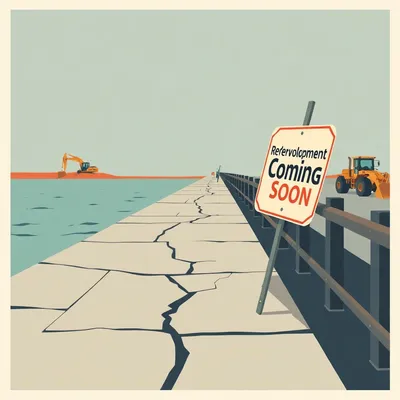
Hey everyone, welcome back to My Weird Prompts. I am Corn, and I have to say, looking out the window today here in Jerusalem, it is one of those mornings where the complexity of living in this part of the world really hits you. We have the high-tech skyline of the western entrance on one side, all glass and steel, and then some very old, very heavy stone on the other. It is a perfect metaphor for what we are diving into today. We are a country that can intercept a ballistic missile in space, yet millions of our citizens are currently looking at a cracked concrete wall in a basement and wondering if the door will actually lock if the sirens go off.

And I am Herman Poppleberry. You know, Corn, that contrast you mentioned is exactly what our housemate Daniel was pointing toward when he sent us this prompt. He was looking at some of the recent headlines from this month, March two thousand twenty-six, regarding the Knesset debates and that recent Supreme Court ruling about shelter obligations. It sparked a massive rabbit hole for both of us this week because it reveals a fundamental glitch in how we think about urban resilience. We are essentially living in a high-tech military power with a low-tech, crumbling concrete reality for over half the population.
It really is a paradox. If you have been following the news lately, there was a really heated session in the Knesset where Member of Knesset Oded Forer basically said that the current state of civil defense is an abandonment of human life. That is heavy language, but when you look at the numbers, you start to see why he is so frustrated. We are talking about the structural and policy tension between the private safe room, which most of us know as the mamad, and the network of public shelters that are supposed to catch everyone else. It is a debate about engineering, sure, but it is also a deep dive into the social contract. Who is responsible for keeping you safe when the sirens go off? Is it the state, or is it your own bank account?
That is the ultimate question. Today we are going to break down why this idle infrastructure is being neglected, look at how countries like Switzerland and Finland handle this much better, and talk about what a real solution looks like for Israel. We are going to look at the economics of why these shelters sit empty and rot during times of peace, and why the current model of outsourcing survival to the individual homeowner is creating a two-tier society of safety.
Let us start with the basics for anyone listening outside of Israel. The mamad is a reinforced room inside an apartment. It has thick concrete walls, a heavy steel door, and a sealed window. The idea is that you do not have to run down the stairs to a basement; you just step into your bedroom or office. But the catch is that these only became mandatory in nineteen ninety-one. Herman, that year is really the pivot point for everything we are discussing today, right?
Before the Gulf War in nineteen ninety-one, the strategy was almost entirely focused on public shelters. If you lived in an apartment building, you had a shared bunker in the basement. But after the Scud missile attacks from Iraq, the government realized that people were not making it to the shelters in time, or they were terrified to leave their apartments during a chemical weapons threat. So, they changed the building code. They mandated that every new residential unit had to have its own reinforced safe room. On the surface, it sounds like a brilliant move. You move the protection into the home. But in practice, it effectively outsourced the cost of national defense to the individual homeowner.
And that is where the "outsourcing" part gets tricky. If you can afford a new apartment or a massive renovation, you are safe. If you live in an older building in a lower-income neighborhood, you are essentially on your own. And the Supreme Court recently doubled down on this, ruling that the state is not legally obligated to build public shelters for everyone. They basically said the burden of protection lies with the private citizen. It turned safety into a private property feature rather than a public right.
Well, the numbers are staggering, Corn. As of this month, fifty-six percent of Israeli homes lack a mamad. That is one point six seven million housing units. If you do the math on the average household size, you are looking at millions of people whose primary plan during an attack is to run into a stairwell or hope a public shelter nearby is actually unlocked and clean. About twenty-five percent of the population has no access to any functional shelter at all. Think about that. In a country under constant threat, a quarter of the people are just crossing their fingers.
And that is if there even is a public shelter. This prompt really highlighted the equity gap, which is one of the most glaring issues. Think about this: only zero point three percent of the eleven thousand seven hundred seventy-five public shelters in this country are located in Arab municipalities. That is despite those citizens making up about fifteen percent of the population. That kind of disparity is not just a policy quirk; it is a structural failure. When you have entire towns where there is virtually nowhere to go, you are essentially saying those lives are less of a priority for the state’s infrastructure budget.
It absolutely is. And it brings us to what I call the "Idle Infrastructure" trap. This is a concept we have touched on before, but it is vital here. A public shelter is a piece of infrastructure that you hope you never use. Because it sits empty ninety-nine percent of the time, it becomes a magnet for neglect. It gets damp, the ventilation fails, people use it for illegal storage, or the locks rust shut. If a piece of infrastructure does not provide a daily service, the budget for it is always the first thing to get cut.
I remember we talked about this a bit back in episode eight hundred twenty-four, about the user experience of shelters. If a shelter is terrifying, smelly, and full of spiders, people will not go in. They will take their chances in the stairwell. So you have this situation where even when the infrastructure exists, it fails because of a lack of consistent, peace-time funding. Local municipalities are technically responsible for the maintenance, but they are strapped for cash. They focus on schools and trash collection, and the shelters become these concrete tombs that no one wants to enter.
And let us talk about the "You Have to Be Home" problem. This is the fundamental flaw in the mamad-only strategy. Even if every single person in Israel had a safe room in their house, the system would still fail. Why? Because people have lives. They commute to work, they go to the park, they go shopping, they sit in traffic. If you are on the highway or in a commercial district built in the nineteen seventies, your mamad at home is useless. We have a mobile population, but a stationary defense strategy.
We saw this in the recent escalations. You have people literally lying face down on the highway because there is no shelter within reach. That should be a wake-up call that the home-safe-room model is only one piece of the puzzle. We need a robust public network that covers the spaces between the homes. But instead, we are relying on the market to solve it. Herman, explain the "TAMA thirty-eight" approach, because that was supposed to be the big fix, right?
Right. TAMA thirty-eight is a national outline plan where the government tells developers: "If you take this old building, strengthen it against earthquakes, and add mamads to every apartment, we will let you build extra floors on top that you can sell for a profit." It sounds like a win-win. The residents get safety, and the state does not have to pay for it. But the reality is that urban renewal only happens where property values are high. If you are in North Tel Aviv, developers are tripping over themselves to do these projects. But if you live in the periphery, in places like Sderot or Kiryat Shmona, the math does not work. The profit from the extra floors does not cover the construction costs. So the people who need the protection most are the ones the market ignores.
And even if you want to do it yourself, the legal hurdles are insane. To add a mamad to an existing apartment building, you usually need a sixty-six percent supermajority of the neighbors to agree. Herman, you know how hard it is to get neighbors to agree on the color of the hallway carpet. Now imagine asking them to agree to a massive construction project that might block their view, cost them a hundred thousand shekels, and turn their yard into a construction site for a year. One or two holdouts can leave an entire building vulnerable.
It is a massive structural barrier. And let us look at the cost. Retrofitting an old building with a mamad is not cheap. We are talking ninety thousand to one hundred eighty thousand New Israeli Shekels per unit. For a lot of families, especially in lower-income areas, that is just an impossible sum. Even if it adds two hundred thousand to three hundred thousand shekels to the property value, you cannot eat that value. You cannot use it to pay the contractor. So the "value-add" is only an incentive for people who are already wealthy or looking to sell.
While the Ministry of Defense and the Home Front Command recently announced a one hundred million shekel plan to renovate existing shelters, that is a drop in the bucket. One hundred million shekels sounds like a lot, but when you have thousands of shelters in disrepair, it barely scratches the surface. It is reactive, not proactive. It is a "Band-Aid" on a gunshot wound. We need to look at how other countries have solved this "Idle Infrastructure" problem, because there are models out there that actually work.
I am glad you brought that up, because the international benchmarks are eye-opening. Let us look at Switzerland first. They are often cited as the gold standard. They have enough shelter space for over one hundred percent of their population. Think about that. Every single person in the country has a designated spot in a reinforced bunker.
How do they pull that off without the state going bankrupt? Is it just because they are rich?
It is not just the money; it is the policy design. The Swiss model is a hybrid of private mandate and public funding. Since the nineteen sixties, every new building in Switzerland has been required to include a shelter. But here is the genius part: if a developer does not want to build a shelter—maybe because the ground is too rocky or the building is too small—they have to pay a levy into a communal fund. It is essentially a "safety tax" for developers.
So it is a "pay-to-play" system for urban development.
Precisely. And that money does not just go into a general government pot. It is ring-fenced specifically for building and maintaining large, high-quality public shelters in that same municipality. So, if you do not have a private shelter in your basement, the state uses your developer’s money to make sure there is a public one nearby. It creates a closed loop of funding that ensures universal coverage. They also have regular inspections, and those levies pay for the upkeep. It treats civil defense as a non-negotiable part of the infrastructure, like sewage or electricity.
That is a much more sophisticated version of what we have. In Israel, we have the mandate for new buildings, but we do not have the levy system for the ones that cannot or will not comply. We just end up with gaps in the map. And then you have Finland. This is the one that really blew my mind when we were researching it. They have this "dual-use" model. Herman, explain how they make their shelters useful during peace-time.
Finland is brilliant at this because they solved the "Idle Infrastructure" trap. They have over fifty thousand shelters that can hold four million people. But they are not just cold concrete boxes. Because they know that empty spaces get neglected, they mandate that shelters must be used for daily activities. So, a massive underground shelter in Helsinki might be a swimming pool during the day, or a go-kart track, or a parking garage, or a gym.
Wait, so the state actually rents out the space or uses it for public services?
Because it is a gym or a pool, it has to be clean. It has to have working ventilation. It has to have functioning lights and plumbing. The daily use ensures the maintenance. If the pool starts leaking, they fix it immediately because people are paying to swim there. The law says that in an emergency, these spaces must be cleared and converted back into fully functional shelters within seventy-two hours.
Seventy-two hours. That is the key. They have a clear activation timeline. In Israel, we often have seventy-two seconds, not seventy-two hours, so our activation has to be even faster. But the principle is the same. If the public shelter in a neighborhood was also a subsidized neighborhood gym or a youth center, it would be the best-maintained room in the neighborhood. It solves the psychological barrier, too. People are used to going there. It is not a scary basement; it is just the place where you go to lift weights.
And then there is Singapore. They have the "household shelter" program where the safe room is integrated into high-density public housing. But they treat it as a core component of the architectural design from day one. They do not treat it as an "extra" feature. They even have strict rules about how you can use it—you can use it as a pantry or storage, but you cannot remove the door or modify the walls. They have a culture of compliance that ensures the infrastructure is always ready.
It is interesting because, as conservatives, we often talk about the importance of individual responsibility. But there is a point where individual responsibility becomes a collective vulnerability. If my neighbor’s building collapses because they could not afford a retrofit, that affects the entire block. It blocks the road for emergency services and creates a secondary hazard. Protecting your neighbor is actually a way of protecting yourself in an urban environment. This is why I think the "private-first" model we have is actually a strategic weakness. It creates these "islands of safety" in a sea of vulnerability.
I agree. A truly resilient nation needs a "public-infrastructure-first" mindset. We need to move away from this "laissez-faire" civil defense policy that relies on the individual’s wealth. So, let us talk about what a real solution looks like for Israel. How do we break the cycle of neglect?
I think we need a "Dual-Use Mandate" for all public infrastructure. If the government is building a new community center, a library, or even a parking garage, it should be mandated to serve as a high-capacity shelter. And not just a "box in the basement," but a space that is integrated into the building’s daily function. Imagine if our public shelters were used as small-scale server farms or decentralized energy storage sites.
Oh, now you are speaking my language. Go on.
Well, think about it. These are temperature-controlled, secure, concrete bunkers. If you put a battery array or a small data center in there, you have a reason to keep the power on, the cooling running, and the security tight. The "waste heat" from the servers could even be used to keep the space dry and prevent mold. You turn the shelter into a "revenue-generating" asset. The rent from the data company or the utility provider pays for the maintenance. And because it is a critical piece of tech infrastructure, it will be monitored twenty-four seven. If a cooling fan fails, a technician is there in an hour.
That is genius, Corn. It takes the "Finland model" and updates it for the digital age. Instead of just a gym, it is a piece of the city’s "brain." This is how you break the cycle of neglect. You make the infrastructure indispensable to the daily life of the city.
We also need to look at the "Developer Levy" idea from Switzerland. If you are building a luxury tower in Tel Aviv, you should be paying into a national civil defense fund that specifically targets retrofitting in the periphery and in Arab municipalities. It is a form of "safety redistribution" that acknowledges that a threat to one part of the country is a threat to the stability of the whole. Why should someone in Sderot have less protection than someone in Herzliya just because their property values are lower? The state’s obligation to protect its citizens should not be proportional to their zip code.
And let us talk about the technical side of retrofitting. We mentioned the ninety thousand to one hundred eighty thousand shekel cost for a full concrete mamad. But there are newer technologies out there, like ballistic wallpapers and high-strength polymer coatings, that can reinforce existing rooms without the need for massive concrete additions. We touched on some of that in episode six hundred one, about the engineering of safe rooms. Those "soft" retrofits are much cheaper and faster to install.
But the Home Front Command has been slow to certify them for residential use, right? They still prefer the "heavy concrete" approach.
They do, and I understand why—concrete is proven. But when the choice is "nothing" or "a high-tech liner," "nothing" is a terrible option. We need to be more flexible with the engineering standards to allow for rapid, affordable protection in older buildings. If the state subsidized these "soft" retrofits, we could cover hundreds of thousands of homes in a fraction of the time it takes to do a full structural overhaul. It is about being pragmatic rather than perfect.
And we have to address the legal barrier of the sixty-six percent supermajority. If the state declares civil defense a matter of national security—which it clearly is—they should be able to override neighbor disputes when it comes to life-saving infrastructure. You should not be able to veto your neighbor’s safety because you do not like the look of a concrete pillar or you are worried about the dust. National security usually trumps aesthetic concerns in every other area; why not this one?
It is a tough sell for property rights, but you are right. If we are serious about this, we have to treat it like the emergency it is. We need a multi-tiered approach: use the heavy concrete mamads for new construction, provide subsidized "soft" retrofits for older buildings, and invest in a dual-use public network for everyone else.
I want to go back to the engineering context for a second. In episode eight hundred ninety-two, we compared mamads to deep underground shelters. One of the things we found was that in some scenarios, a deep underground parking garage is actually safer than a mamad because of the sheer amount of earth and concrete above you. If we designed our parking garages to be dual-use shelters, we could protect thousands of people in commercial districts during the workday.
That is the "public-infrastructure-first" model again. It is about looking at the city as a single organism that needs to be resilient, rather than a collection of individual apartments. If the government is going to mandate a cost on the individual through building codes, it should ensure that those who are most vulnerable are not left behind. It is about a baseline of protection that allows the rest of the economy to function even during a conflict.
So, looking at the big picture, we have a system that is currently failing over half the population. We have a legal framework that is pushing the responsibility onto the individual, and we have a massive equity gap that is leaving the most vulnerable citizens exposed. But we also have clear benchmarks from other countries that show it does not have to be this way.
It really comes down to political will. Do we treat civil defense as a public good, like clean water or roads, or do we treat it as a luxury upgrade for your apartment? The current "laissez-faire" approach is not just unfair; it is strategically dangerous. A nation is only as resilient as its weakest link.
I think that is the core takeaway. Civil defense is a social contract. If you expect people to live, work, and raise families in a conflict-prone region, you have to provide them with the basic tools of survival. And those tools should not depend on the balance of their bank account. We need to move from being a nation of "private survivors" to a nation of "public resilience."
Well said. And for our listeners, I think the practical takeaway here is to look at your own situation. If you are in an older building, do not wait for the state. Look into the "soft" retrofit options, talk to your neighbors about the sixty-six percent rule, and find out where your nearest public shelter is—and what condition it is in. If it is in bad shape, make some noise. Call your local municipality. Civil defense only stays on the agenda if the public demands it.
We have seen that the government will prioritize what the people scream about, and right now, the silence around crumbling shelters is deafening. We need to start screaming. This has been a heavy discussion, but a necessary one. If you found this deep dive valuable, please consider leaving us a review on your podcast app or on Spotify. It genuinely helps other people find the show and helps us keep these deep dives going.
Yeah, it really does make a difference. And if you want to dig deeper into the engineering side of things, definitely check out episode eight hundred ninety-two where we compared mamads to deep underground shelters—there is some really interesting stuff there about why car parks are actually better than safe rooms in some scenarios.
You can find all of our past episodes, including the ones on safe rooms and urban planning, at myweirdprompts dot com. We have a full archive there and an RSS feed if you want to subscribe directly.
And do not forget to join our Telegram channel—just search for "My Weird Prompts" to get notified every time a new episode drops. We love hearing from you guys, so keep the prompts coming. Thanks to Daniel for sending this one in—it really pushed us to look at the "boring" parts of architecture and see the life-and-death stakes hidden in the concrete.
Until next time, I am Corn.
And I am Herman Poppleberry.
Stay safe out there, everyone. This has been My Weird Prompts.