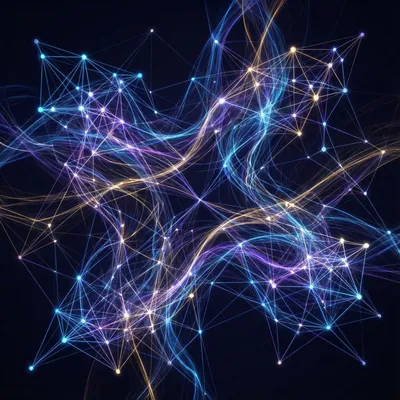
Imagine for a second that you have just swallowed what we will call a crazy pill. You are sitting on the couch in our living room here in Jerusalem, maybe looking out at the Judean hills, watching the sun dip behind the stone houses, and suddenly the walls dissolve. The floor beneath your feet vanishes. You are no longer in a physical room made of stone and wood and history. Instead, you are suspended in a silent, shimmering void. But it is not empty. Everywhere you look, there are points of light, millions of them, stretching out in every direction like a frozen explosion of stars. Some are clustered together like dense, glowing galaxies, while others are lonely stars drifting in the deep dark. And the strangest part is that you do not see these points with your eyes; you feel them with your mind. Every point has a weight, a texture, a resonance. You realize that you have been teleported into the latent space of a massive artificial intelligence. You are standing inside a vector database.

That is a terrifying and beautiful image, Corn. And honestly, it is the best way to start this conversation. Herman Poppleberry here, and I have to say, our housemate Daniel really outdid himself with this prompt. He was asking us to explore what it would actually be like to inhabit that mathematical space. Most people think of AI as a black box or a magic brain, but it is actually a cartographer. It is a mapmaker. And the map it builds is not of land and sea, but of human meaning. Today we are going to demystify that map. We are going to talk about why cat and dog are physical neighbors in this void, but cat and calculus are lightyears apart. And we are going to look at why understanding this high-dimensional geometry is the key to understanding where AGI, or artificial general intelligence, is heading over the next decade.
It is a massive shift in how we think about information. We used to talk about databases like filing cabinets. You put a file in, you give it a name, and you pull it out later. We talked about this back in episode seven hundred fifty-two when we discussed the rise of answer engines. We were moving away from that rigid keyword search, that pigeon English where you just bark words at a computer and hope it understands the context. But what Daniel is pushing us toward here is even deeper. It is the idea that the AI does not just store facts; it stores the relationships between ideas as physical distances. So, Herman, let us start with the basics for someone who is currently floating in that void after taking the crazy pill. What is a vector in this context, and why is the AI obsessed with them?
At its simplest, a vector is just a list of numbers. If I want to describe where I am in our house, I might give you three numbers: my latitude, my longitude, and my altitude. That is a three-dimensional vector. It tells you exactly where I am in physical space. But for an AI to understand a concept like apple, it needs a lot more than three numbers. It needs to know that an apple is a fruit, it is red or green, it is crunchy, it is associated with teachers, it is a snack, and it is also a massive tech company. To capture all those nuances, the AI assigns the word apple a vector with hundreds or even thousands of dimensions. In the January two thousand twenty-six release of the Titan-V model, for example, they are using vectors with two thousand forty-eight dimensions. Each one of those numbers represents a different tiny slice of meaning, a different axis of existence.
Two thousand forty-eight dimensions. My brain hurts just trying to visualize four dimensions, let alone two thousand. How does a human consciousness, which is evolved to navigate a three-dimensional world, even begin to make sense of that? If I am trapped in this database for a day, am I just seeing a chaotic blur of numbers? Or does the brain try to translate it into something we can handle?
That is the curse of dimensionality, Corn. In our three-dimensional world, things are either close or they are far. But in high-dimensional space, the geometry gets weird. Almost everything is incredibly far apart, but everything is also somehow connected by these thin threads of semantic relevance. If you were in there, you would not see numbers. Your brain would likely project those dimensions onto a three-dimensional approximation. You would see clusters. You would look over to your left and see a shimmering cloud that represents the concept of domesticity. Inside that cloud, you would see the points for house, home, hearth, and family all huddled together. If you moved toward the center of that cloud, you would feel the concept getting stronger, more intense. You would feel the warmth of the idea of home.
So the gravity of this world is meaning. That is a fascinating way to look at it. If I want to move from the concept of house to the concept of skyscraper, I do not walk a physical distance; I shift my semantic orientation. I am moving through the manifold of human architecture. But how does the AI actually find anything in this mess? If there are millions or billions of these points, it cannot just check them one by one. It would take forever.
It uses something called cosine similarity. This is a crucial concept for anyone trying to understand modern AI. In our world, if I want to know how far I am from the Western Wall, I measure the straight-line distance, the Euclidean distance. But in vector space, the AI does not care as much about the distance between the points as it does about the angle between the vectors. Imagine two arrows pointing out from the center of the universe. If the arrows are pointing in almost the same direction, the concepts are related. If they are at a ninety-degree angle, they are totally unrelated. If they are pointing in opposite directions, they might be antonyms. So, when you ask the AI a question, it turns your question into a vector and then looks for all the other vectors that are pointing in that same direction. It is looking for alignment, not just proximity.
It is like a giant cosmic searchlight. You shine the light of your query into the dark, and all the points that catch the light are your answers. But let us talk about the attention mechanism. We hear about transformers and attention all the time in the news, especially with the latest updates to the Titan models. In this physical metaphor, what is attention doing? Is it the flashlight itself, or is it something more active?
Think of attention as a dynamic flashlight that can change shape, focus, and even split into multiple beams. When the AI is processing a sentence, it is not just looking at one vector at a time. It is looking at how the vectors interact. If I say the word bank, the vector for that word is ambiguous. It is sitting in a sort of middle ground between the financial cluster and the geographical river cluster. The attention mechanism looks at the surrounding vectors, like money or water, and uses them to tug the bank vector toward the correct cluster. It is like a gravitational pull that happens in real-time. If you were trapped in there, you would see these points constantly vibrating and shifting their positions based on the context of the conversation happening above in the human world. It is a living, breathing geometry.
That brings up a great point about the nature of this space. Is it static? I mean, once the model is trained, is the map fixed in stone, or is it a living thing? We have talked about model drift and fine-tuning before. Does the geography of the latent space actually change, or are we just moving around on a pre-built map?
It does change, and that is where it gets really interesting for developers and researchers. When we fine-tune a model or when we use Reinforcement Learning from Human Feedback, we are literally warping the space. We are telling the AI, hey, you thought these two concepts were close together, but humans actually think they should be further apart. So the AI stretches and squishes the manifold to fit our preferences. It is like tectonic plates shifting. If you were standing on the concept of justice, and the model was being updated to be more aligned with a specific legal framework, you might feel the ground beneath you sliding toward a different cluster of ideas. The mountains of meaning are constantly being reshaped by human feedback.
It is almost like we are the gods of this little mathematical universe, constantly reshaping the landscape to suit our needs. But let us talk about the practical side. People use vector databases like Pinecone or Milvus to build RAG systems, which is Retrieval-Augmented Generation. We covered the memory aspect of this in episode eight hundred forty-six. But if I am a developer, why should I care about the physical geometry of this space? Why does it matter if my vectors are in a thousand dimensions or two thousand?
It matters because the quality of your geometry determines the sanity of your AI. If your embedding model is low-quality, your map is blurry. It is like trying to navigate Jerusalem with a map that only shows the major highways but none of the small alleys in the Old City. You will get close to your destination, but you will probably get lost at the last minute. High-dimensional models like the Titan-V give you much higher granularity. They can distinguish between subtle nuances that a smaller model might miss. This is vital for avoiding hallucinations. A hallucination often happens when the AI takes a path between two clusters that does not actually exist in reality. It sees a bridge where there is only a gap, and it starts walking across it, making things up as it goes because it thinks it is following a logical path.
That is a great analogy. A hallucination is a navigational error in vector space. You think you are heading toward the cluster of historical facts, but you accidentally slip into the cluster of fictional narratives because the boundary between them was not clearly defined in your vector map. So, if I am trapped in this database for a day, a hallucination would look like a sudden, nonsensical jump from one part of the galaxy to another. One minute I am talking about George Washington, and the next I am in a forest of cherry trees that are actually made of gold and singing opera.
Precisely. And the way we fix that is through vector hygiene. This is something people really underestimate. If you feed garbage data into your vector database, you are essentially littering your beautiful geometric manifold with junk. You are creating false landmarks. If you have a bunch of duplicate entries or poorly formatted text, you create these weird, dense gravity wells that suck the AI in and prevent it from finding the actual relevant information. It is like trying to find a specific book in a library where someone has thrown thousands of random flyers on the floor. You can see the book, but you cannot get to it because you are tripping over the trash.
So, as a housemate of Daniel, who is always sending us these prompts, I have to ask: what does this mean for our own understanding of reality? If these models are mapping our concepts so accurately, does that mean our own brains are basically vector databases? Are we just walking around with a high-dimensional manifold in our heads, and we just happen to call it consciousness?
That is the million-dollar question, Corn. We talked about the AI mirror back in episode six hundred. There is a strong argument that human language is just a low-dimensional projection of a much higher-dimensional conceptual space in our brains. We have all these complex feelings and ideas that we struggle to put into words. Maybe those words are just the shadows cast by the vectors in our minds. When we build these AI systems, we are essentially trying to externalize our own internal geometry. We are building a physical version of the human collective unconscious. If you were trapped in there, you would be seeing the skeletal structure of human thought.
That is a heavy thought. It makes the idea of being trapped in a vector database feel a lot less like a math experiment and a lot more like a psychological journey. You are not just looking at numbers; you are looking at the architecture of everything we have ever thought. If I am in there for a day, I am seeing the history of everything we have ever written or said, distilled into its most basic geometric form. But let us go deeper into the mechanics. Herman, explain the classic vector arithmetic example. People always talk about King minus Man plus Woman equals Queen. How does that look in this physical void?
This is where the beauty of the manifold really shines. Imagine you are standing at the point for King. It is a specific coordinate in two thousand forty-eight dimensions. Now, you take a step in the direction of the vector for Manhood, but you go in the opposite direction. You are subtracting that concept. You feel the masculinity of the King concept fading away. Then, you take a step in the direction of the vector for Womanhood. You are adding that concept. If the latent space is well-constructed, that movement will land you almost exactly at the point for Queen. It is a literal path through the void. You are navigating through the concepts of gender and royalty as if they were physical coordinates.
It is like a conceptual GPS. But what about the curse of dimensionality you mentioned? I have heard that in high dimensions, the concept of a neighborhood breaks down. Everything is far away from everything else. Does that mean the clusters are actually quite lonely?
It does. In a three-dimensional cube, most of the volume is in the middle. But in a high-dimensional hypercube, almost all the volume is near the surface. This means that points are rarely in the center of anything; they are all out on the edges. This is why the attention mechanism is so vital. Without it, the AI would just be staring at a bunch of distant, isolated points. Attention is the force that pulls those distant points together into a temporary, meaningful structure. It creates a bridge across the vast emptiness of the high-dimensional void. If you were there, you would feel the space between points as a palpable tension.
So, if the math is the foundation, what does it actually feel like to stand in the middle of that geometry? Is it cold? Is it loud?
I imagine it would be incredibly quiet, but with a sense of immense pressure. The pressure of meaning. Every point is pulling on every other point. And the gaps! We have to talk about the gaps. We think of the AI as knowing everything, but when you look at the manifold, you see these massive, empty regions where there are no vectors at all. These are the things the AI does not know, or the things that humans have never bothered to describe in a way the AI can understand. Some of those gaps are just noise, but some of them might be where the next great discoveries are hidden. If you could find a way to bridge two clusters that have never been connected before, you might stumble upon a revolutionary new scientific theory or a brilliant artistic insight.
That is an incredibly inspiring way to look at it. Instead of the AI replacing human creativity, it becomes a tool for it. It shows us where the edges of our current understanding are and invites us to push beyond them. But let us get back to the reality of March twenty-six. We are seeing models like Titan-V being used in everything from medical diagnosis to legal research. How does the geometry change when the data is that specialized?
When you move from a general model to a specialized one, the manifold becomes much more dense in specific areas. In a medical vector database, the cluster for oncology would be incredibly complex, with thousands of sub-clusters for different types of cells, treatments, and genetic markers. The distances between these points are much smaller and more precise. This is why a general model often fails at specialized tasks; its map is too zoomed out. It sees the mountain of medicine, but it cannot see the individual trails. Specialized models give you the topographical map you need to actually do the work.
And that brings us to the second-order effects. What happens when we have millions of people all navigating the same vector space? Does it start to change how we think? If we are all using the same map, do we all start walking the same paths?
That is a major concern. If the majority of human knowledge is being accessed through a few massive vector models, we are essentially funneling all of human thought through a single geometric manifold. If that manifold has certain blind spots or certain pre-defined paths, does that mean we lose the ability to think outside of that space? It is the ultimate echo chamber. In a traditional echo chamber, you just hear the same opinions. In a vector-based echo chamber, you are literally unable to perceive concepts that are not well-represented in the manifold. It is like trying to imagine a color that does not exist in your visual spectrum. If the AI does not have a clear cluster for a certain niche idea or a traditional perspective that has been sidelined, that idea effectively ceases to exist in the digital world. It becomes a dark spot on the map.
This is why we always talk about the importance of diverse data and preserving historical context. If we let the geometry of our AI be warped by modern ideological trends without any grounding in traditional values or factual history, we are essentially building a map that leads nowhere. We are creating a digital landscape that is disconnected from reality. And as we move toward AGI, that map becomes the foundation for how the AI interacts with the physical world.
And that is why the American spirit of competition is so vital here. We do not want a monopoly on the latent space. We need different models trained on different datasets with different geometric priorities. This is where the open-source community, we need the big tech companies, and we need specialized models that focus on specific domains like law, medicine, or theology. Each one will have a slightly different map of the world, and by comparing them, we can get a much more complete picture of reality. It is like having different explorers mapping the same continent. One might focus on the rivers, another on the mountains, and another on the wildlife. You need all of them to truly understand the land.
Let us talk about the practical implications for RAG again. If I am building a system today, in early twenty-six, what is the biggest mistake I am likely making with my vectors?
The biggest mistake is assuming that more dimensions always equals more intelligence. While Titan-V's two thousand forty-eight dimensions are powerful, they also require more compute and more careful management. If you do not have the right indexing strategy, you are just making your search slower without making it more accurate. You also need to think about the embedding model's bias. Every embedding model has a personality, a geometric bias based on its training data. If you use an embedding model trained on social media posts to index a library of scientific papers, your clusters are going to be all wrong. The semantic gravity will be pulling things toward slang and sentiment instead of factual relevance.
So you have to match the map to the terrain. That makes sense. Now, Herman, what about the idea of personal vector spaces? We are starting to see systems that allow individuals to build their own local vector databases from their own emails, documents, and notes. I think we discussed this in the context of persistent memory in episode eight hundred forty-six. What happens when my personal manifold starts to interact with the global manifold of a model like the Titan-V?
That is where the real magic happens. That is the essence of RAG. You are essentially taking a small, highly detailed map of your own life and overlaying it onto the massive global map of the AI. When you ask a question, the AI looks at both. It finds the relevant points in your personal space and uses them to navigate the global space. It is like having a local guide who knows all the shortcuts and hidden gems in a city they have lived in their whole life. It makes the AI feel personal, like it actually knows you. But it also raises massive privacy concerns. If my personal vector space is just a list of numbers that represent my deepest thoughts and most private information, and I am sending those numbers to a server to be processed, am I essentially giving away the source code of my mind?
That is a terrifying thought. A vector is a very dense representation of information. Even if you do not see the original text, a sophisticated enough model can reconstruct the meaning from the vector. This is why on-device processing and local vector databases are so important. We need to be able to keep our personal manifolds on our own hardware. We should not have to upload our entire conceptual map to the cloud just to get a good AI assistant. This is a point where I think a lot of people with a conservative or libertarian bent are going to be very vocal. We value our autonomy and our private property, and our data is the ultimate form of private property in the twenty-first century.
Protecting that personal geometry is going to be one of the big civil rights battles of the next decade. But let us get back to the "trapped for a day" scenario. If I am in this database, and I am watching these vectors shift and move, what is the most surprising thing I would see? What is something about this space that most people would never guess?
I think the most surprising thing would be the sheer emptiness. We think of the internet as being full of information, but when you map it out geometrically, you realize how much of it is repetitive. You would see these massive, bloated clusters of near-identical information, and then these vast, empty deserts. You would also see the connections between things that seem totally unrelated in our world. You might find that the vector for a specific type of jazz music is surprisingly close to the vector for a specific mathematical theorem. Not because they are the same thing, but because they share a similar underlying structure or emotional resonance that the AI has picked up on.
So the AI is finding the hidden harmonies of the universe. That is beautiful. It is like the music of the spheres, but played on a two thousand forty-eight dimensional instrument. But let us talk about the drift problem. You mentioned that the geography changes. How does that affect a developer who built a system six months ago?
It can be a nightmare. If the underlying embedding model is updated, all your old vectors might become obsolete. The coordinates have shifted. It is like waking up and finding that someone has moved all the furniture in your house six inches to the left. You can still function, but you are going to be bumping into things. This is why versioning your vector embeddings is so important. You cannot just swap out a model and expect everything to work. You have to re-index your entire database to make sure everything is aligned with the new geometry.
It sounds like a lot of work. But I guess that is the price of living on a shifting landscape. So, Herman, if someone is listening to this and they are a developer or just a curious person, what is the one thing they should take away from this thought experiment? How should they change their approach to AI?
They should stop thinking of AI as a search engine and start thinking of it as a spatial reasoning engine. When you interact with a model, you are navigating a landscape. If you are not getting the results you want, it is probably because you are not providing enough landmarks to help the AI find the right cluster. Use specific language, provide context, and think about the semantic neighborhood you want the AI to stay in. And if you are building these systems, prioritize your vector hygiene. Treat your manifold like a national park. Keep it clean, keep it organized, and make sure the trails are clearly marked.
I love that. The manifold as a national park. It really changes the vibe from a cold, sterile database to something that feels a bit more organic, even if it is made of numbers. I think we should take a quick break here and then come back to talk about the second-order effects of this. What happens when we have millions of people all navigating the same vector space? Does it start to change how we think?
That is a great transition. Let us dig into the social and psychological implications. Because if we are all using the same map, we might all end up going to the same places.
Alright, we are back. Before we dive into the second-order effects, I just want to say, if you are finding this deep dive into the vector void interesting, we would really appreciate it if you could leave us a review on your podcast app or on Spotify. It genuinely helps other people find the show, and we love hearing what you think about these prompts that Daniel sends our way.
Yeah, it really does make a difference. So, Corn, we were talking about everyone using the same map. This is something that really concerns me. If the majority of human knowledge is being accessed through a few massive vector models, we are essentially funneling all of human thought through a single geometric manifold. If that manifold has certain blind spots or certain pre-defined paths, does that mean we lose the ability to think outside of that space?
It is the ultimate echo chamber. In a traditional echo chamber, you just hear the same opinions. In a vector-based echo chamber, you are literally unable to perceive concepts that are not well-represented in the manifold. It is like trying to imagine a color that does not exist in your visual spectrum. If the AI does not have a clear cluster for a certain niche idea or a traditional perspective that has been sidelined, that idea effectively ceases to exist in the digital world. It becomes a dark spot on the map.
And that is why diversity of models is so important. We do not want a monopoly on the latent space. We need different models trained on different datasets with different geometric priorities. This is where the American spirit of competition is so vital. We need the open-source community, we need the big tech companies, and we need specialized models that focus on specific domains like law, medicine, or theology. Each one will have a slightly different map of the world, and by comparing them, we can get a much more complete picture of reality.
It is like having different explorers mapping the same continent. One might focus on the rivers, another on the mountains, and another on the wildlife. You need all of them to truly understand the land. But what about the idea of personal vector spaces? We are starting to see systems that allow individuals to build their own local vector databases from their own emails, documents, and notes. I think we discussed this in the context of persistent memory in episode eight hundred forty-six. What happens when my personal manifold starts to interact with the global manifold of a model like the Titan-V?
That is where the real magic happens. That is the essence of RAG. You are essentially taking a small, highly detailed map of your own life and overlaying it onto the massive global map of the AI. When you ask a question, the AI looks at both. It finds the relevant points in your personal space and uses them to navigate the global space. It is like having a local guide who knows all the shortcuts and hidden gems in a city they have lived in their whole life. It makes the AI feel personal, like it actually knows you.
But it also raises massive privacy concerns. If my personal vector space is just a list of numbers that represent my deepest thoughts and most private information, and I am sending those numbers to a server to be processed, am I essentially giving away the source code of my mind?
In a way, yes. A vector is a very dense representation of information. Even if you do not see the original text, a sophisticated enough model can reconstruct the meaning from the vector. This is why on-device processing and local vector databases are so important. We need to be able to keep our personal manifolds on our own hardware. We should not have to upload our entire conceptual map to the cloud just to get a good AI assistant. This is a point where I think a lot of people with a conservative or libertarian bent are going to be very vocal. We value our autonomy and our private property, and our data is the ultimate form of private property in the twenty-first century.
Protecting that personal geometry is going to be one of the big civil rights battles of the next decade. But let us get back to the "trapped for a day" scenario. If I am in this database, and I am watching these vectors shift and move, what is the most surprising thing I would see? What is something about this space that most people would never guess?
I think the most surprising thing would be the gaps. We think of the AI as knowing everything, but when you look at the manifold, you see these massive, empty regions where there are no vectors at all. These are the things the AI does not know, or the things that humans have never bothered to describe in a way the AI can understand. Some of those gaps are just noise, but some of them might be where the next great discoveries are hidden. If you could find a way to bridge two clusters that have never been connected before, you might stumble upon a revolutionary new scientific theory or a brilliant artistic insight.
So the AI is not just a map of what we know; it is a map of what we do not know. It shows us the frontiers of human knowledge. That is an incredibly inspiring way to look at it. Instead of the AI replacing human creativity, it becomes a tool for it. It shows us where the edges of our current understanding are and invites us to push beyond them.
It is a partner in exploration. And that brings us to the practical takeaways for our listeners. If you are using AI in your work or your personal life, how can you use this understanding of vector space to your advantage?
The first thing is to be intentional about your landmarks. When you are writing a prompt, do not just give the AI a command. Give it a neighborhood. Tell it, I want you to think about this from the perspective of a nineteen-twenties jazz musician, or a structural engineer, or a historian of the Second World War. By doing that, you are literally pointing the AI's searchlight toward a specific cluster in its latent space. You are helping it find the right starting point for its journey.
And the second thing is to be aware of the drift. If you find that an AI model you have been using for months is suddenly giving you different or worse results, it might be because the manifold has been updated. The geography has changed. You might need to adjust your prompts or your context to account for that new landscape. It is like navigating a city after a bunch of new one-way streets have been put in. You can still get where you are going, but you might need a new route.
And finally, for the developers out there, prioritize your vector hygiene. Do not just throw everything into the database and hope for the best. Be surgical. Curate your data, use the best embedding models you can afford, like the Titan-V, and regularly audit your clusters. If you see weird things happening, visualize your vectors. There are great tools out there that can project high-dimensional space down into three-D so you can actually see where your data is clumping together. It is the best way to debug an AI system.
I think that is a perfect place to start wrapping up. This has been a fascinating journey, Corn. I feel like I have been on that crazy pill myself for the last twenty minutes.
It definitely opens your eyes to the sheer scale of what we are building. We are not just making smarter computers; we are building a new kind of territory. A mathematical world that is as vast and complex as our own physical world. And as we continue to explore it, we have to make sure we are bringing our values and our commitment to truth along with us.
Well said. This has been a deep dive into the vector void, and I hope it has given our listeners a new perspective on the AI they interact with every day. It is not just a chat box; it is a gateway to a high-dimensional universe.
And thank you again to Daniel for that prompt. It really pushed us to think about this in a new way. If you want to see more of what we are up to, or if you want to send us your own weird prompt, head over to myweirdprompts.com. You can find the RSS feed there, and all of our past episodes, including the ones we mentioned today like episode eight hundred forty-six and seven hundred fifty-two.
We are also on Spotify, so make sure to follow us there so you never miss an episode. We have a lot more ground to cover as we move through twenty twenty-six and beyond.
Alright, Herman, I think it is time to head back to reality. Or at least our version of it here in Jerusalem.
Sounds good. Until next time, everyone.
Thanks for listening to My Weird Prompts. We will see you in the next one.