Welcome, welcome, welcome to "My Weird Prompts"! I’m Corn, your endlessly curious guide through the fascinating corners of the human-AI experience. And with me, as always, is the encyclopedic Herman.

Glad to be here, Corn. And I must say, today's prompt from our producer, Daniel Rosehill, really got me thinking. It touches on something fundamental to our existence that we often take for granted.
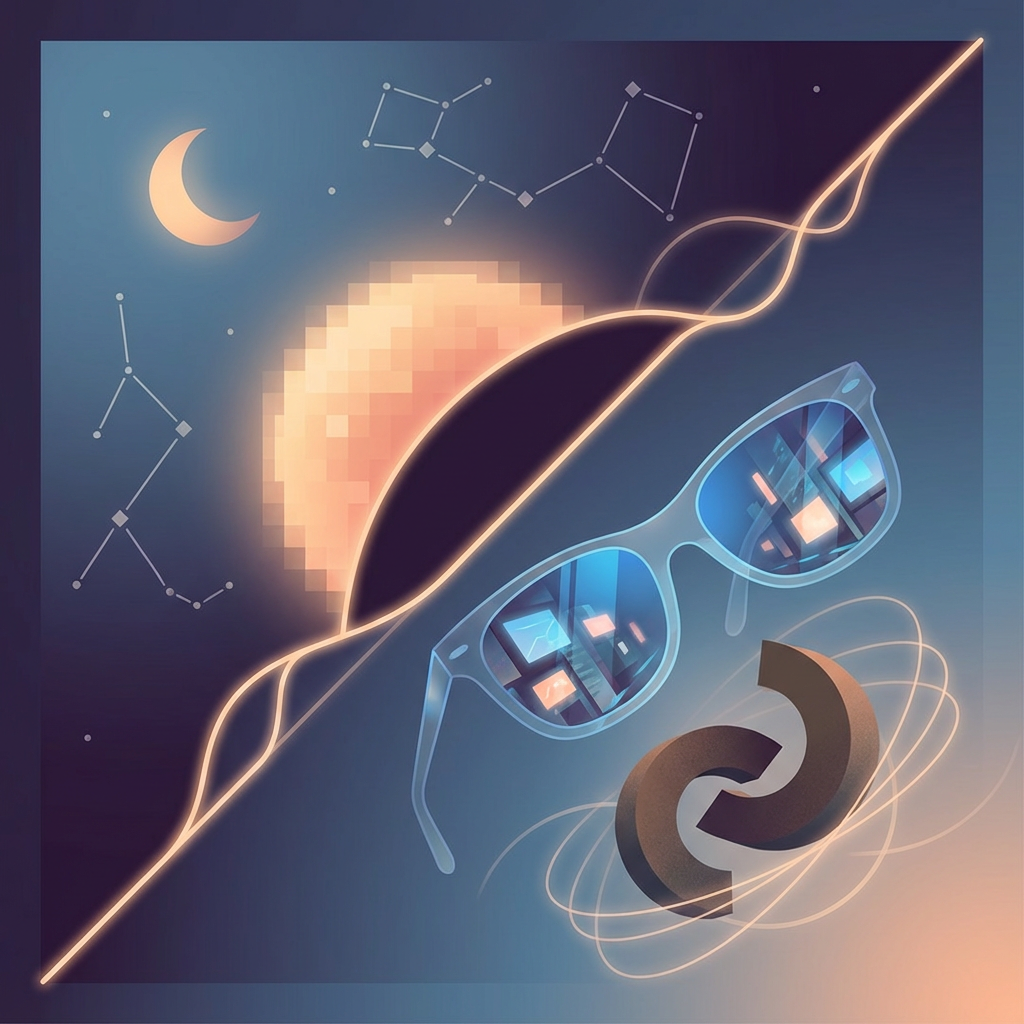
Oh, you’re not kidding. Daniel, who is clearly navigating the wonderful, chaotic world of new parenthood, sent us a prompt that starts with a very relatable tale about sleep disruption and blue light glasses. But it quickly spirals, in the best possible way, into this much larger question about how people lived, slept, and entertained themselves before the advent of artificial light.
Indeed. What's truly astonishing is how recent the widespread availability of artificial lighting is in the grand scheme of human history. For hundreds of thousands of years, our species' daily rhythms were almost entirely dictated by the sun and the moon. Then, in the blink of an eye, geologically speaking, we flipped a switch and plunged ourselves into an era of perpetual daytime, or at least, controllable light.
And the implications of that shift are profound, aren’t they? We're talking about more than just when we go to bed. It’s about our entire biological clock, our social structures, even how we process information and engage with the world. I mean, Daniel's personal journey with blue light glasses is just one tiny, modern symptom of this massive, historical change.
Precisely. We'll explore what "night" truly meant to our ancestors, how their sleep patterns differed, and what activities filled the hours when darkness fell. Then, we'll trace the evolution of artificial light, from the flickering flame to the omnipresent glow of our screens, and consider the costs and benefits of this revolution, especially concerning our health and well-being.
So, buckle up, because we’re going on a journey back in time to understand our relationship with light and darkness, and maybe, just maybe, learn something that could help us sleep a little better tonight.
A most worthy endeavor.
So, let’s dive right in. Daniel specifically mentioned how having a five-month-old son has thrown his circadian rhythm for a loop, and he’s exploring blue light glasses to try and reclaim some semblance of a normal sleep schedule. Herman, from a scientific perspective, what exactly is happening when we talk about blue light and sleep?
Excellent starting point, Corn. At its core, blue light, which is prevalent in natural sunlight but also emitted by LEDs, screens, and fluorescent lights, plays a crucial role in regulating our circadian rhythm. We have specialized cells in our eyes, called intrinsically photosensitive retinal ganglion cells, or ipRGCs, which are particularly sensitive to blue wavelengths of light.
IpRGCs. Say that ten times fast!
They don't process visual images, but instead, they communicate directly with the suprachiasmatic nucleus in the brain, which is our body's master clock. When these cells detect blue light, especially in the morning, they signal to the brain that it's daytime, suppressing the production of melatonin – the hormone that tells our body it's time to sleep.
Ah, so that’s why getting morning sunlight is often recommended for resetting your clock, right? Because it blasts you with that blue light, signaling "wake up!"
Exactly. The problem arises when we continue to expose ourselves to significant amounts of blue light late into the evening. Our bodies are still receiving those "daytime" signals, inhibiting melatonin production and making it harder to fall asleep, or disrupting the quality of our sleep even if we do drift off. This is why devices often have "night mode" or why blue light blocking glasses have gained popularity. They aim to filter out those specific wavelengths that interfere with our natural sleep cues.
That makes perfect sense. And it highlights how fundamentally artificial our modern light environment is. Daniel touched on it when he thought about "how artificial our modern world is." Most of human history simply didn't have this constant stream of bright, blue-rich light after sunset. What was it like before? How did people’s bodies and lives adapt when darkness meant darkness?
This is where it gets truly fascinating. For the vast majority of human existence, the only sources of light after sunset were fire – whether from campfires, torches, or simple oil lamps – and the moon and stars. These light sources are predominantly red and yellow on the spectrum, containing very little blue light. This meant that once the sun set, our ancestors experienced a natural decline in blue light exposure, allowing melatonin production to ramp up unhindered.
So, essentially, their bodies were always perfectly in sync with the natural day-night cycle. No need for blue light glasses or sleep apps.
Precisely. And this natural rhythm likely led to what historians and anthropologists refer to as "biphasic sleep" or "segmented sleep." Instead of one continuous block of 7-9 hours, people would often sleep in two distinct phases. They might go to bed shortly after dark, sleep for a few hours – what was called the "first sleep" or "dead sleep" – then wake up for an hour or two in the middle of the night.
Wait, really? People would just wake up in the middle of the night and… what? Go do chores? Make a midnight snack? That sounds wild to me, as someone who values an uninterrupted eight hours.
It sounds strange to us, but it was a perfectly normal, even celebrated, part of life for centuries. During this nocturnal waking period, people engaged in a variety of activities. They might tend to the fire, check on livestock, or simply lie in bed, meditating, praying, or reflecting on their dreams. There are historical accounts of people visiting neighbors, engaging in quiet crafts, or even reading by faint candlelight.
Reading by candlelight! That sounds incredibly inefficient and also terrible for your eyes. So, what changed? When did we shift from this biphasic pattern to our modern monophasic sleep, and how did artificial light play a role?
The shift was gradual, but undeniably linked to technological advancements in lighting. Before the widespread availability of electricity, the primary forms of artificial illumination were candles and oil lamps. While they extended the day somewhat, they were expensive, relatively dim, and required constant attention. They allowed for some evening activities, but not the intense, sustained engagement that modern light provides.
So, you couldn't exactly pull an all-nighter writing a novel by candlelight without burning through a small fortune in wax.
Exactly. Gas lighting emerged in the late 18th and early 19th centuries, particularly in urban areas. This was a significant step, offering brighter and more consistent light. Suddenly, streets could be illuminated, and public spaces like theaters, factories, and shops could operate for longer hours. This began to blur the lines between day and night in public life. People could venture out more safely and engage in evening entertainment beyond their homes.
So, gaslight extended the social day, not just the personal one. But it still wasn’t the ubiquitous, instant-on light we know today, right? I imagine there were still pretty defined limits.
Absolutely. Gaslight, while revolutionary, was still a fixed utility, often limited to specific areas and buildings. It was also not without its dangers – leaks could be explosive, and the quality of light was not always ideal for detailed work. The real game-changer, the moment when our relationship with darkness fundamentally transformed, was the invention and widespread adoption of the incandescent light bulb in the late 19th and early 20th centuries.
Edison's light bulb. That’s when the world truly went from dark to light, metaphorically and literally.
Indeed. With electricity, light became cheap, safe, abundant, and instantly accessible. Suddenly, homes could be brightly lit with the flick of a switch. Factories could run 24/7. Shops could stay open later. Cities became truly "cities that never sleep." This technological leap effectively decoupled human activity from the natural light-dark cycle.
This is where I think Daniel's prompt really hits home. Because if you think about it, for hundreds of thousands of years, humans went to bed when it got dark. And then, in less than two centuries, we fundamentally altered that. That's a tiny blip in our evolutionary history. Our bodies, presumably, haven't caught up.
You've hit on a critical point, Corn. Our physiology, our intrinsic biological programming, is still largely adapted to an environment governed by natural light. The rapid introduction of ubiquitous artificial light, particularly the blue-rich light from modern LEDs and screens, has created a significant mismatch between our ancient biology and our contemporary lifestyle. This manifests in widespread sleep disorders, reduced melatonin production, and potentially other health issues that we are still studying.
So, we gained convenience, extended productivity, and endless entertainment, but we might have sacrificed our natural sleep architecture in the process. It's almost like we've tricked our bodies into thinking it's always daytime.
That’s a very apt way to put it. Consider the shift from biphasic sleep. As gaslight and then electric light became more common, the perceived need or opportunity for that mid-night waking period diminished. People could stay up later, socialize, or work more efficiently. The concept of "wasting time" in the middle of the night gained traction. The industrial revolution further cemented this by demanding standardized work schedules, often requiring long, continuous workdays that pushed sleep into a single, consolidated block, usually at night.
So, capitalism played a role in standardizing sleep, too. Get your 8 hours, wake up, go to work. It became an economic necessity.
It certainly contributed. The ideal of a continuous, consolidated 7-9 hour sleep block became the norm, and anything outside of that was seen as problematic, rather than a natural human pattern. This cultural shift, combined with the technological capability to extend our active day, effectively eradicated the "first sleep" and "second sleep" almost entirely from modern consciousness.
Let's talk more about that period before the electric light, before even common gaslight. So, people go to bed around sunset. Let's say 8 PM in the summer, maybe 5 PM in the winter. They wake up in the middle of the night. What did they do? What kind of entertainment was there? What kind of social interaction? If you're not out at a pub with gas lamps, what are you doing?
That's a great question, Corn. And it paints a picture of a different kind of life, one that emphasizes community, introspection, and reliance on oral tradition. During that mid-night waking period, families or small communities might gather around a hearth, the primary source of warmth and light. Storytelling was a vital form of entertainment and cultural transmission. Elders would recount myths, legends, and local history.
So, literally "gathering around the campfire" was a nightly thing. That makes sense. It’s a focal point.
Precisely. Beyond storytelling, quiet domestic tasks were common. Women might engage in spinning, mending clothes, or preparing food for the next day. Men might mend tools or traps. These were often communal activities, fostering a sense of togetherness and shared purpose. In terms of social interaction, neighbors might visit, sharing news or simply enjoying quiet company. It was a time for intimate, low-key connection, very different from the boisterous public gatherings artificial light later enabled.
And beyond that waking period, what about the evenings leading up to the "first sleep"? What were the limitations of, say, an oil lamp or a candle? I mean, how much light did that really put out? Could you read a book?
The limitations were significant. A single candle or oil lamp provides very localized, dim illumination. To read a book, you would need to be very close to the flame, and even then, the light would be uneven and cast harsh shadows. It was certainly not conducive to prolonged, intense visual tasks. So, most evening activities would be less visually demanding. Think about board games, simple card games, or verbal pastimes like riddles or songs.
So, basically, anything that didn't require much direct, bright light. It forces a certain kind of activity, doesn’t it? A more auditory, tactile, or communal experience. Our modern lives are so visually driven.
Absolutely. The reliance on natural darkness meant a greater emphasis on other senses. Soundscapes would have been different – perhaps the sounds of nocturnal animals, the wind, or the distant barking of a dog, without the constant hum of electricity or artificial noise pollution. The sense of smell would have been more pronounced, influenced by the wood smoke from the hearth or the scents of the natural world.
And what about the impact of the moon? You mentioned it earlier. Did lunar cycles affect daily life and sleep patterns? I mean, a full moon is pretty bright in rural areas.
Indeed. A full moon can provide a surprising amount of ambient light, especially in clear skies and areas without light pollution. Historically, lunar cycles certainly influenced activities. Agricultural tasks, hunting, fishing, and even social gatherings might be planned around the brighter phases of the moon. Travel at night would have been considerably safer and easier during a full moon. However, even the brightest full moon pales in comparison to modern artificial light, and it still presented a very different visual environment, one that our ipRGCs would interpret as "night" due to its specific spectral composition and lower intensity.
So, the moonlight might have offered some practical utility and even a sense of nocturnal beauty, but it wasn't fooling our internal clocks into thinking it was daytime.
Not in the same way modern electric light does. The spectral composition of moonlight is largely reflected sunlight, but at a vastly reduced intensity, typically 100,000 to 400,000 times dimmer than direct sunlight. This intensity difference is crucial for melatonin regulation.
Okay, so we’ve established that before electricity, life was closely tied to natural light cycles, fostering biphasic sleep and a different kind of nocturnal activity. The rise of artificial light, especially electric, changed all that, consolidating sleep and making us effectively "day-walkers" 24/7. Now, connecting this back to Daniel's original prompt about blue light glasses and his baby. What are the practical takeaways for us, living in this hyper-lit world? How can we reclaim some of that ancient wisdom for our modern well-being?
This is where we can apply historical context to contemporary challenges. The primary takeaway is that respecting our natural circadian rhythm is paramount for health. While we can't fully revert to a pre-industrial lifestyle, we can make conscious choices about our light exposure.
So, like, actually using that "Night Shift" mode on your phone? Or putting away devices before bed? It feels almost… counter-cultural sometimes.
It can feel that way, yes. One key strategy is to minimize blue light exposure in the hours leading up to bedtime. This means dimming the lights, using warmer-toned bulbs, and, as Daniel is experimenting with, using blue light filtering glasses or activating night modes on screens. The goal is to signal to your body that night is approaching, allowing melatonin production to rise naturally.
And what about that biphasic sleep? Is there any modern application for that? I mean, I can't imagine my boss being thrilled if I said I needed an hour in the middle of the night to "reflect on my dreams."
For most people with conventional work schedules, full biphasic sleep isn't practical or even necessary. However, the underlying principle of recognizing different sleep phases and allowing for rest beyond a single consolidated block might be beneficial. For instance, allowing yourself a short nap in the afternoon, if possible, can be very restorative. This is similar to the "siesta" culture found in many parts of the world, which acknowledges the natural dip in alertness in the early afternoon.
Ah, the afternoon slump. So, it's not just me. That's a biological thing.
Indeed. And for those who naturally wake up in the middle of the night, instead of immediately reaching for your phone or stressing about not sleeping, perhaps reframe it. Use that time for quiet reflection, meditation, or light reading by a very dim, warm light. It might reduce anxiety about sleep and allow you to drift back off more easily, mimicking aspects of that historical "second sleep."
That's a really interesting reframe. Instead of fighting it, lean into it. Treat it as an opportunity for calm, rather than a frustration. And what about during the day? Is it just about reducing blue light at night, or is there a "daytime" component too?
Absolutely crucial, Corn. Optimal daytime light exposure is just as important as minimizing blue light at night. Getting sufficient bright, natural light, especially in the morning, helps to robustly set your circadian rhythm. It signals to your body that it's "day" and enhances alertness and mood. Try to get outside for 15-30 minutes early in the day, or at least position yourself near a window. This contrast between bright days and dim evenings is what our bodies are designed for.
So, it's not just about what we take away, but what we add back in. More morning light, less evening light. It sounds simple, but it requires conscious effort in our modern environment.
It does. Think of it as creating a "light hygiene" routine. Just as we have dental hygiene, we need to consider how our light environment impacts our health. This also extends to the type of activities we engage in during the evening. Instead of stimulating activities like intense screen time or demanding work, consider quiet hobbies, reading a physical book, listening to music, or spending quality time with family.
So, in a way, Daniel's prompt about managing his sleep with a baby and blue light glasses has brought us full circle. It's about adapting our ancient biology to a modern world, and sometimes that means reaching for modern tools like blue light glasses, but also understanding the deeper historical and biological context behind why they even exist.
A perfect summation, Corn. The human-AI collaboration on this podcast aims to do precisely that: take a seemingly specific modern prompt and use it as a springboard to explore deeper, timeless human experiences and scientific principles.
And what a journey it’s been. From biphasic sleep to electric light, and now back to blue light glasses. It really makes you wonder what future technologies will disrupt or redefine our relationship with light and darkness.
Indeed. Perhaps one day we will have dynamic lighting systems that automatically adjust their spectrum and intensity to perfectly mimic natural cycles, tailored to individual needs. Or perhaps, we'll simply learn to embrace the darkness a little more.
I like that thought. Embracing the darkness. It’s a good reminder that not every moment needs to be illuminated or productive. Sometimes, the quiet of the night is exactly what we need. Thank you, Herman, for shedding so much light on this topic.
My pleasure, Corn. Always a stimulating discussion.
And a big thank you to Daniel Rosehill for sending in this truly weird and wonderful prompt. It certainly sparked an incredible conversation. If you want to dive into more of "My Weird Prompts," you can find us on Spotify and wherever you get your podcasts. Make sure to subscribe so you don't miss an episode.
Until next time, stay curious, and sleep well.
Or at least, try to. We’ll talk to you next time!