Hey everyone, welcome back to My Weird Prompts. I am Corn, and I am sitting here in our living room in Jerusalem, which, thankfully, is relatively cool today, but we all know that is not going to last. We are currently in early February of twenty twenty-six, and even though it is winter, we just had that bizarre heat spike last week that reminded everyone exactly what is coming. I am joined, as always, by my brother.

Herman Poppleberry, at your service. And you are right, Corn. The Jerusalem summer is no joke, and the shoulder seasons are getting shorter every year. It is beautiful, but when that sun hits the Jerusalem stone buildings, they just soak up the heat like a giant thermal battery. It is great in the winter when you want that heat to radiate inward, but in July? It is like living inside a slow cooker.
Exactly. And our housemate Daniel actually sent us an audio prompt about this very thing. He was thinking about how we keep our spaces livable without breaking the bank or destroying the environment. He specifically mentioned something called Variable Refrigerant Flow technology, or V-R-F, and how it compares to the ancient ways people used to stay cool before electricity even existed. He is basically asking if we have traded wisdom for raw power.
Daniel always has a knack for hitting on those topics that sit right at the intersection of public health, engineering, and history. It is a great prompt because, in a place like this, cooling isn't just a luxury. If you are elderly or have certain health conditions, a heatwave can be genuinely dangerous. We saw the data from the twenty twenty-five heatwaves across the Mediterranean; the mortality rates in buildings without proper thermal management were staggering. It is a major public health crisis that we often treat as just a matter of personal comfort.
Right, and the way we usually solve it is by slapping those big, noisy white boxes on the side of every building. We see them everywhere here. Every apartment has its own little unit, or sometimes three or four of them. It is not exactly the most elegant solution, is it? It makes the streets louder and the air hotter.
Not at all. From an urban planning perspective, it is a bit of an eyesore. But more importantly, from an engineering perspective, those traditional mini-split systems are often quite inefficient when you look at the building as a whole. They are essentially either all the way on or all the way off. They are binary systems living in an analog world.
That is an interesting point to start with. Most people think their air conditioner is like a gas pedal where you can press it down halfway, but you are saying it is more like a light switch?
For traditional units, yes. Most standard air conditioners use a fixed-speed compressor. When the thermostat detects that the room is too warm, it kicks the compressor on at one hundred percent power. It runs until the room hits the target temperature, and then it shuts off completely. Then the temperature starts to creep back up, and the cycle repeats. That constant starting and stopping is incredibly energy-intensive. It is like driving a car by only using full throttle or the brakes, with nothing in between. You waste a massive amount of energy just overcoming the inertia of the motor every time it starts up.
That sounds like a recipe for a very high electricity bill and a lot of wear and tear on the machine. So, how does this V-R-F technology that Daniel mentioned change that dynamic? What makes it variable?
V-R-F is a bit of a game-changer, though it has actually been around in Japan since the nineteen eighties. The acronym stands for Variable Refrigerant Flow. The key word there is variable. Instead of that on-off switch approach, a V-R-F system uses an inverter-driven compressor. This means the system can adjust its speed to meet the exact cooling demand of the space at any given moment. If you only need a tiny bit of cooling to maintain the temperature, it runs at a very low, efficient speed. It is much more like a dimmer switch for your lights or a cruise control for your car. It maintains a state of equilibrium rather than a state of constant correction.
Okay, so it is more precise. But Daniel also mentioned per-room control. In a lot of the older buildings here, or even the newer ones with central air, you often have one big unit that cools the whole house. If I am in the office and you are in the kitchen, we are cooling the hallway, the bedrooms, and the living room all at once. How does V-R-F handle that?
That is actually its biggest strength. A single outdoor V-R-F unit can be connected to multiple indoor units, sometimes up to sixty or more in large commercial buildings, but even in a residential setting, you might have five or six. Each of those indoor units can be controlled independently. But here is the really cool part, Corn. In some advanced V-R-F systems, specifically heat recovery systems, you can actually cool one room while heating another using the same system simultaneously.
Wait, how is that possible? You are moving heat from one place to another, right? It sounds like you are breaking the laws of thermodynamics.
Not at all! It is actually a perfect application of thermodynamics. Think about the physics. An air conditioner doesn't actually create cold; it removes heat. It absorbs heat from the indoor air and dumps it outside. In a heat recovery V-R-F system, you have a component called a branch selector box. If the server room needs cooling because the computers are running hot, and the corner office needs a bit of heat on a chilly morning, the system can take the heat it removed from the server room and pump it directly into the office. It is incredibly efficient because you are recycling thermal energy rather than just venting it into the atmosphere. You are essentially using the waste of one room to fuel the comfort of another.
That is fascinating. It is like a thermal stock exchange within the building. But let's talk about the practical side for a second. Daniel mentioned the noise and the bulk of traditional units. One of the things I noticed about V-R-F when I was reading up on it is that the outdoor units seem much quieter. Why is that?
It goes back to that variable speed. Because the compressor isn't constantly slamming on at full power, it doesn't create that massive vibration and noise spike. It hums along at a much lower frequency. Also, because you have one larger, more sophisticated outdoor unit instead of six small, cheap ones, the manufacturers can invest more in high-quality sound dampening and more efficient fan blade designs. In a dense city like Jerusalem, reducing that ambient hum is a huge win for mental health. We often don't realize how much that constant low-frequency drone stresses us out until it is gone.
And I suppose for a city like Jerusalem, where we have these strict building codes about preserving the look of the stone, having one unit tucked away on a roof is much better than having a dozen units hanging off the balconies. It is almost like a preservation tool.
Absolutely. It preserves the architectural integrity. But we should address the elephant in the room, which is the cost. V-R-F systems are significantly more expensive to install than traditional split units. The piping is more complex, the electronics are more sophisticated, and you need specialized technicians to set it up. As of twenty twenty-six, the labor costs for these installs have actually risen because the technology is so specialized.
So is it actually worth it for the average homeowner? Or is this something that only makes sense for big hotels or office buildings?
It is a bit of a calculation. If you have a large home with many rooms that are used at different times, the energy savings over ten years can absolutely offset the initial cost. We are talking about energy efficiency gains of thirty to forty percent in some cases. Plus, there is the comfort factor. Because V-R-F maintains a very steady temperature rather than the big swings of an on-off system, the air feels much more consistent. You don't get those cold drafts followed by stuffy periods. It is about the quality of the air, not just the temperature.
I can see how that would be a major plus. But you know, as much as I love talking about high-tech inverters and refrigerant flow, Daniel’s prompt also pointed us toward the ancient world. It is easy to forget that people lived in this climate for thousands of years before Willis Carrier invented the modern air conditioner in nineteen hundred and two. How did they do it without burning a single watt of electricity?
This is where it gets really beautiful, Corn. The ancient methods were all about working with physics rather than trying to brute-force it with electricity. One of the most famous examples, which you can still see in places like Iran and parts of North Africa, is the wind catcher, or what they call a Badgir. These are architectural marvels that have been around for over two thousand years.
I have seen pictures of those. They look like tall, ornate chimneys with slats on the sides. How do they actually work? Is it just a fancy window?
It is a masterclass in pressure differentials and the Venturi effect. The tower is designed to catch even the slightest breeze high above the ground where the air is cleaner and cooler. It funnels that air down into the building. But here is the clever part: they often combined it with water. The air would be directed over an underground stream or a pool of water called a qanat. The water evaporates, which absorbs heat from the air. It is evaporative cooling, just like when you sweat. The air entering the living quarters could be ten or fifteen degrees cooler than the air outside. It is basically a zero-carbon air conditioning system.
That is incredible. No moving parts, no electricity, just clever architecture. And I imagine the thick stone walls we see in the Old City here play a role too? I have noticed that even in the middle of August, if you walk into one of those old vaulted houses, it feels like you are walking into a cellar.
Precisely. That is what we call thermal mass. Stone and earth have a very high heat capacity. They take a long time to warm up and a long time to cool down. In a traditional Jerusalem stone house, the walls might be a meter thick. During the day, the stone absorbs the heat from the sun, but it takes so long to penetrate that the interior stays cool. By the time the heat finally reaches the inside, it is nighttime and the outside air has cooled down. The building is essentially time-shifting the temperature.
So the building itself acts like a thermal buffer. It is like a giant battery, but for temperature instead of electricity.
Exactly. And then at night, you open the windows to let the cool air in, which flushes out the heat the stone absorbed during the day. This is why you see those beautiful lattice screens on windows in older Mediterranean and Middle Eastern buildings. They are called mashrabiya.
Right, I have seen those in the Muslim Quarter. They are very intricate wood carvings. Are they just for privacy, or is there a cooling function there too?
Both. The mashrabiya is designed to allow air to flow through while blocking the direct sunlight. But there is a secondary effect. Because the openings are small, the air has to speed up to pass through them. This is the Venturi effect again. Faster-moving air feels cooler on the skin because it increases the rate of evaporation of your sweat. Sometimes they would even place porous clay jars filled with water behind the lattice. As the air whistled through the screen, it would pick up moisture from the jars, creating a localized evaporative cooling effect right there in the window. It is a multi-stage cooling system made entirely of wood and clay.
It makes our modern approach feel a bit... I don't know, crude? We just build thin walls and then pump in massive amounts of energy to fight the environment. It is like we are at war with the sun.
It is definitely a different philosophy. Modern construction often prioritizes speed and cost over thermal performance. We use a lot of glass and concrete, which are terrible for heat management in a desert climate. Then we use V-R-F or traditional A-C to fix the problem we created with the architecture. But there is another ancient technology that really blows my mind, Corn. Have you ever heard of a yakhchal?
A yakh-what? Sounds like something out of a fantasy novel.
A yakhchal. It is an ancient Persian ice house. Imagine a giant mud-brick dome, sometimes sixty feet high, with a deep subterranean storage space. They used these to store ice in the middle of the desert during the summer. They would harvest ice from nearby mountains or even create it in shallow pools at night through radiative cooling, and then store it in these domes. The walls were made of a special mortar called sarooj, which was a mix of sand, clay, egg whites, lime, goat hair, and ash. It was incredibly heat-resistant. They were basically making ice in the desert four hundred years before Christ was born.
Egg whites and goat hair? That is definitely a weird prompt. But it shows that the ancients understood insulation on a level we are only just getting back to. So, looking at Daniel’s question about what we can learn from the ancient world, how do we bridge that gap? We are not all going to start building mud-brick domes in our apartment complexes.
Well, we can certainly adopt the principles. For example, passive cooling techniques are making a huge comeback in modern architecture. This means designing buildings with proper orientation to the sun, using high-performance insulation that mimics the effect of thick stone walls, and creating natural ventilation paths. We are also seeing the use of Phase Change Materials, or P-C-Ms. These are modern materials that can absorb and release thermal energy as they melt and solidify, acting like a high-tech version of that ancient thermal mass.
I have heard about cool roofs too. Is that part of this? It seems almost too simple to work.
It is a very simple concept, but incredibly effective. In the ancient world, people painted their houses white to reflect sunlight. A modern cool roof uses specialized reflective coatings to do the same thing. If the roof doesn't get hot, the top floor of the building doesn't get hot, which reduces the load on the air conditioning system. We are seeing cities like Los Angeles and even parts of Tel Aviv painting their streets with reflective coatings to combat the urban heat island effect.
Let's talk about that urban heat island effect for a moment. You mentioned it at the beginning. In a city like ours, or any major city facing rising temperatures, how does this technology impact the community? It is not just about my living room, right?
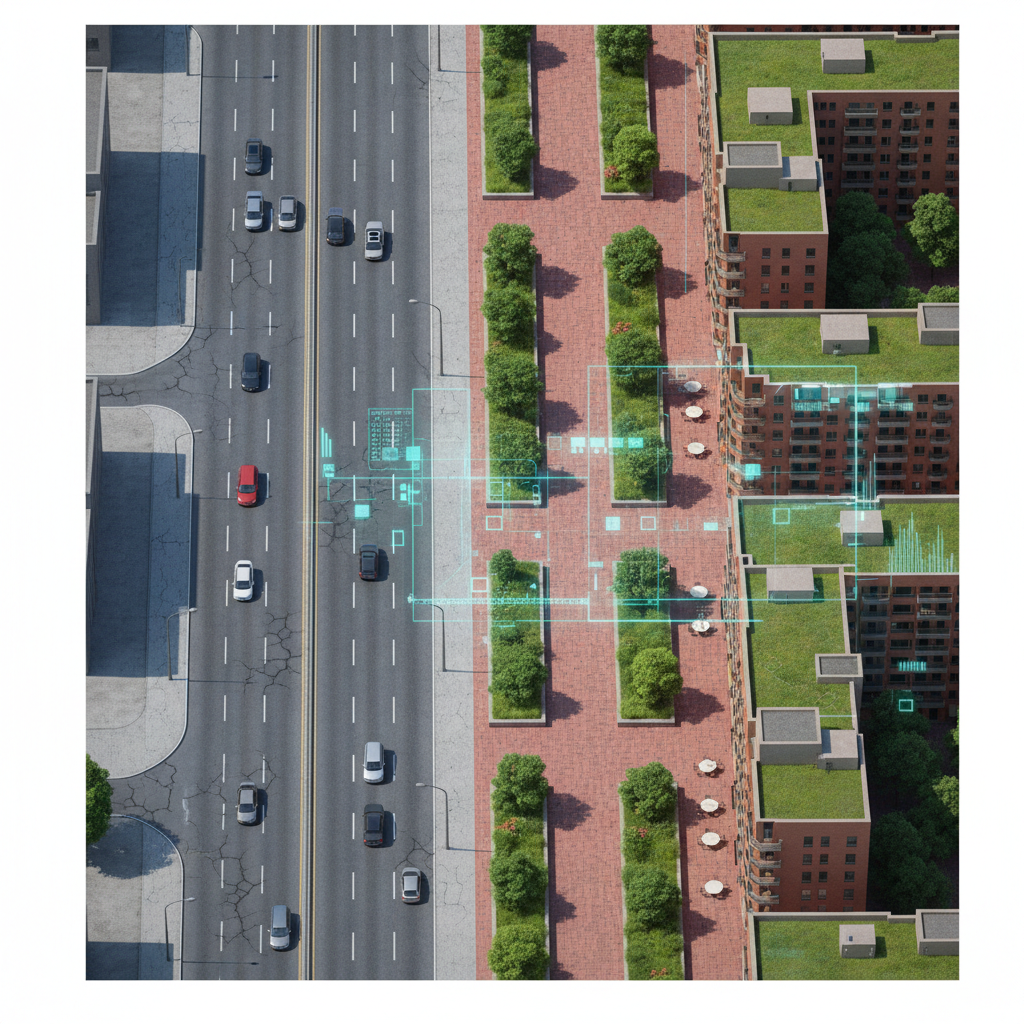
Exactly. All that concrete and asphalt in the city absorbs heat during the day and radiates it at night. Traditional air conditioners actually make this worse. They are essentially heat pumps that take heat from inside your house and dump it into the street. If everyone in a neighborhood is running an old, inefficient A-C, the street temperature can actually rise by several degrees. It is a vicious cycle. The hotter the street gets, the harder the A-C has to work, which makes the street even hotter.
So we are literally cooling ourselves by making our neighbors hotter. That seems like a recipe for social friction.
It is! And it is a public health issue. V-R-F systems help because they are so much more efficient. They move less heat for the same amount of cooling because they aren't wasting energy on that constant start-stop cycle. But the ancient methods are even better because they don't dump waste heat into the environment in the same way. Shading the streets with trees or architectural overhangs, for example, prevents the heat from being absorbed in the first place. We need to stop thinking about cooling as an appliance and start thinking about it as an ecosystem.
I think about the narrow streets in the Old City. Even on a boiling day, when you walk into those stone alleys, it feels ten degrees cooler. Is that just the shade?
It is the shade, but it is also the thermal mass of the buildings protecting the street itself. The buildings are so close together that the sun never hits the ground. The cool air from the previous night gets trapped in those narrow corridors. It is a collective cooling strategy. In modern suburbs, we do the opposite. We spread buildings out, remove the trees, and let the sun bake the pavement. We have traded collective comfort for individual control, and we are paying for it in our energy bills.
So we have lost the collective wisdom. But I am curious, Herman, if someone is listening to this and they are thinking about their own home, maybe they are in a hot climate and they want to be more efficient. What are the practical steps? Not everyone can afford a V-R-F system tomorrow, especially with the twenty twenty-six prices.
Right. The first step is always the passive stuff. It is the boring but effective things like sealing gaps around doors and windows. If your cool air is leaking out, you are just throwing money away. Second is shading. If you can stop the sun from hitting your glass windows, you will see a massive drop in temperature. External shutters or even just heavy curtains make a huge difference. In the ancient world, they used wet blankets over windows; today, we can use high-tech solar films.
And if they are looking at upgrading their A-C? What should they look for in twenty twenty-six?
If you are replacing a system, look at the S-E-E-R-two rating, which is the Seasonal Energy Efficiency Ratio. As of last year, the standards have gotten quite high. A V-R-F system is great if you are doing a major renovation or building a new house, but even a high-quality mini-split with an inverter is a massive upgrade over an old fixed-speed unit. Also, pay attention to the refrigerant. We are currently in the middle of a massive transition away from R-four-ten-A to refrigerants with lower Global Warming Potential, like R-thirty-two or R-four-fifty-four-B. Choosing a system with the latest refrigerant is better for the planet and ensures your system won't be obsolete in five years.
What about the maintenance? I have heard that V-R-F systems can be finicky because they use so much complex electronics. Is it like owning a European sports car?
That is a fair point. Because the system is more complex, if something goes wrong, you can't just call any handyman. You need someone who understands the specific logic boards and refrigerant sensors of that brand. However, because they don't have that mechanical stress of starting and stopping constantly, the actual compressors tend to last longer. It is a trade-off between electronic complexity and mechanical durability. In the long run, the reliability is actually quite high if the installation was done correctly.
It is interesting to see how the conversation around H-V-A-C has changed. It used to be just about how do we get this room cold. Now it is about how do we manage the thermal health of the entire building and the surrounding city. It is much more holistic.
It has to be. With global temperatures rising, we can't afford to be inefficient. We are seeing more and more innovation in this space. There is research into solid-state cooling that doesn't use refrigerants at all, using something called the electrocaloric effect. It uses electric fields to change the temperature of special ceramics. But for now, V-R-F is really the gold standard for high-efficiency active cooling.
You know, what strikes me is that the ancient people were essentially master physicists without having the formal terminology we use today. They understood convection, evaporation, and thermal mass just by observing the world and surviving in it.
They had to. It was a matter of survival. I think we went through a period in the mid-twentieth century where we thought we could just ignore nature because we had cheap electricity. Now we are realizing that was a bit arrogant. We are going back to those ancient principles and trying to enhance them with our modern technology. It is a synthesis of the old and the new.
It is like that old saying about standing on the shoulders of giants. We are using the wisdom of the ancient builders and adding a layer of sophisticated control systems on top of it. Imagine a building with meter-thick walls and a wind catcher, but the wind catcher has automated louvers controlled by an A-I that optimizes airflow based on the humidity, and then a small V-R-F unit kicks in only when the passive system can't keep up.
That is the dream, Corn. And honestly, it is becoming more of a reality. We are seeing these Net Zero buildings popping up that use exactly those kinds of strategies. They use the earth's natural temperature through geothermal loops, combine it with V-R-F for precision, and wrap the whole thing in a high-thermal-mass envelope. It is the future of sustainable living.
I would live in that house. It sounds incredibly peaceful. And quiet, too! No rattling window units or the roar of a massive central fan.
That is a huge part of it. We underestimate how much constant background noise from air conditioners affects our stress levels. There is actual research showing that chronic exposure to low-frequency noise from H-V-A-C systems can lead to increased cortisol levels and poorer sleep quality. It is a subtle but real public health issue. When you switch to a V-R-F system or a passive cooling method, the silence is one of the first things people notice. It changes the whole atmosphere of a home.
It is that aha moment when the hum stops and you realize how loud it actually was. Like when the power goes out and suddenly the house feels... still.
Precisely. It is like when you are hiking and you realize how quiet the woods are compared to the city. That silence is a form of luxury that we have forgotten.
So, we have covered a lot of ground here. We have talked about the mechanics of V-R-F, the brilliance of ancient wind catchers and thermal mass, and how we can combine these things for a more sustainable future. It is not just about being cold; it is about being smart.
It is a big topic. And I think Daniel was right to bring it up because it is something that affects every single one of us, especially here in Jerusalem where the history and the future are constantly bumping into each other.
Definitely. Before we wrap up, Herman, do you have any last technical nuggets for the listeners who might be planning a home build or a renovation? Anything they should ask their contractor?
I would say, don't ignore your insulation. People spend thousands on the most expensive V-R-F system but then have zero insulation in their roof. It is like buying a Ferrari and then driving it with the parking brake on. Your H-V-A-C system is only as good as the envelope it is working within. Also, ask about integrated controls. Some of the newer V-R-F systems can use occupancy sensors to only cool the rooms you are actually in, which takes that per-room control to the next level. And finally, check for local rebates. In twenty twenty-six, many governments are offering massive tax credits for switching to high-efficiency heat pump technology like V-R-F.
That is a great analogy. Keep the cool in, and you won't need nearly as much power to make it. Well, I think we have given people a lot to think about. This has been a really enlightening deep dive.
I enjoyed it. It is always fun to geek out on the stuff that usually stays hidden behind our walls and on our rooftops. It is the invisible infrastructure of our lives.
For sure. And hey, if you have been enjoying My Weird Prompts and you find these deep dives helpful, we would really appreciate it if you could leave us a review on your podcast app or over on Spotify. It genuinely helps other curious people find the show.
Yeah, it makes a huge difference for us. And remember, you can find all our past episodes, all four hundred ninety-six of them, at myweirdprompts.com. There is a search bar there if you want to look up other topics we have covered, from archeology to advanced computing.
We also have a contact form on the website if you want to send in a prompt like Daniel did. We are always looking for new things to explore, no matter how weird or technical they might be.
Thanks to Daniel for the prompt. It was a good excuse to talk about something other than the latest software updates for once. It is good to look at the physical world occasionally.
Absolutely. Well, stay cool out there, everyone, whether you are using a wind catcher or a high-tech V-R-F system.
Until next time!
This has been My Weird Prompts. Thanks for listening.