Welcome back to My Weird Prompts! I am Corn, and I am joined as always by my brother.

Herman Poppleberry, at your service. And we are coming to you from our home in Jerusalem, where the urbanism is, well, a very loud topic of conversation lately. Especially with the Green Line light rail, which has been in the works with recent test runs and is expected to transform the city soon.
It is a wild time to be a pedestrian here. We have test runs of the new trains humming past us, while areas like King George Street continue to see major transit improvements like the Blue Line. It is the perfect, albeit slightly chaotic, backdrop for today's prompt. Our housemate Daniel sent us a voice note about this. He has been thinking a lot about the way cities are built, especially since his wife, Hannah, is an architect and a serious urbanist. He has been feeling that frustration we all feel when we are stuck in traffic or walking along a sidewalk that just ends for no reason.
The classic sidewalk to nowhere. A staple of modern planning, unfortunately.
Exactly. Daniel mentioned that he tried to dive into the foundational stuff, like Jane Jacobs, but found it a bit dense for a casual start. He wants to know how a regular person can understand the principles of good urbanism and, more importantly, how to actually advocate for better city planning at a local level. He is looking for a reading list or some podcasts that make these big ideas feel accessible.
I love this because urbanism is the operating system of our lives. We spend almost all our time in the built environment, yet most people do not realize that the way a street is designed or where a grocery store is located is the result of specific policy choices.
Right, it is not just the way things are. It is a series of decisions. And you do not need a master's degree in urban planning to have an opinion on whether your kids can safely walk to school. But having the vocabulary to explain why it is unsafe makes you a much more effective advocate.
Spot on. So, let us start with the why. Why should a layperson care about urbanism beyond just wanting a shorter commute?
Well, the biggest aha moment for most people comes when they realize that urbanism is about the financial health and social resilience of a community. There is this misconception that suburban sprawl is a sign of a wealthy city. But if you look at the data, sprawl is often a massive financial liability.
That is the core argument of Strong Towns, my first big recommendation. Charles Marohn, the founder, is a former civil engineer who realized that the way we have been building since World War Two is essentially a Ponzi scheme. We build new roads with federal grants, but forty years later, the local tax base from those low-density houses is not nearly enough to cover the maintenance costs. If Daniel wants the latest on this, check out Marohn's Strong Towns principles, expanded in his recent advocacy on housing and zoning. It is a great follow-up to his original book, Strong Towns: A Bottom-Up Revolution to Build American Prosperity.
I remember when you first explained that to me. It really flipped my perspective. We think of the leafy suburbs as the ideal, but they are often subsidized by the dense, walkable downtowns that people claim are dying.
Exactly. And for the day-to-day experience, we have to talk about Jeff Speck. Daniel mentioned Jane Jacobs, whose book The Death and Life of Great American Cities is legendary but written in nineteen sixty-one. If that is the Old Testament, Jeff Speck's Walkable City is the New Testament. Daniel should specifically look for the tenth anniversary edition from 2020. It has a hundred pages of new material covering things like the impact of the pandemic on our streets and the rise of the reckless driver narrative.
Speck breaks down walkability into four simple criteria, right? For a person to choose to walk, the walk has to be useful, safe, comfortable, and interesting.
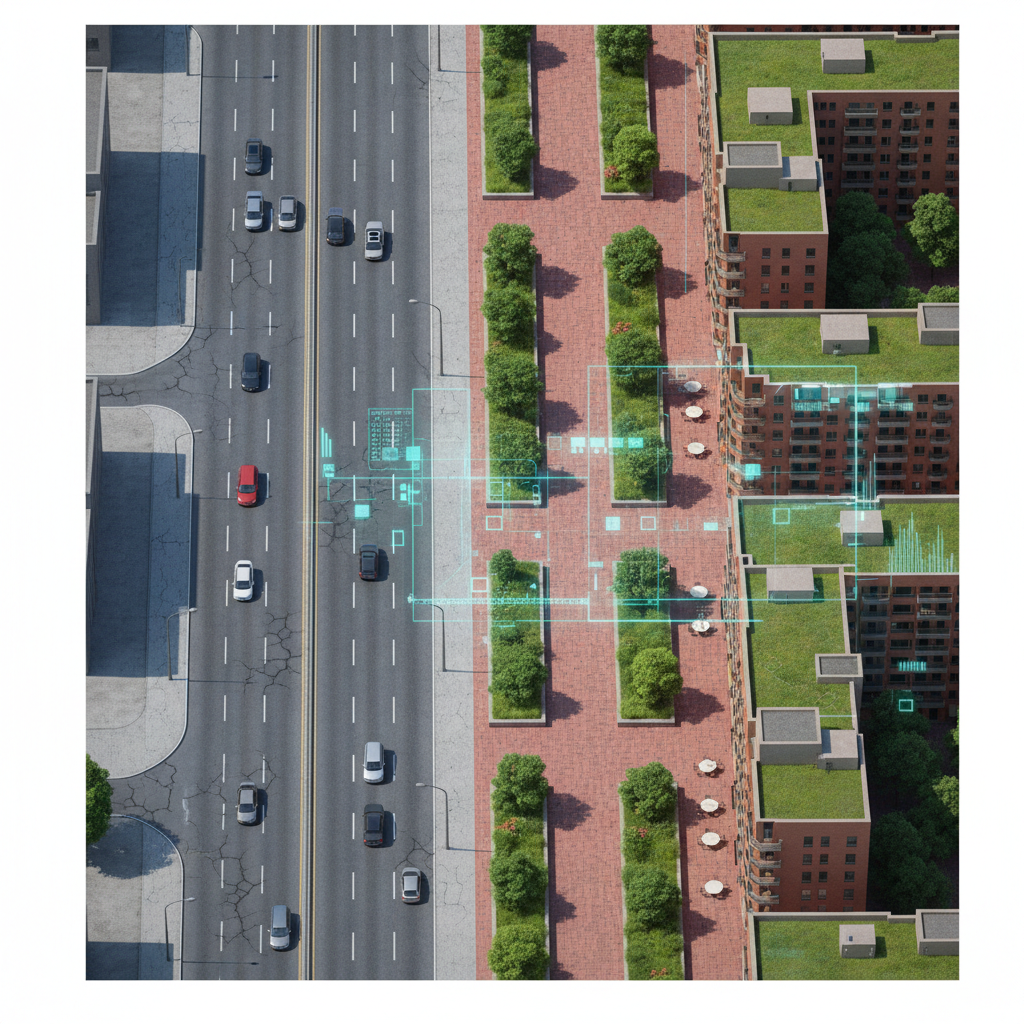
Right. Useful means there are actually places to go. If the nearest milk is a three-mile walk along a highway, that is a failure of zoning. Safe is about the physical design, which brings us to the Stroad. That is a term coined by Strong Towns. It is a cross between a street and a road. A road is a high-speed connection between two places. A street is a place where people and businesses interact. When you try to make a street act like a road, with wide lanes and high speeds, it becomes a Stroad. They are the most dangerous places in our cities because they have the complexity of a street but the speed of a highway.
We see that in Jerusalem all the time. Those wide boulevards where cars fly at sixty kilometers per hour right next to a narrow sidewalk. It feels hostile.
It is hostile! And that leads to comfort and interest. Comfort means you are protected from the elements, maybe by trees. Interest means you are not walking past a giant blank wall or a parking lot. You want shop windows and architectural detail.
So, if Daniel wants to advocate for his neighborhood, he can look at a specific street and ask: Is this useful? Is it safe? Is it comfortable? Is it interesting? If the answer is no, he now has a framework to explain to a city councilor exactly what is missing.
Exactly. And for the psychological side, I highly recommend Happy City by Charles Montgomery. He explores how urban design affects our mental health. Research shows that people who live on streets with less traffic have more friends on their block. It connects dry stuff like setback requirements to something we all care about, which is our own happiness.
That is a great point. Now, Daniel also mentioned being a useful advocate at the grassroots level. One of the biggest hurdles is the Missing Middle housing debate. Can you explain that?
For decades, many cities only allowed two things: single-family houses or massive apartment towers. The Missing Middle refers to duplexes, triplexes, and townhouses. These allow a neighborhood to have enough density to support a local grocery store or a frequent bus line without feeling like a concrete jungle.
And the advocacy part usually involves fighting against NIMBYism, or Not In My Backyard.
Yes. And for Daniel, I have a specific recommendation for the social justice side of this. He should read The Color of Law by Richard Rothstein to understand how government policy created segregated neighborhoods. But more importantly, he should read the sequel, Just Action, which Rothstein co-wrote with his daughter, Leah. It is a literal blueprint for concerned citizens on how to challenge those historical inequities at the local level. It is the perfect companion for someone who wants to move from learning to doing.
I love that. It makes the advocacy feel less like complaining and more like restorative work. Now, what about more modern media? Daniel asked for podcasts too.
The Strong Towns Podcast is a must. For a more cultural and political angle, The War on Cars is fantastic. It is often funny and very thoughtful about how the automobile has reshaped our world. And if he wants something visual, the YouTube channel Not Just Bikes is a phenomenon for a reason. Jason Slaughter breaks down things like filtered permeability and continuous sidewalks in a way that is incredibly easy to understand. Seeing a five-year-old in Amsterdam biking to school by themselves is a very powerful image for someone living in a car-dependent suburb.
I have seen those! They are great because it is hard to imagine a better world if you have never seen one. Now, let us talk about the fifteen-minute city concept. It has become a bit of a buzzword, and even a controversial one in some circles.
It is bizarre that it became controversial. The idea is simply that you should be able to meet most of your daily needs within a fifteen-minute walk or bike ride from your home. It is how every city was built for ten thousand years until about nineteen fifty. For Daniel's advocacy, this is a very easy concept to explain. Do you want to spend two hours a day in a car, or do you want a bakery and a library ten minutes away?
And the how often involves incrementalism. That is a huge Strong Towns principle. Don't try to fix the whole city at once. Find the smallest thing you can do to make a place slightly better, and do that.
Exactly. Like Tactical Urbanism. There is a book by that name by Mike Lydon and Anthony Garcia. It is the idea that you can use traffic cones, paint, and potted plants to test a new bike lane over a weekend. It moves the conversation from what if to look at this. It is the minimum viable product approach to city planning.
That feels very empowering. You are providing a proof of concept. So, to summarize for Daniel: Start with Walkable City for the design principles, Strong Towns and recent housing advocacy for the economics, and Just Action for the social advocacy.
And for the ears, keep The War on Cars and the Strong Towns Podcast on rotation.
Well, this has been a really deep dive. I hope this gives Daniel a good starting point. You don't need to be an architect like Hannah to have a voice in how your city is shaped.
Not at all. In fact, some of the best urbanists are just people who love their cities and want them to be better.
Before we wrap up, a quick thank you to Daniel for sending this in. If you are enjoying these deep dives, please leave us a review on your podcast app or on Spotify. It genuinely helps other curious people find us.
You can find all our past episodes and a contact form at our website, myweirdprompts.com. We are also on Spotify, of course. Thanks for listening to My Weird Prompts. I am Herman Poppleberry.
And I am Corn. Until next time, keep looking at those sidewalks!
And watch out for those Stroads!
See you at myweirdprompts.com.
Goodbye everyone!