You know Herman, sometimes I think we take the sheer scale of the world for granted. We sit here in Jerusalem, we click a link, and within milliseconds, a server in California or Singapore answers back. It feels like magic, or maybe just some ethereal cloud-based wizardry. But as our housemate Daniel pointed out in his message to us this week, it is actually a very physical, very heavy, and very wet reality.

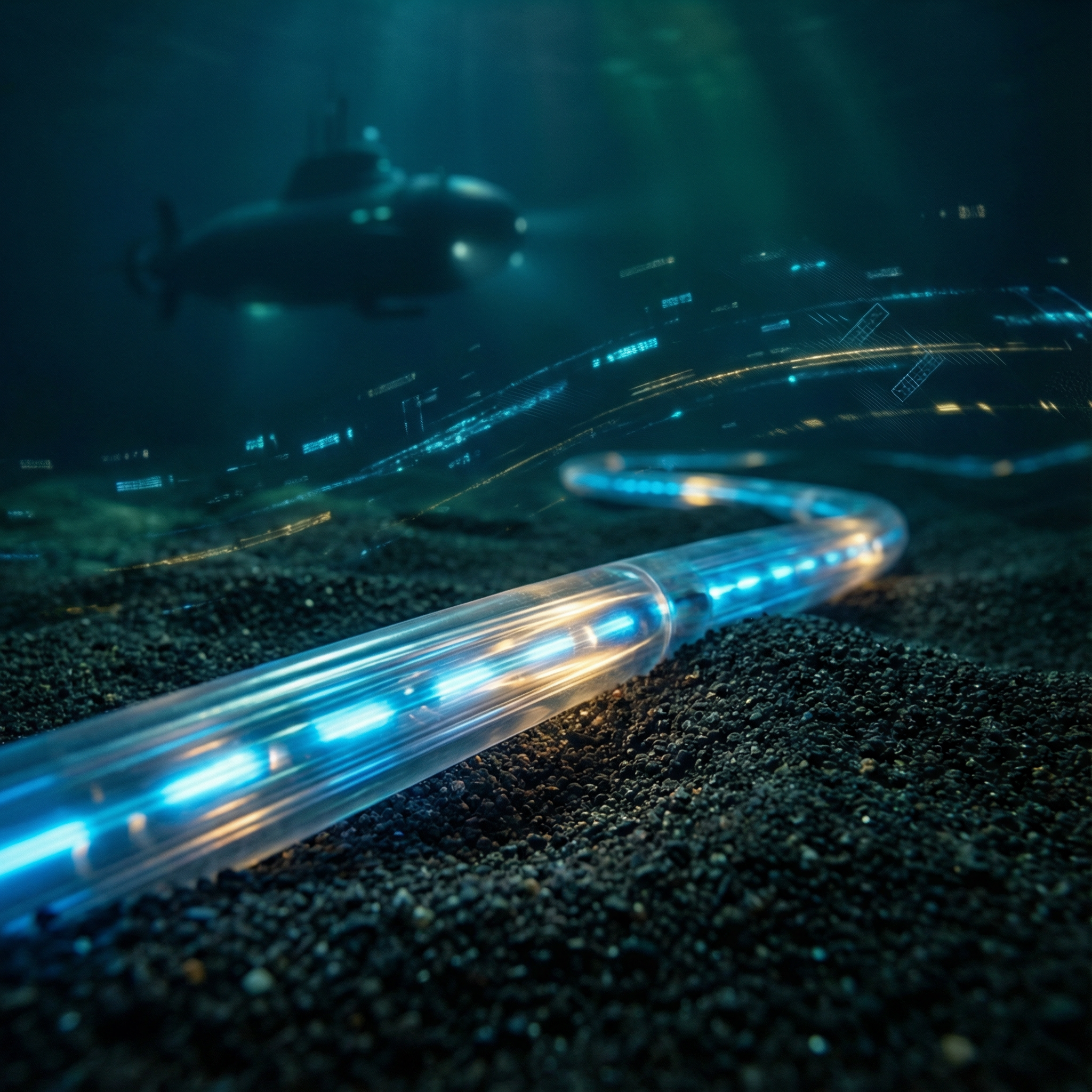
It really is. Herman Poppleberry here, and I have to say, Daniel really hit on one of my favorite topics. We are talking about hundreds of thousands of miles of cable resting on the actual floor of the ocean. It is the most impressive infrastructure project in human history that almost nobody ever sees. As of today, January thirty-first, twenty-six, there are over five hundred active subsea cable systems stretching across the globe. If you laid them all end-to-end, they would wrap around the Earth more than thirty-five times.
Right, and Daniel specifically wanted to know about the power. Because it is one thing to send light through a glass fiber, but it is another thing entirely to keep that signal strong across three thousand miles of Atlantic Ocean. You need repeaters. And repeaters need electricity. So, Herman, how do you plug in a cable that is five miles underwater?
That is the million dollar question, or really the multi-billion dollar question. Most people imagine that there is a power cord taped to the side of the fiber optic cable, or maybe that these repeaters have batteries that last twenty years. Neither of those is true. The power delivery system for transoceanic cables is a masterpiece of high voltage engineering that uses the entire Earth as part of its circuit. But before we get into the high-voltage weeds, we have to understand the history. This is not a new problem. We have been trying to power things under the ocean since the mid-nineteenth century.
You are talking about the original telegraph cables? The ones Cyrus Field laid back in the eighteen-fifties?
Exactly. Those early cables did not have repeaters because they were just sending simple electrical pulses. But they still faced the problem of resistance. The longer the wire, the harder it is to push electricity through it. Lord Kelvin, the famous physicist, actually worked on the math for this. He realized that a long cable acts like a giant capacitor, holding onto the charge and smearing the signal. It took us nearly a hundred years to move from those simple copper wires to the sophisticated optical systems we use today.
So, let us jump to the modern era. Why do we need repeaters at all? If we are using high quality fiber optics, does the light not just travel through?
Well, even the purest glass has what we call attenuation. Think of it like a fog. Even in very clear air, you cannot see a flashlight from fifty miles away. In fiber optics, the signal loses strength as it travels because the photons are absorbed or scattered by the atoms in the glass. Usually, every sixty to eighty kilometers, the light gets so dim that the data would be lost. So, you need a repeater, which is essentially an optical amplifier, to boost that signal back up and send it on its way to the next one.
Okay, so every fifty miles or so, there is a literal box at the bottom of the ocean that needs to stay powered on for decades without anyone ever touching it. How many of these are we talking about for a typical Atlantic crossing?
For a cable like the Grace Hopper or the newer Amitiie cable, you are looking at anywhere from eighty to over one hundred repeaters. Each one of those is a sophisticated piece of hardware that has to be perfectly synchronized with the others.
And these are not just little boxes, right?
Not at all. They are massive, pressure resistant housings made of high-strength steel or Beryllium Copper. Inside, they use something called Erbium Doped Fiber Amplifiers, or EDFAs. This is where the physics gets really cool. Instead of converting the light to electricity and then back to light, which would be slow and inefficient, they use a special piece of fiber that has been infused with ions of the rare-earth element Erbium.
Erbium? I do not think I have seen that on the periodic table since high school.
It is one of the lanthanides. When you hit those Erbium atoms with a specific wavelength of laser light—usually around nine hundred eighty or fourteen hundred eighty nanometers—it excites the electrons into a higher energy state. When your weakened data signal passes through that doped fiber, it triggers those electrons to drop back down, releasing photons that are identical to the ones in your signal. It is a chain reaction of light. But those pump lasers that excite the Erbium need a constant, extremely reliable source of direct current power.
And this is where the engineering gets wild. Because you cannot exactly run an extension cord from the shore for three thousand miles. The resistance alone would be astronomical.
Right. If you tried to send low voltage power over that distance, you would lose all of it to heat before you even got past the continental shelf. So, the engineers use a constant current, high voltage system. We are talking about anywhere from ten thousand to eighteen thousand volts of direct current. For the newest high-capacity cables being laid in twenty-twenty-six, we are pushing closer to that eighteen thousand volt limit to power more fiber pairs.
Eighteen thousand volts? That is intense. And you said it is a constant current system. Most of our home electronics are constant voltage, right? My wall outlet always gives me two hundred thirty volts here in Israel, and the device draws as much current as it needs. Why flip that for the ocean?
That is a great observation, Corn. In a transoceanic cable, the resistance is massive because the cable is so long. If you used a constant voltage system, any slight change in the cable's resistance—maybe due to temperature changes on the ocean floor or a small leak—would cause the voltage at the end of the line to fluctuate wildly, potentially frying the repeaters. By using a constant current, usually around one to one point five amperes, the Power Feed Equipment at the landing stations on either coast can adjust the voltage automatically to ensure that exactly the right amount of current is flowing through every single repeater in the chain, regardless of the distance.
So, it is like a series circuit. Like old Christmas tree lights where if one goes out, they all go out?
Precisely. They are all connected in one long loop. But here is the part that usually blows people's minds. Most cables only have one single conductor for power. A single tube of copper or aluminum.
Just one? But a circuit needs a path out and a path back. You need a positive and a negative. Where is the return path?
The return path is the ocean itself. And the Earth's crust. They use what is called an Earth Return or a Sea Return. At the landing station on one side of the ocean, say in New York, they have a massive electrode buried in the sea or the ground. On the other side, in London or Bilbao, they have another one. They pump the current into the cable, it goes through all the repeaters, and then it is dumped into the Earth at the far end. The current then flows back through the planet to complete the circuit.
That sounds like something out of a Jules Verne novel. You are telling me that when I send a WhatsApp message, there is a one amp current traveling through the literal crust of the Earth to power the amplifiers that carry my text?
It is absolutely true. Using the Earth as a return conductor is incredibly efficient because the Earth has almost zero resistance when you are dealing with such a massive volume. It also means you only have to pay for the weight and cost of one conductor inside the cable instead of two. When you are laying six thousand kilometers of cable, that weight savings is worth tens of millions of dollars. The electrodes themselves are often made of titanium with a special coating to prevent corrosion, and they are buried deep in the seabed to ensure a stable connection.
Okay, let us talk about the cable itself then. Daniel mentioned the electrical engineering at extreme depths. If we have eighteen thousand volts running through a cable at the bottom of the Atlantic, how do you stop it from shorting out into the salt water? Salt water is a fantastic conductor.
It is a nightmare for insulation. The construction of the cable is very specific. At the very center, you have the glass fibers. Around those, you have a protective plastic tube filled with a thixotropic gel. That gel is important because it keeps water from migrating down the cable if there is a small nick. Then, around that, you have the actual power conductor, which is usually a tube of copper or aluminum.
Wait, the conductor is a tube?
Yes, because it needs to be flexible but also strong. Around that copper tube, you have a very thick layer of high density polyethylene insulation. This is the critical part. It has to be perfectly manufactured with zero air bubbles or impurities. If there is even a tiny flaw, the eighteen thousand volts will find a way to jump through the insulation into the sea, and the whole system fails. This is known as a shunt fault.
And then outside of that insulation, you have the armor, right?
Only in shallow water. This is another misconception. In the deep ocean, where the cable is just resting on the silt, the cable is actually quite thin, maybe an inch or two in diameter. It does not need heavy steel armor because there are no fishing boats or anchors at four thousand meters. But as the cable gets closer to the shore, they wrap it in layers of galvanized steel wire and tar to protect it from the environment. In twenty-twenty-five, we saw a significant increase in the use of aluminum for that central conductor because it is lighter and cheaper than copper, which allows ships to carry more cable in a single load.
I remember reading about sharks biting the cables. Was that a real thing or just an internet myth?
It was a real thing in the nineteen eighties! The electromagnetic fields from the high voltage DC power actually mimic the bioelectric signals of distressed fish. Sharks would sense the cable and try to take a snack. Nowadays, they use specialized shielding and different types of polyethylene that do not attract them as much. Plus, the cables are often buried in the seabed near the coast where sharks are more common, so it is much less of a problem today.
So we have eighteen thousand volts, a constant current, and a return path through the center of the Earth. What happens if the cable breaks? If a tectonic shift or a massive underwater landslide snaps the cable, does the whole thing just die?
This is where the redundancy of the Power Feed Equipment, or PFE, comes in. Normally, the stations on both sides of the ocean work together in what is called a double-end feed. One side might push positive nine thousand volts, and the other side pulls negative nine thousand volts. This keeps the voltage relative to the sea floor lower in the middle of the ocean, which reduces stress on the insulation.
Oh, that is clever. It is like a tug of war where the middle point is zero.
Exactly. Now, if the cable snaps, the system detects the loss of current immediately. The Power Feed Equipment can then switch into what they call single-end feed mode. It will ramp up the voltage from one side to try and power the cable as far as the break. This allows engineers to use electrical measurements to find exactly where the break is. They use a technique called Electro-TDR, or Time Domain Reflectometry. They send an electrical pulse down the cable and measure how long it takes to bounce back from the break. Because they know the exact resistance and capacitance of the cable per kilometer, they can tell the repair ship almost exactly where to drop the hook.
I love the idea of these massive ships out in the middle of a storm, dropping a literal grappling hook to find a two inch wide cable miles below the surface.
It is incredibly precise work. Once they find the break, they bring both ends up, splice in a new section of fiber and a new section of conductor, re-insulate it with a portable injection molder, and drop it back down. But the electrical engineering of the repeaters themselves is also fascinating because they have to handle the pressure. At the bottom of the Atlantic, you are looking at hundreds of atmospheres of pressure.
How do you keep a box of electronics from being crushed into a pancake at those depths?
You don't just make a strong box; you make a pressure vessel. The repeater housings are usually shaped like long cylinders with hemispherical ends because that shape distributes the pressure most evenly. The seals where the cable enters the repeater are the most engineered part of the whole system. They use a series of ceramic and metal seals that have to be flexible enough to allow the cable to bend during deployment but strong enough to keep out water that is trying to get in at ten thousand pounds per square inch.
It is basically a submarine for lasers.
It really is. And these repeaters are designed to last for twenty-five years without a single failure. Think about the electronics we use every day. Your phone might last three years. Your laptop maybe five. These repeaters are sitting in a pitch black, near freezing, high pressure environment, powered by a circuit that uses the Earth as a return, and they just work, day in and day out, for decades. The failure rate for these components is measured in FITs, or Failures In Time, which is one failure per billion hours of operation.
You mentioned earlier that the current is about one ampere. Is that standard for all cables, or has it changed as we have moved into the era of massive data? Daniel was talking about his two point five gigabit home connection, but these cables are carrying hundreds of terabits per second. Does more data mean more power?
Interestingly, the power requirement has stayed relatively stable even as the data capacity has exploded, but we are reaching a tipping point. This is because the power is mostly used by those pump lasers I mentioned earlier. As laser technology has become more efficient, we can get more light for the same amount of electricity. However, the latest generation of cables, which we call Space Division Multiplexing cables, or SDM, are starting to push the limits.
Space Division Multiplexing. That sounds like a Star Trek term. What does that actually mean in this context?
In the past, we tried to cram as much data as possible into a single pair of fibers. But we hit a physical limit called the fiber non-linearity limit. Basically, if you put too much light into a tiny glass strand, the glass itself starts to distort the signal. So, the new strategy is just to use more fibers. Instead of eight or sixteen fibers in a cable, we are seeing cables like Google's Nuvem cable, which was announced a few years back, using much higher fiber counts.
And more fibers means you need more pump lasers in each repeater to amplify all those extra signals.
Exactly. And that is where the electrical engineering is hitting a wall. If you have forty-eight fibers, you need a lot more current or a much higher voltage to power all those lasers. But we are already at eighteen thousand volts. If you go much higher, the insulation has to get so thick that the cable becomes too heavy and too stiff to lay off a ship. So, engineers are now working on higher efficiency repeaters and even looking at ways to send power from both ends of the cable more effectively using advanced power sharing branching units.
It is amazing how every step of this process is a fight against physics. You are fighting the fog of the glass, the pressure of the ocean, the conductivity of the salt water, and the electrical limits of the insulation.
And don't forget the heat! Even though the ocean is near freezing, the repeaters generate heat from those lasers and the electrical resistance. Because they are encased in such thick pressure vessels and insulation, getting that heat out into the water is a major design challenge. If the repeater gets too hot, the lasers fail.
I never thought about a box at the bottom of the freezing ocean having an overheating problem.
It is a classic engineering irony. You are surrounded by a giant heat sink, but you have wrapped your device in so much protective gear that it cannot breathe. They use specialized thermal bridges, basically copper paths that lead from the internal electronics to the outer shell of the repeater, to wick that heat away. They even use the surrounding seawater to help cool the external housing, but they have to be careful not to create a temperature gradient that could crack the seals.
So, when Daniel is sitting in his room, downloading a game or watching a video, he is part of this massive, global electrical circuit. It really changes your perspective on the internet. It is not a cloud; it is a giant, high voltage, underwater machine.
It is the most tangible part of our digital lives. And the reliability is staggering. We only ever hear about it when a cable gets cut by an earthquake or a stray anchor, but the fact that ninety-nine percent of the time it just works is a testament to the electrical engineers who figured out how to use the Earth as a wire. In fact, there are over two hundred cable repair ships stationed around the world, ready to go at a moment's notice, but they are rarely needed for electrical failures—it is almost always external damage.
I am curious about the future of this. We are seeing more and more of these cables being laid by companies like Google and Meta rather than just traditional telecom companies. Are they doing anything differently with the power?
They are actually driving a lot of the innovation in the Space Division Multiplexing I mentioned. They want the highest capacity for the lowest cost per bit. One of the things they are exploring is the use of multicore fibers—where a single strand of glass has multiple cores inside it. This would allow for even more data without significantly increasing the power load on the repeaters. They are also looking at high-voltage DC converters that are even more efficient, reducing the amount of waste heat generated at the landing stations.
It always comes back to the ship, doesn't it? The physical act of laying the cable is the bottleneck.
Absolutely. A cable ship can only carry so much weight. If your insulation and your conductor are too heavy, you have to make more trips, and that costs millions. Every millimeter of thickness you can shave off that polyethylene insulation while still safely holding back eighteen thousand volts is a huge win. There is also the issue of the cable's own weight. In the deep ocean, the cable has to be strong enough to support its own weight as it hangs from the ship to the bottom, which can be five miles of vertical distance.
What about the landing stations? We have talked about the ocean floor, but what does it look like where the cable actually comes out of the water?
It is usually a very nondescript building near the coast. You would probably drive past it and think it was a small warehouse. But inside, it is a fortress. They have these massive Power Feed Equipment suites. These are essentially giant, highly regulated power supplies that take the local grid power, convert it to DC, and then use sophisticated electronics to maintain that constant current perfectly. They are often located in places like Bude in the United Kingdom or Virginia Beach in the United States.
I imagine they have some pretty serious backup systems.
Oh, incredible backups. They have giant battery banks and diesel generators that can kick in instantly. If the power to a landing station fails, the internet for an entire continent could be at risk. And they also have to deal with something called Ground Potential Rise.
That sounds like a geological event.
It is actually electrical. During a solar storm, or even just due to natural fluctuations in the Earth's magnetic field, the electrical potential of the Earth itself can change. This can create thousands of volts of difference between the ground in New York and the ground in London.
Wait, so the Earth itself can mess up the circuit?
Yes! During the Great Solar Storm of eighteen fifty-nine, the telegraph wires actually operated without batteries because the Earth's atmosphere was so electrically charged. In modern fiber optic cables, the Power Feed Equipment has to be smart enough to detect these earth currents and compensate for them in real time. If the Earth suddenly decides to push five hundred volts against your circuit, the power supply has to back off by five hundred volts to keep the current at exactly the right level. If it didn't, the current would spike and could damage the repeaters.
That is incredible. The system is literally dancing with the Earth's magnetic field just to keep our cat videos flowing.
It is a constant, invisible struggle. And I think that is what makes Daniel's question so great. We think of the internet as this new, high tech thing, but the power delivery is still rooted in these fundamental, almost nineteenth century concepts of high voltage DC and earth returns, just refined to an insane degree of precision. We are even seeing research into using these cables as giant sensors. Because they are so sensitive to changes in the Earth's magnetic field and pressure, scientists are using the power fluctuations in the cables to detect underwater earthquakes and tsunamis before they hit the shore.
It really makes you appreciate the sheer robustness of the system. We often hear about how fragile the internet is, but the physical layer—the part at the bottom of the ocean—is actually one of the most rugged things we have ever built. It is a three-thousand-mile-long machine that has to work perfectly in one of the most hostile environments on the planet.
It has to be. You cannot just send a technician down to fix a blown fuse at five thousand meters. Every single component is tested for months before it is deployed. They even do accelerated aging tests where they blast the components with heat and radiation to simulate twenty-five years of wear and tear in a few weeks. The reliability of the optical fibers themselves is also incredible—they are made of glass so pure that if the ocean were as clear as that glass, you could see the bottom of the Mariana Trench from the surface.
You know, it occurs to me that as we look toward putting more infrastructure on the Moon or Mars, we are going to be using a lot of these same principles. Long distance power delivery in harsh environments with no easy way to repair it.
Exactly. The lessons we have learned from the bottom of the ocean are going to be the blueprint for the first lunar power grids. Constant current, high voltage, and extreme reliability. Whether it is under the Atlantic or across the lunar regolith, the physics of moving energy across vast distances remains the same.
Well, Herman, I think we have thoroughly explored the weird in this prompt. From using the Earth as a return wire to sharks biting high voltage cables, it is a fascinating piece of engineering. It is a reminder that the digital world is built on a very physical foundation.
It really is. And I hope Daniel is satisfied with the answer. Next time you are on a Zoom call with someone on the other side of the Atlantic, just imagine that one amp current traveling through the silt and the rock beneath the waves, keeping those lasers pumping. It is a silent, invisible miracle happening every second of every day.
It definitely adds a bit of weight to every click. Before we wrap up, I want to say that if you out there are enjoying these deep dives into the plumbing of our world, we would really appreciate it if you could leave us a review on your podcast app. Whether it is Spotify or Apple Podcasts, it really helps other curious minds find the show. We are closing in on our four hundredth episode, and your support is what keeps us going.
Yeah, it makes a huge difference. And if you want to see more about what we do, or if you have a weird prompt of your own—maybe something about the engineering of the world that you have always wondered about—head over to myweirdprompts.com. There is a contact form there and you can see our full archive of past episodes.
We have covered everything from the bizarre to the highly technical, so there is plenty to explore. We also have some great diagrams of cable cross-sections on the website if you want to see that thixotropic gel for yourself.
This has been My Weird Prompts. Thanks to Daniel for the great topic, and thanks to all of you for listening. It is always a pleasure to dive into the deep end with you all.
Stay curious, and we will talk to you in the next one.
Goodbye everyone!