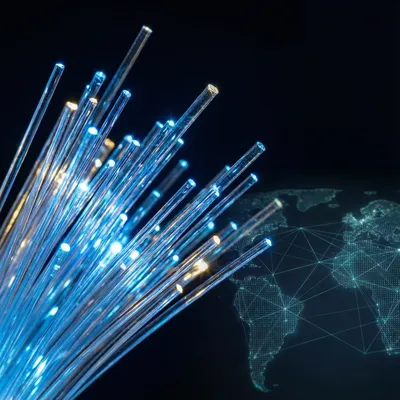
You know, Herman, I was walking through the hallway this morning and I nearly tripped over that massive coil of yellow fiber optic cable you left by the shoe rack. It made me realize just how much our house has turned into a miniature data center lately.

My apologies for the obstacle course, Corn. That is for the new backbone link I am setting up between the living room and the office. I am Herman Poppleberry, by the way, and yes, I am currently obsessed with light-speed data transmission. It is January thirty-first, twenty-six, and if you are not running at least ten gigabits between rooms, are you even living in the future?
Well, it is timely, because our housemate Daniel sent us a prompt about exactly that. He has been upgrading his own setup to two point five gigabit speeds and noticed that his new switches have these SFP ports, which are basically slots for fiber optic modules. He is asking a pretty fundamental question: is Ethernet just a last-mile technology that is eventually going to be phased out by fiber optics? Are we looking at a future where every device in the house is connected by glass instead of copper?
That is such a fascinating question because it touches on the friction between what is technically superior and what is practically viable. Daniel is right that the vast majority of the world's data travels over fiber. If you look at the backbone of the internet, the undersea cables, the connections between data centers, it is almost entirely fiber optics. Copper Ethernet, the stuff we usually think of as a network cable, really is the odd one out when you look at the global scale.
Right, and it feels like we are in this transitional period. For years, one gigabit per second was the ceiling for most home users. Now that we are pushing past that to two point five, five, or even ten gigabits in the home, the limitations of copper start to show up. But I wonder, is the transition to fiber inevitable? Or is there something about copper that makes it sticky in a way that fiber cannot replace?
That stickiness is exactly what we need to pull apart. To understand why we are not all using fiber to connect our laptops and refrigerators yet, we have to look at the physical properties of these two mediums. Fiber uses light, obviously. It is essentially a very pure glass or plastic strand that reflects light pulses down its length. Copper uses electrical signals. And that distinction creates a whole ripple effect of pros and cons.
Let us start with the big one Daniel mentioned: the SFP ports. For those who have not seen them, these are those little rectangular slots on high-end switches. You plug a module into them, and that module can be for a copper cable or a fiber cable. Daniel is seeing them used for chaining switches together. Why is fiber the preferred choice for connecting two switches, but not necessarily for connecting a computer to a switch?
Distance and interference are the two main reasons. Copper Ethernet, specifically the twisted pair cables we all know, has a hard limit of about one hundred meters, which is roughly three hundred and twenty-eight feet. Beyond that, the electrical signal just degrades too much to be reliable at high speeds. Fiber, on the other hand, can go for kilometers without needing a repeater. In a home, you are rarely hitting that one hundred meter limit, but you do deal with electromagnetic interference. If you run a copper cable next to a power line in your wall, the electricity can actually leak noise into your data signal. Fiber is immune to that because light does not care about electricity.
So, if I am running a cable from one side of the house to the other, maybe through the attic or near some heavy appliances, fiber is actually cleaner. But here is the thing that always stops me: the fragility. I can move my desk, yank on a copper Ethernet cable, accidentally step on it, and it usually keeps working. Fiber feels like I am handling a very long, very thin wine glass.
That is a common perception, and it used to be much more true than it is today. Modern fiber, especially what they call bend-insensitive fiber, is actually remarkably tough. You cannot tie it in a tight knot, but it can handle most of the curves and pulls of a standard home installation. The real issue is not the cable itself; it is the termination. If you want to put a connector on the end of a copper cable, you can buy a twenty-dollar crimping tool and learn how to do it in five minutes. If you want to terminate fiber optic cable yourself, you are looking at specialized tools, fusion splicers that still cost thousands of dollars, or very expensive pre-terminated cables.
And that brings us to the last thirty centimeters problem Daniel brought up. If I have a fiber optic port on my wall, how do I get that into my laptop? Most laptops do not have an SFP port. They barely have USB ports these days. We would need a whole new ecosystem of consumer hardware.
Exactly. And that leads us to the biggest reason why Ethernet—specifically copper Ethernet—is not going anywhere anytime soon: Power over Ethernet, or PoE. This is the absolute killer app for copper.
Right, we have talked about this before in the house. Our security cameras and our Wi-Fi access points do not have power plugs. They just have one Ethernet cable that carries both the data and the electricity to run the device.
Precisely. And in twenty-six, we are seeing the rise of PoE plus plus, the eighty-two point three bt standard. It can deliver up to ninety watts of power. That is enough to run not just a camera, but a large monitor, a laptop, or even high-performance Wi-Fi seven access points. You cannot send electricity through a glass fiber. Light carries energy, sure, but not enough to power a motorized security camera or a ninety-watt workstation. If we switched the whole house to fiber, every single device would suddenly need a separate power brick plugged into a wall outlet. That would be a massive step backward in terms of convenience and cable management.
That is a huge point. So even if the data speed of fiber is superior, the utility of copper as a power delivery system keeps it relevant. But let us look at the speed aspect for a second. Daniel mentioned two point five gigabits is becoming the standard. We are already seeing ten gigabit copper becoming more affordable. At what point does copper just hit a physical wall where it cannot go any faster?
It is a moving target. For a long time, people thought one gigabit was the limit for copper. Then came Category Six and Category Six-A cables, which can do ten gigabits over that same one hundred meter distance. Now we have Category Eight, which is rated for twenty-five or even forty gigabits, though only over shorter distances like thirty meters. The problem is that as you increase the frequency of the electrical signal to get those speeds, the cable has to be more heavily shielded, thicker, and less flexible. It becomes harder to work with and generates more heat, especially when you are pushing ninety watts of PoE through it.
So we are reaching a point of diminishing returns. A Category Eight cable is thick, stiff, and expensive. At that point, a thin, flexible fiber optic cable starts looking a lot more attractive, even if it cannot carry power.
Right. And this is where I think Daniel's parallel existence theory is most likely. We are moving toward a hybrid model. Think of it like the transition from spinning hard drives to Solid State Drives. For a while, you had a small SSD for your operating system and a big, slow hard drive for your files. In networking, the backbone—the link between your main router and your secondary switches—is increasingly going to be fiber. That is why Daniel is seeing those SFP ports. It allows you to move massive amounts of data between rooms without any bottleneck.
But the edge devices—the laptops, the smart TVs, the cameras—stay on copper.
Exactly. Copper is the convenience layer. It is easy to plug in, it is durable, and it provides power. Fiber is the performance layer. It handles the heavy lifting in the background. If you look at how a modern office or a data center is built, this is exactly what they do. They use fiber to connect the racks and the floors, and copper to connect the individual workstations.
I want to push back on the fragility thing again, though. Even if the cable is tougher now, the interfaces are still sensitive. If a speck of dust gets into a fiber optic connector, it can completely block the signal or cause massive errors. With an RJ-forty-five copper jack, you can basically blow on it like an old Nintendo cartridge and it is fine. Can you imagine the average consumer trying to troubleshoot a dirty fiber connection?
Oh, it would be a nightmare. I can already see the tech support calls. My internet is slow. Did you wipe the end of the glass with a ninety-nine percent isopropyl alcohol lint-free wipe? It is just not a consumer-friendly technology in that sense. Copper is chunkier and more forgiving. That physical robustness is a design feature that we often overlook when we are just comparing gigabits per second.
So, if we look ahead ten or twenty years, do you see any scenario where a breakthrough makes fiber the only choice? Maybe some kind of hybrid cable that has copper strands for power wrapped around a fiber core?
Those actually exist! They are called powered fiber or hybrid cables. They are used in some industrial settings or for outdoor cellular towers. But they are expensive and they require special connectors. For the home market, the cost would have to come down significantly. I think the more likely scenario is that Wi-Fi continues to eat the lunch of both copper and fiber for most consumer devices.
That is a great point. Most people do not even use the Ethernet port on their laptops anymore. They use Wi-Fi. And with Wi-Fi seven now being the standard in twenty-six, we are seeing real-world speeds that rival wired ten-gigabit connections.
Right, but what powers the Wi-Fi seven access point? A copper Ethernet cable with PoE plus plus. So, in a weird way, the more we rely on wireless, the more we rely on the specific strengths of copper Ethernet to support those wireless nodes. The last mile is not the cable to your laptop; the last mile is the air between the access point and your laptop. The cable to the access point is the second-to-last mile, and that is where copper is king.
I like that framing. It makes Ethernet feel less like a dying technology and more like a specialized tool that has found its perfect niche. It is not trying to be the global backbone; it is trying to be the ultimate delivery system for the last hundred meters.
Precisely. And if you look at the history of technology, obsolete mediums often hang around much longer than people predict. We still use coaxial cables for cable internet, which is a technology from the nineteen-forties. We still use twisted-pair copper for phone lines in some places. Ethernet is so deeply embedded in our infrastructure—in the walls of our homes, in the design of our chips, in the manufacturing of our devices—that it would take a monumental shift to displace it entirely.
Let us talk about that infrastructure for a second. If someone is building a new house today, or doing a major renovation, what should they be putting in the walls? Daniel is seeing these two point five gigabit switches with SFP ports. If I am Daniel, am I pulling fiber through my walls right now?
If I were building a house today, I would do both. I would run two or three Category Six-A copper cables to every room for the convenience and the PoE. Category Six-A is the real sweet spot because it handles ten gigabits perfectly and manages the heat of high-power PoE much better than older cables. But I would also run a smurf tube—that is the flexible blue plastic conduit—from my central closet to each major room. That way, if we do hit a point ten years from now where ten gigabit copper is not enough, I can easily pull fiber through that tube without tearing down the drywall.
That is the Herman Poppleberry special—future-proofing with a bit of plastic tubing. It is practical. But it also highlights the uncertainty. We do not know for sure if fiber will ever become a desktop technology.
We do not. But we do know that data demands only go in one direction, and that is up. Think about eighty-k video, or virtual reality headsets that need to stream massive amounts of data with zero latency. If you have a dedicated VR room, you might actually want a fiber connection directly to that headset to keep it light and fast.
That is a cool thought experiment. A fiber-optic tether for a VR headset would be much thinner and lighter than a copper one. You could move around more easily. But again, you would need a battery on the headset because you cannot get power through the fiber.
True, but we are already seeing headsets with battery packs. It is all about the trade-offs. The weight of the copper cable versus the weight of a battery.
I think this brings us back to Daniel's original observation. He is seeing fiber being used for chaining switches. That is the most logical first step. You have your main switch where the internet comes in, and then you have a satellite switch in your home theater or your office. Using fiber to connect those two hubs is a brilliant move because it keeps your inter-room traffic at maximum speed and zero interference, while letting your intra-room devices stay on easy-to-use copper.
Exactly. It is a hub and spoke model. Fiber for the hubs, copper for the spokes. And honestly, for ninety-nine percent of people, that is going to be the gold standard for a long, long time. Even as we move to ten gigabit and beyond, that architecture holds up.
What most people do not realize is that even the two point five gigabit standard Daniel mentioned is a bit of a compromise. It was created specifically so that people could get faster speeds over their existing Category Five-E cables that were already in their walls. It was a way to avoid the need for new cables. That tells you everything you need to know about how much people hate pulling new wire.
That is a great point. The industry spent years developing a way to squeeze more speed out of old copper just to avoid the fiber-to-the-desk transition. That NBASE-T technology, which gives us two point five and five gigabit speeds, is basically a testament to the resilience of copper. If we could have just switched to fiber easily, we would not have needed to invent it.
It is like the internal combustion engine. We keep finding ways to make it more efficient because the infrastructure for gas stations is already there. Changing to a whole new system, like hydrogen or electric, takes a lot more than just a better engine; it takes a whole new world of support.
I love that analogy. Ethernet is the internal combustion engine of networking. It is familiar, we have the gas stations—meaning the ports and the switches—everywhere, and we keep finding clever engineering tricks to make it faster. Fiber is like the electric motor. It is technically superior in almost every way, but we are still building out the charging network and the specialized tools to make it universal.
So, to answer Daniel's question directly: No, I do not think Ethernet is being phased out. I think it is being redefined. It is no longer the only way to move data, but it is becoming the primary way to deliver power and connectivity to the edge.
I agree. And I think we will see more and more hybrid devices. Maybe your next high-end workstation will have an SFP port alongside its standard Ethernet port. You choose based on your needs. If you are a video editor moving fifty-terabyte files, you plug in the fiber. If you are just browsing the web and want a reliable connection, you use the copper.
It is funny, because we always want there to be a winner in these technology battles. We want to say fiber won or copper is dead. But reality is usually much more messy and interesting. It is usually a coexistence.
A coexistence of mediums. That sounds like the title of a very boring textbook I would definitely read.
I am sure you have it on your shelf already, Herman. But seriously, this shift to two point five gigabit that Daniel is going through is a major milestone. It is the first time in twenty years that the standard home speed has actually moved. We were stuck at one gigabit for so long that we forgot what a transition feels like.
It is true. And it is exciting because it forces us to rethink everything. Is our router fast enough? Is our cabling good enough? Do we need to start thinking about SFP modules? For a nerd like me, this is a golden age.
And for someone like me, who just wants the Wi-Fi to work when I am in the kitchen, it is a bit of a headache. But I appreciate the depth you bring to this, Herman. It helps me understand why my hallway is currently a tripping hazard.
Again, sorry about the yellow cable. I will have it tucked away by dinner.
You better! But before we wrap up this part of the discussion, I want to touch on one more thing Daniel mentioned. He called Ethernet a last-mile technology. In the world of telecommunications, the last mile is often the most expensive and difficult part to solve. Do you think there is any chance that some other technology, like satellite or five-G, could eventually make all of this moot?
That is the wild card, isn't it? If Starlink or some future six-G cellular network can give us ten gigabits wirelessly with no latency, then the very idea of wiring a house starts to seem quaint. But we are nowhere near that yet. Physics is a harsh mistress. The density of data you can send through a physical wire or fiber will always be orders of magnitude higher than what you can send through the air, simply because you do not have to share the spectrum with everyone else.
Right, my cable is my cable. Your airwaves are everyone's airwaves.
Exactly. So as long as we keep demanding more data, we will keep needing physical paths for it. And for the foreseeable future, those paths will be a mix of glass and copper.
I think that is a perfect place to pivot into some practical advice. If you are like Daniel and you are looking at these new switches, what should you actually buy? Because those SFP modules are not all created equal.
Oh, definitely not. If you are getting into SFP, you need to know the difference between multi-mode and single-mode fiber. For a home, you almost always want multi-mode. It is designed for shorter distances—up to a few hundred meters—and the equipment is generally cheaper. Single-mode is what they use to connect cities. It can go for miles, but the lasers required are much more expensive and sensitive.
And then there is the Direct Attach Copper or DAC cables. Those are basically a copper cable with SFP connectors already permanently attached to the ends. They are great for connecting two switches that are right next to each other in the same rack.
Yes! DAC cables are the unsung heroes of the data center. They give you the speed of fiber with the plug and play simplicity of copper. If Daniel's switches are in the same room, he should just use a DAC cable. It is cheaper, tougher, and uses less power than a fiber module.
Wait, fiber uses more power? I would have thought the opposite.
It is a common misconception. To turn an electrical signal into light, and then back again, takes a surprising amount of energy. A fiber SFP module can get quite warm. A DAC cable is just copper, so it is passive—no power needed for the conversion. In a big data center with thousands of ports, that power difference adds up to a lot of money and cooling.
That is a great insider tip. Most people would assume fiber is the green choice, but for short runs, copper is actually more efficient.
Exactly. Specifics matter!
They really do. So, if we are summarizing the takeaways for our listeners: One, do not throw away your Ethernet cables yet. They are still the only way to power your devices easily. Two, if you are building or renovating, run conduit so you can add fiber later. Three, if you are connecting switches in the same room, look at DAC cables instead of fiber modules.
And four, do not be afraid of the SFP port! It looks intimidating, but it is just a universal slot that gives you options. It is the pro version of a network port.
I think Daniel is going to be happy with that. He is already ahead of the curve with his two point five gigabit setup. It is funny to think that in five years, we will probably be talking about how twenty-five gigabits is the new slow.
I cannot wait for that episode. Why is my eighty-k holographic projector working? Oh, it is only on a ten-gigabit link.
Do not give the manufacturers any ideas, Herman. We are still trying to get the Wi-Fi to reach the basement.
Working on it, Corn. Working on it.
Alright, I think we have covered a lot of ground here. From the physics of light versus electricity to the practicalities of power over Ethernet and the smurf tubes in our walls. It is clear that the death of Ethernet has been greatly exaggerated.
It is not dying; it is just getting a very high-speed roommate.
Well said. And hey, to everyone listening, we really appreciate you spending time with us in our nerdy little corner of Jerusalem. If you are enjoying these deep dives into the plumbing of the digital world, we would love it if you could leave us a review on your podcast app. Whether it is Spotify or Apple Podcasts, those ratings really help other people find the show.
They really do. And if you have your own weird prompt or a question about your home network—or anything else, really—head over to myweirdprompts.com. There is a contact form there, and you can also find the RSS feed for all our past episodes. We have done nearly four hundred of these now, so there is a good chance we have covered something else you are curious about.
Yeah, the archive is searchable, so if you want to know more about home automation or the history of the internet, it is all there. Thanks again to Daniel for sending this one in. It is always fun to geek out with my brother.
Always a pleasure, Corn. Even if you do trip over my cables.
I am watching my step from now on. This has been My Weird Prompts. We will catch you in the next one.
Until next time!
So, Herman, be honest. How many more kilometers of fiber do you have hidden in the attic?
Kilometers is a strong word. Let us just say I have enough to reach the Western Wall if I really needed to.
Of course you do. See you later, everyone.
Bye!