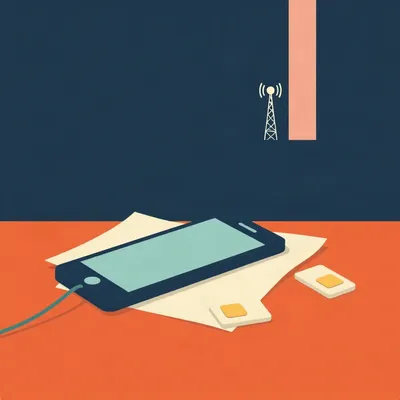
You know, I was looking at my desk the other day—cleaning out that one drawer that everyone has, the one where batteries and old cables go to die—and I found this tiny, translucent plastic tray with a little piece of metal inside. It looked like a relic from a different century, like a piece of a spacecraft that crashed in the nineties, but it was just a nano sim card from a couple of years ago. It is wild that we still carry these things around in twenty twenty-six. Welcome back to My Weird Prompts. I am Corn, and I am joined as always by my brother.

Herman Poppleberry, at your service. And yeah, Corn, that little piece of plastic is actually one of the most successful pieces of technology in human history if you think about it. It has survived through the transition from analog to digital, from two G to five G, and now into the early days of the six G research cycle. But our housemate Daniel sent us a prompt today that really hits on the absurdity of its continued existence.
Right, Daniel was telling us about helping his mom set up a tourist e-sim when she visited us here in Jerusalem last month. He said it took about three minutes from start to finish. You pay on an app, you scan a Q-R code, and boom, you are on the network. No waiting for a courier, no hunting for a kiosk at the airport, and definitely no fumbling with a paperclip to open a tiny, frustrating hole in the side of your phone. So his question is the one we have all been thinking: why on earth are we still using physical sim cards at all? Why has it taken so long for e-sims to take over, and why is it still so hard to find phones that fully embrace it?
It is such a great question because it touches on everything from hardware engineering to the deep, dark politics of mobile network operators. I have actually been looking into the history of the e-u-i-c-c—which is the technical name for the e-sim, standing for embedded Universal Integrated Circuit Card—and the story is much more about corporate control than it is about the limits of technology.
That makes sense. I mean, the technology for an embedded sim has been around for over a decade, right? I remember we had it in smartwatches and some tablets back in twenty fifteen or twenty sixteen. So, if the tech was ready, what was the hold up? Was it just the carriers being stubborn, or was there a technical wall we hit?
Stubborn is a polite way to put it. Think about what a physical sim card represents to a carrier. It is a physical anchor. It is a piece of their property inside your device. For decades, the sim card was the primary way carriers enforced what we call friction. If you wanted to switch from one carrier to another, you had to physically go to a store, or wait for a card in the mail, or deal with a salesperson who would try to talk you out of leaving while you stood there awkwardly.
So it was essentially a physical manifestation of a lock-in strategy. If switching is hard, people stay. If switching is a button press in an app, the carriers lose that leverage. It is like the difference between canceling a gym membership in person versus clicking unsubscribe on a newsletter.
Exactly. There was a huge amount of pushback from the major mobile network operators when the G-S-M-A, the global organization that sets these standards, first started pushing for e-sim. The carriers knew that if customers could jump between networks as easily as they change their wallpaper, the price wars would be brutal. They would lose that captive audience. In fact, back in twenty eighteen, the United States Department of Justice actually investigated several major carriers for allegedly colluding with the G-S-M-A to prevent the adoption of e-sim technology. They were worried it would make switching too easy and hurt their bottom line.
I remember that investigation. It is fascinating how a piece of plastic the size of a fingernail becomes a legal battleground for the Department of Justice. But even beyond the carrier politics, there is the hardware side. Daniel mentioned that it is still relatively difficult to find e-sim capable handsets, or at least, it feels like it has taken a long time for them to become the standard. If you are an engineer at a company like Samsung or Apple or Google, why wouldn't you want to get rid of the sim tray immediately? That is a lot of internal space being wasted in a device where space is at a premium.
Oh, you are preaching to the choir there. From a design perspective, the sim tray is a nightmare. It is a hole in the side of the device. That means you need a mechanical ejector, you need a gasket to keep it waterproof, and you need a dedicated slot on the motherboard to read the chip. In a modern smartphone, where every square millimeter is fought over for battery capacity or larger camera sensors, the sim tray is like having a giant, empty closet in a tiny studio apartment. It is inefficient.
So if the engineers want it gone, and the tech is there, why the delay on the handset side? Is it just because they don't want to alienate customers in markets where e-sims aren't supported yet?
That is a huge part of it. We live in a bit of a bubble here in Israel, and the United States has its own bubble, but the global mobile market is incredibly diverse. In many parts of the world, especially in Africa and parts of Southeast Asia, the physical sim card is the basis of the entire mobile economy. People buy sim cards from street vendors like they are buying candy. They might have five different cards for five different purposes—one for cheap data, one for international calls, one for a specific social media bundle. Moving those markets to a purely digital e-sim system requires a massive infrastructure shift on the carrier side that just hasn't happened everywhere yet.
That is a great point. It is easy to forget that what works in a high-tech hub might not work in a place where people rely on cheap, disposable hardware. But even here, Daniel mentioned the boomerang effect of Israeli technology. We develop a lot of the underlying tech, it goes to the United States and gets big, and then it eventually filters back here. Why do you think Israel was so slow to adopt e-sim for domestic plans? I mean, we only really saw the big carriers here start offering it for everyone in the last year or two, around twenty twenty-four.
It is that classic Israeli paradox. We have some of the most advanced telecommunications research in the world, but the actual consumer market is heavily regulated and, frankly, a bit conservative when it comes to infrastructure changes. The Ministry of Communications had to step in and basically mandate that carriers support e-sim. Before that, the carriers were perfectly happy keeping the status quo because, again, it prevented easy switching. But once Apple decided to go e-sim only for the iPhone fourteen in the United States back in twenty twenty-two, the writing was on the wall. Manufacturers didn't want to keep making two different versions of every phone forever.
Wait, let’s dig into that Apple move. When they removed the sim tray entirely for the U-S models of the iPhone fourteen, it felt like a bold, almost aggressive move. But here we are in early twenty twenty-six, and most other manufacturers still haven't followed suit entirely. Most flagship Android phones, like the latest Samsung Galaxy S-twenty-six or the Pixel ten, still have a physical slot in most regions. Why the hesitation?
It comes down to the safety net. If you are a manufacturer like Samsung, you sell phones in every single country on earth. Apple can afford to say, okay, for the U-S market, we are going all in. But for a company that relies on a massive variety of markets, maintaining that physical slot is a way to ensure the phone works everywhere. Also, there is a psychological element. Some people really like the idea that if their phone breaks or the battery dies, they can just pop the sim out and put it in an old backup phone. With e-sim, that process is still a bit clunky on some networks. You often have to go through an app or even call customer support to move your profile.
That is the part that gets me. The whole promise of e-sim is convenience, but sometimes it feels more complicated. If I want to move my e-sim from an iPhone to a Pixel, it isn't always as simple as scanning a code. Sometimes the old e-sim has to be deactivated in a specific way, or the carrier charges a fee for a new Q-R code. It feels like the carriers have found a way to reintroduce friction into a digital system.
They absolutely have. They are trying to turn a digital standard into a proprietary experience. But that is changing. The newer versions of the e-sim standard allow for much easier device-to-device transfers without carrier intervention. We are seeing more of that now in twenty twenty-six. But I want to talk about what comes after the e-sim, because that is where it gets really interesting for the future of the physical sim card.
You mean the i-sim? I have heard that term floating around in the tech blogs lately.
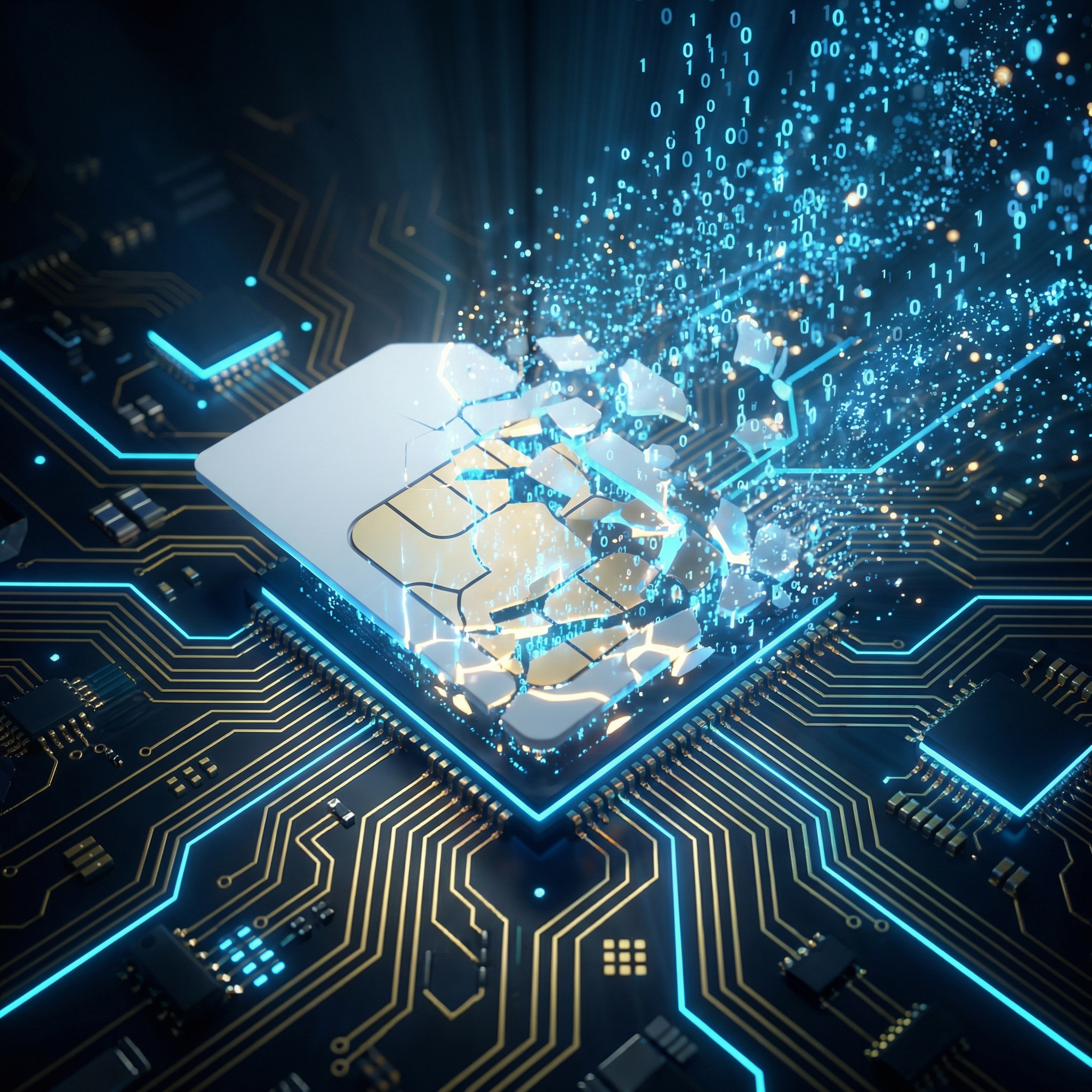
Exactly. The i-sim, or integrated sim. While the e-sim is a dedicated chip soldered onto the motherboard, the i-sim takes that entire functionality and moves it directly into the main processor, the System on a Chip. This is what Qualcomm and others have been pushing since twenty twenty-three. When the sim is just a tiny corner of your main processor, the physical footprint is literally zero. At that point, the physical sim card doesn't just look old, it looks impossible.
So if we move to i-sim, the cost of adding cellular connectivity to devices drops to almost nothing. Does that mean everything will have a phone number? My toaster? My shoes? My smart glasses?
Maybe not your shoes, but certainly your laptop, your tablet, even small industrial sensors. The goal of i-sim is to make cellular connectivity as easy to include as Bluetooth or Wi-Fi. And that is the real nail in the coffin for the physical sim card. Once you have billions of small devices that need to be connected, you can't be mailing out billions of pieces of plastic. The logistics alone would be a nightmare.
It is funny, Daniel’s prompt mentioned that he has had a dual sim phone for ten years. He has one for business and one for personal use. He was saying how great it is to be able to physically turn off a line when he is off the clock. Can you still do that as easily with e-sims?
Oh, even better. On most modern phones in twenty twenty-six, you can store eight or even ten e-sim profiles at once. You can't have them all active at the same time—usually just two—but you can toggle them on and off in the settings menu in seconds. It is much more flexible than having to carry around a little plastic case with all your different sims and a paperclip.
I guess the real question is, when does the physical sim finally die? If we look at the history of technology, things usually linger much longer than we expect. We still have people using fax machines in some government offices, after all. Do you think we will still see sim trays in twenty thirty?
In twenty thirty? Probably not on flagship devices. I think we are at the tipping point right now. By twenty twenty-eight, I expect almost all mid-range and high-end phones in major markets will be e-sim or i-sim only. The cost savings for the manufacturers are just too high to ignore. But in the ultra-low-cost market—the ten dollar or twenty dollar phones sold in developing nations—the physical sim might stick around for another decade. It is a very robust, very cheap way to handle identity without needing a complex digital infrastructure or a constant high-speed internet connection to activate a profile.
That is an interesting point about identity. The sim card isn't just about the network; it is a security module. It is a tiny, secure computer that holds your cryptographic keys. Is an e-sim as secure as a physical card? Can it be hacked more easily since it is just software?
That is a common misconception. An e-sim isn't just software running on your phone’s main processor. It is a hardware-based secure element. It has the same level of physical and logical security as a traditional sim card. In some ways, it is actually more secure because you can't just steal someone's phone and pop the sim out to put it in another device to intercept their two-factor authentication codes. If the phone is locked, the e-sim is locked.
That is a huge plus that people don't talk about enough. Sim swapping is a massive security problem. If someone gets their hands on your physical sim, they can basically take over your entire digital life by resetting passwords through S-M-S. If that sim is embedded in the hardware and protected by your Face I-D or fingerprint, that whole attack vector disappears.
Exactly. It is a massive upgrade for personal security. But let’s go back to Daniel’s observation about traveling. He mentioned the hassle of picking up a data sim in the United States and having to take out one of his existing cards. That is where the e-sim really shines. There are apps now, like Airalo or Holafly, where you can buy a data plan for almost any country in the world before you even leave your house. You land, the phone sees the new network, and you are online. No more hunting for a kiosk at the airport or worrying about getting ripped off by a local vendor.
I have used those apps, and it really does feel like living in the future. But I have noticed that those travel e-sims are often data-only. You don't get a local phone number. Is that a technical limitation or just a business model choice?
It is mostly a business and regulatory choice. Getting a phone number in many countries requires a lot of paperwork. You have to provide a passport, a local address, things like that—what they call K-Y-C or Know Your Customer laws. For a data-only plan, the regulations are often much looser. But as the tech matures, we are seeing more travel providers offer full-service plans with numbers. It is just taking time for the legal frameworks to catch up with the digital reality.
It always comes back to the law and the money, doesn't it? The technology is ready to sprint, but the institutions are walking with a cane.
That is the history of telecommunications in a nutshell. But I think what Daniel is feeling, that sense of the physical sim being archaic, is a sign that the culture is finally shifting. When regular people start noticing that a technology is inconvenient, the market has to respond. We saw it with the headphone jack, we saw it with the transition to U-S-B type C, and now we are seeing it with the sim card.
The headphone jack is a painful memory for some people, though. People were really upset about that. Do you think there will be a similar outcry when the sim tray disappears entirely? Or is it different because the sim card is something we almost never touch anyway?
I think it is different. Most people only touch their sim card once every two years when they get a new phone. It doesn't have that daily tactile utility that a headphone jack had. The only people who will really miss it are the power users and the frequent travelers who like to swap cards manually. But even for them, the benefits of having ten digital sims on one device will eventually outweigh the nostalgia of a little plastic tray.
I wonder if there is a second-order effect here for the carriers themselves. If physical sims go away, do the carriers lose their branding? Right now, when you buy a sim, it has the carrier's logo on it. It is a physical reminder of who you pay every month. If that becomes an invisible entry in a settings menu, does the carrier just become a faceless pipe?
That is exactly what they are afraid of. They are terrified of being commoditized. If the network is just a utility that you switch between based on price and signal strength, then the brand doesn't matter as much. That is why you see carriers trying to bundle all these extras, like streaming services or cloud storage. They are trying to find new ways to create that stickiness that the physical sim card used to provide.
It is a fascinating power struggle. On one side, you have Apple and Google and the hardware makers who want to simplify the device and take more control over the user experience. On the other side, you have the legacy carriers trying to hold onto their physical anchors. And in the middle, we have users like Daniel who just want their phones to work without a trip to the mall or a wait for a courier.
And let’s not forget the environmental impact. Billions of sim cards are produced every year. They are made of plastic, they have gold and silicon in them, and they are almost always packaged in a giant plastic card the size of a credit card that just gets thrown away immediately. Then they are shipped all over the world. Moving to e-sim is a massive win for sustainability. It eliminates a huge amount of electronic waste and a massive carbon footprint from logistics.
I hadn't even thought about the environmental side. That alone should be a reason to kill off the physical sim. Thousands of tons of plastic and metal just to identify a phone to a tower. It really is obscene when you put it that way.
It really is. And when you look at the numbers, it is staggering. We are talking about over four billion sim cards produced annually. That is a lot of waste for something that could be a few kilobytes of data.
So, to answer Daniel’s question: the physical sim card is absolutely due for retirement. It has been kept on life support by carrier resistance and the complexities of the global market, but the momentum is now unstoppable. Between the hardware benefits for manufacturers, the security upgrades, and the environmental impact, the tray’s days are numbered.
I agree. I think by the end of this decade, finding a phone with a physical sim slot will be like finding a laptop with a C-D drive today. It will be a niche feature for specific legacy uses, but the world will have moved on. The future is integrated, it is invisible, and it is a lot more convenient.
It is a bit of a bittersweet end for the little piece of plastic that could. It has been with us since the beginning of the mobile revolution. I remember my first phone, a Nokia where the sim card was the size of a credit card. You just slid the whole thing in.
Oh, the old full-size sims! Yeah, that was the standard back in the early nineties. We have shrunk it down to the mini, the micro, and finally the nano, but we have reached the limit of how small we can make a physical object that a human still has to handle with their fingers. The next step has to be no object at all.
From a credit card to a grain of sand to a ghost in the machine. That is quite the evolution. I think we have really dug into the why and the how here. It is one of those things where once you see the logic behind the change, the old way starts to look more and more ridiculous every day.
Exactly. And that is what we love about these prompts. They take something mundane that we all have in our pockets and reveal this whole hidden world of corporate strategy, engineering trade-offs, and global economics.
Well, I think that is a good place to wrap up our deep dive into the death of the sim card. Daniel, thanks for sending that in. It definitely gave us a lot to chew on. And to our listeners, if you have ever struggled with a sim card at an airport or felt the joy of a three-minute e-sim setup, we would love to hear your stories.
Definitely. And hey, if you are enjoying the show and our little deep dives into the weird world of tech and life, please consider leaving us a review on your favorite podcast app. Whether it is Spotify or Apple Podcasts, those reviews really do help other curious people find us. We appreciate every single one of you who takes the minute to do that.
Yeah, it really makes a difference. You can find all our past episodes and a way to get in touch with us at our website, myweirdprompts dot com. We are also on Spotify, so make sure to follow us there so you never miss an episode.
This has been My Weird Prompts. We will be back next week with another rabbit hole to explore. Until then, keep those prompts coming.
Thanks for listening. We will catch you in the next one. Sign off, Herman.
Goodbye, everyone! Stay curious!