Hey everyone, welcome back to My Weird Prompts. I am Corn, and I am sitting here in our living room in Jerusalem with my brother.

Herman Poppleberry, at your service. It is good to be here, Corn. We have a heavy one today, but a really important one.
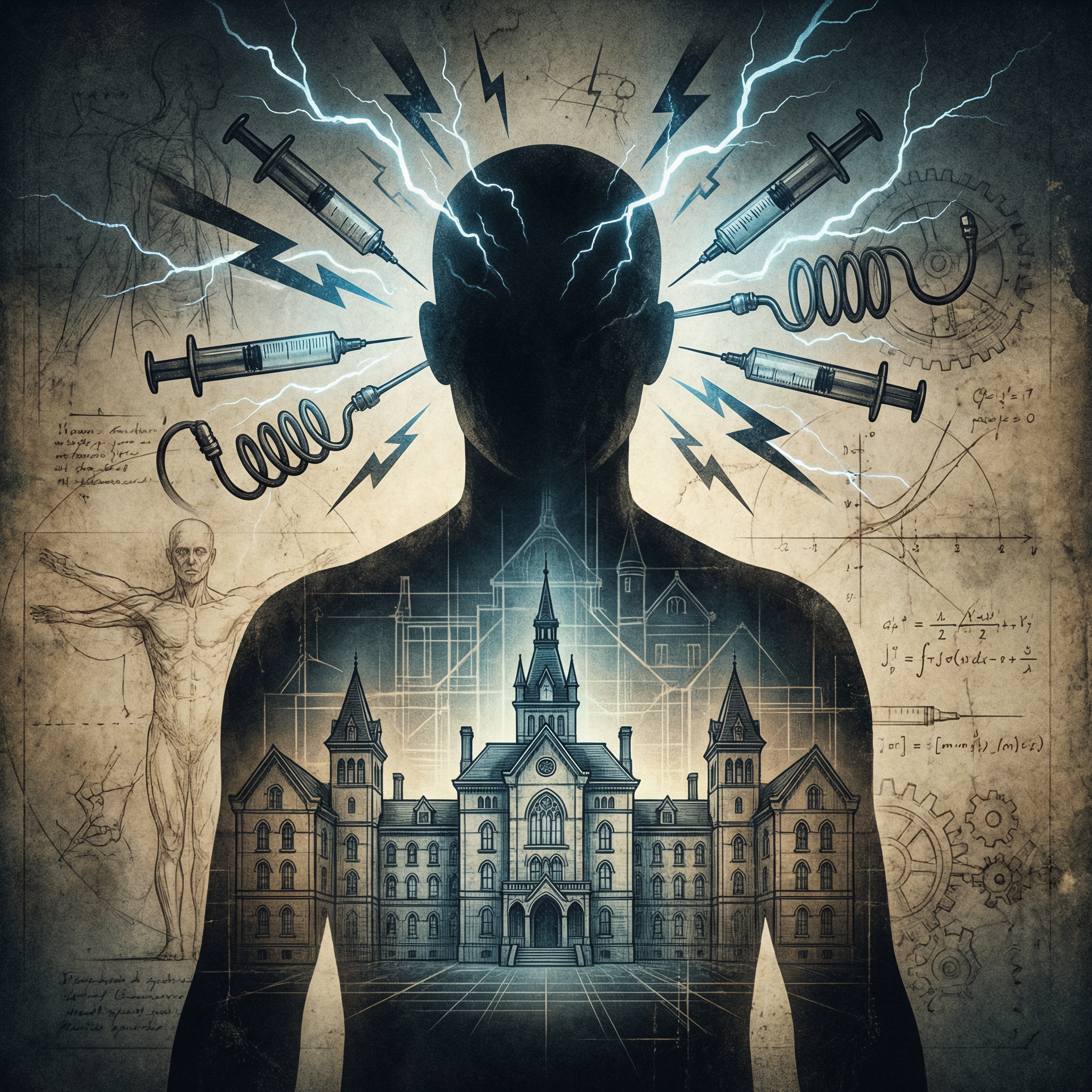
Yeah, our housemate Daniel sent this one in, and it is a follow up to some of the things he has mentioned before regarding his own family history with alcoholism and how that ripples through a life. He is asking about the connection between childhood trauma and mental health, but specifically, he wants us to dive into Eye Movement Desensitization and Reprocessing, or E M D R.
It is a fascinating topic because E M D R is one of those treatments that, on the surface, looks almost like magic or science fiction. You have got people following a light or a finger with their eyes while recalling their worst memories. It sounds like something from a movie, but the clinical evidence behind it is actually quite robust.
Right, and Daniel mentioned he was a bit skeptical when he first saw the device. I think a lot of people feel that way. It does not look like traditional talk therapy where you just sit on a couch and chat. So, before we get into the nuts and bolts of the eye movements, Herman, let us set the stage. How strong is the link between what happens to us as kids and the mental health issues we see in adults?
It is incredibly strong, Corn. In the world of psychology, we often talk about the Adverse Childhood Experiences study, or the A C E study. This was a massive piece of research done in the late nineteen nineties by the Centers for Disease Control and Kaiser Permanente. They surveyed over seventeen thousand people and found a direct, linear relationship between the number of childhood traumas a person experienced and their risk for things like depression, anxiety, substance abuse, and even physical illnesses like heart disease later in life.
And when we say trauma, are we just talking about extreme abuse, or is the definition broader than that?
It is much broader. The A C E study looked at ten categories, including physical, emotional, and sexual abuse, but also household dysfunction like having a parent with a mental illness, an incarcerated relative, or a parent struggling with substance abuse, like what Daniel mentioned. The key takeaway is that these experiences are not just sad things that happened in the past. They actually change the architecture of the developing brain through what we call toxic stress.
That is the part that fascinates me. We are not just talking about memories; we are talking about biological changes. If your brain is constantly in a state of high alert because your home environment is unpredictable, that amygdala, the alarm center of the brain, gets oversized and hyper-responsive, right?
Exactly. And the prefrontal cortex, which is the part of the brain responsible for logical thinking and emotional regulation, can actually have less gray matter density. So, you end up with an adult who has a very sensitive smoke detector in their brain but a weakened ability to tell if there is actually a fire or just someone burning toast. This is where something like E M D R comes in. It is designed to address those stuck memories that keep the alarm system ringing.
Okay, so let us talk about E M D R. It was developed by Francine Shapiro in the late nineteen eighties. The story goes that she was walking in a park, thinking about something upsetting, and noticed that her eyes were moving back and forth rapidly. She realized the distress went away. Now, that sounds almost too simple to be the foundation for a major therapeutic movement. What is the actual theory there?
The theory is called the Adaptive Information Processing model, or A I P. The idea is that our brains are naturally wired to process information and move toward mental health. When something normal happens to you, your brain processes it, files it away in long term memory, and you learn from it. But when something traumatic happens, that processing system gets overwhelmed. The memory gets stuck in its raw, original form.
Like a file that got corrupted while it was being saved?
That is a perfect analogy. The memory is stored with the original sights, sounds, smells, and especially the original physical sensations and beliefs. So, thirty years later, something might trigger that memory, and your body reacts as if the trauma is happening right now because the memory was never fully digested or integrated into your life story. E M D R uses what we call bilateral stimulation, usually eye movements, to jumpstart that processing system.
This is where Daniel’s skepticism comes in, and mine too, honestly. Why does moving your eyes back and forth help you digest a memory? Is it just a distraction?
That is actually one of the leading scientific theories. It is called the working memory account. Your working memory has a limited capacity. When you ask a person to hold a vivid, distressing memory in their mind while simultaneously following a therapist’s finger or a light bar back and forth, you are taxing the working memory. Because the brain cannot fully hold the intensity of the memory and the task of following the light at the same time, the memory starts to lose its vividness and emotional charge. It becomes more like a regular, boring memory and less like a reliving of the event.
So it is essentially forcing the brain to see the memory as something that is in the past rather than a current threat.
Precisely. There is also research suggesting it might mimic what happens during R E M sleep, where our eyes move rapidly and we process the day’s events. Some researchers also point to the orienting response. When your eyes track something in the environment, it signals to the brain that you are currently safe in your surroundings, which helps decouple the old fear from the memory.
You mentioned the evidence is robust. If we look at the data, how does E M D R stack up against something like Cognitive Behavioral Therapy, which is usually the gold standard?
For Post Traumatic Stress Disorder, or P T S D, multiple meta-analyses have shown that E M D R is just as effective as Trauma Focused C B T, and it often works faster. In some studies, eighty to ninety percent of single trauma victims no longer have P T S D after only three ninety minute sessions. For complex trauma, like what Daniel is asking about with childhood issues that went on for years, it takes longer, but the results are still very impressive. Organizations like the World Health Organization and the American Psychiatric Association have endorsed it as a top tier treatment for trauma for years now.
One thing Daniel asked about was whether to see a specialist or a general therapist who just happened to take an E M D R course. Given that we are in episode five hundred seventeen and we have talked a lot about the importance of the therapeutic alliance, what do you think the move is here?
That is a nuanced question. E M D R training is usually divided into levels. A therapist who has done Level One and Level Two has the basic tools. But an E M D R Certified Therapist has gone through much more rigorous supervision, has treated a certain number of cases, and has completed ongoing education. If you are dealing with complex, long term childhood trauma, I would strongly lean toward a specialist or at least someone who is E M D R Certified and very experienced with complex P T S D.
Why is that? Is there a risk if it is done poorly?
There is a risk of retraumatization. If a therapist opens up a very heavy childhood memory and the patient does not have the grounding skills to handle the emotional flood, they can leave the session feeling worse. A specialist is going to spend a lot more time in the preparation phase. They make sure you have a safe place in your mind and a set of internal tools to calm yourself down before they ever start the eye movements. It is not just about the light bar; it is about the container the therapist creates.
That makes sense. You do not want to go digging in a minefield if you do not know how to handle the explosives you might find. Now, Daniel also asked about other interventions for long term trauma, specifically mentioning psychedelics. Since we are in early two thousand twenty six, the landscape for this has changed quite a bit since the early twenty twenties.
It really has. We are seeing the fruits of years of clinical trials now. M D M A assisted therapy is the big one for trauma. Despite some regulatory hurdles back in twenty twenty four, the long term data was so undeniable that it has become a cornerstone for treatment resistant P T S D. Unlike E M D R, which focuses on taxing the working memory, M D M A seems to work by quieting the amygdala and increasing activity in the prefrontal cortex, while also boosting oxytocin, the bonding hormone.
So it creates this window of safety where you can look at the trauma without being overwhelmed by fear.
Exactly. It is often described as a year of therapy in a single day. The patient can approach memories that were previously too painful to even touch. But it is important to emphasize that it is the therapy that does the work, not just the drug. It is M D M A assisted therapy. You have two therapists in the room for an eight hour session, helping you navigate the experience. It is a very intensive process.
And what about psilocybin? I know people talk about that a lot for depression, but does it have a role in childhood trauma specifically?
Psilocybin is more about neuroplasticity and breaking out of rigid thought patterns. For someone with childhood trauma, they often have very fixed beliefs about themselves, like I am unlovable or the world is dangerous. Psilocybin can help shake up those neural pathways and allow for a perspective shift. It is like looking at your life from thirty thousand feet. You see the patterns, but you are not trapped in them.
It sounds like we are entering an era where we have a lot more tools than just talking about our problems. We have E M D R for reprocessing the specific memories, M D M A for creating emotional safety, and psilocybin for changing the overarching narrative. But Herman, what about things that are not pharmacological or high tech? Daniel asked about other interventions.
I am glad you asked, because some of the most effective treatments for childhood trauma are actually very body focused. There is a saying in this field, the body keeps the score, which is also the title of a very famous book by Bessel van der Kolk. Trauma is not just stored in our thoughts; it is stored in our nervous systems.
Right, that is why people get that tight feeling in their chest or their heart starts racing even if they are not consciously thinking about something bad.
Exactly. So, interventions like Somatic Experiencing or Sensorimotor Psychotherapy are huge. They focus on tracking physical sensations in the body and helping the nervous system complete the fight or flight responses that were frozen during the trauma. Even things like trauma informed yoga or neurofeedback can be incredibly helpful because they help the person regain a sense of mastery over their own physical state.
I think that is such an important point. If you grew up in an environment where you had no control, your body learned that it was not a safe place to be. Learning how to feel safe in your own skin is a massive part of the healing process.
It is the foundation. You can have all the insights in the world about why your parents acted the way they did, but if your body still feels like it is under attack, you are going to struggle. That is why a multi-modal approach is often best. Maybe you do some talk therapy to understand the context, some E M D R to take the sting out of the worst memories, and some somatic work to calm your nervous system.
It is a lot of work, though. I mean, Daniel’s question really highlights how much an adult has to do to unpack what was handed to them as a child. It can feel a bit unfair, can’t it?
It is profoundly unfair. You are essentially being asked to clean up a mess you didn’t make. But the good news is that the brain is plastic. We used to think that once the brain was wired a certain way in childhood, that was it. We now know that you can heal these pathways. You can actually change the way your brain responds to stress even decades later.
That is the hopeful part of this whole discussion. We are not just stuck with the hand we were dealt. So, Herman, if someone is listening to this and they relate to Daniel’s prompt, where do they start? If they are looking at all these options, E M D R, somatic work, maybe even the newer psychedelic therapies, how do they choose?
I think the first step is always stabilization. You don’t want to jump straight into the deepest trauma if your life is currently in chaos or if you don’t have good coping mechanisms. I would suggest finding a therapist who is trauma informed as a baseline. Ask them about their approach. Do they understand the nervous system? Do they use E M D R or somatic techniques?
And don’t be afraid to interview them. We always say this on the show, but the relationship is the biggest predictor of success. If you don’t feel safe with the therapist, none of the fancy techniques are going to work.
Absolutely. And for E M D R specifically, you can go to the E M D R International Association website, E M D R I A, to find certified practitioners. They have a directory that lets you search for people who have gone through that extra level of certification we talked about.
What about the skepticism part? If someone is sitting there in the chair, and the therapist starts moving their finger, and the patient is thinking, this is ridiculous, does that stop it from working?
Not necessarily. You don’t have to believe in E M D R for it to work. It is a physiological process. However, if you are so skeptical that you are resisting the process or not allowing yourself to focus on the memory, that can be a barrier. Usually, once people start to feel the shift, the skepticism fades. When you realize that a memory that used to make you cry or shake now feels like just a movie you saw a long time ago, it is hard to argue with the results.
I like that. It is like physical therapy. You don’t have to believe the exercises will work for your knee to get stronger; you just have to do the exercises.
Exactly. It is brain physical therapy.
We have covered a lot of ground here. We talked about the A C E study and how childhood trauma actually changes the brain. We looked at the mechanics of E M D R and the working memory theory. We touched on the new frontier of M D M A and psilocybin, and we talked about the importance of body-based work. Is there anything else you think Daniel should know?
I would just say that healing is not linear. Sometimes you take two steps forward and one step back. You might clear one memory with E M D R and then realize there is another layer underneath it. That is normal. The goal isn’t to erase your past; it is to make it so that your past doesn’t own your present.
That is a powerful way to put it. Making it so the past doesn’t own the present. I think that is what we are all aiming for, whether we have major trauma or just the usual baggage of being human.
Well said, Corn. And I think it is great that Daniel is asking these questions. It shows a real commitment to his own well being and a curiosity about the tools available.
Definitely. We are lucky to have him as a housemate. He keeps us on our toes with these prompts.
He really does. I am always excited to see what he sends over. Usually, it is something I have to go and read three new papers on just to keep up.
Guilty as charged, Herman. I saw you with those journals yesterday. You were in the zone.
I can’t help it. The research coming out of the neurobiology of trauma right now is just too good. We are finally getting a handle on how the mind and body interact.
Well, I think that is a good place to wrap up the core of this discussion. But before we go, I want to take a second to talk to our listeners.
Oh, are we doing the pitch?
We are doing the pitch, Herman. Look, we have been doing My Weird Prompts for five hundred seventeen episodes now, and we love this community. If you have been listening for a while and you find these deep dives helpful, please leave us a review on your podcast app or on Spotify.
It really does help. It is the main way new people find the show. And we read all of them, even the ones that tell me I am being too nerdy.
Especially those ones. They keep you humble, Herman Poppleberry. But seriously, a quick rating or a review makes a huge difference for independent podcasts like ours.
It truly does. And if you want to get in touch or see our back catalog, you can always go to myweirdprompts.com. We have the full R S S feed there and a contact form if you want to send us your own weird prompts.
Just like Daniel does. We love hearing from you all.
This has been a really meaningful episode for me, Corn. Thanks for digging into this with me.
Any time, brother. It is what we do.
Alright, I think that is it for today.
Thanks for listening to My Weird Prompts. We will be back soon with another one.
Take care of yourselves out there.
Goodbye, everyone.
Goodbye.