Hey everyone, welcome back to My Weird Prompts. I am Corn, and I am here in our home in Jerusalem with my brother.

Herman Poppleberry, ready to dive into the deep end today. And I mean the really deep end.
Yeah, no kidding. Our housemate Daniel sent us a voice note that honestly gave me a bit of a chill. He was talking about this concept of magical thinking and his own superstitions, but then he shared a story about a family friend that just defies a lot of what we consider to be the standard rules of biology and communication.
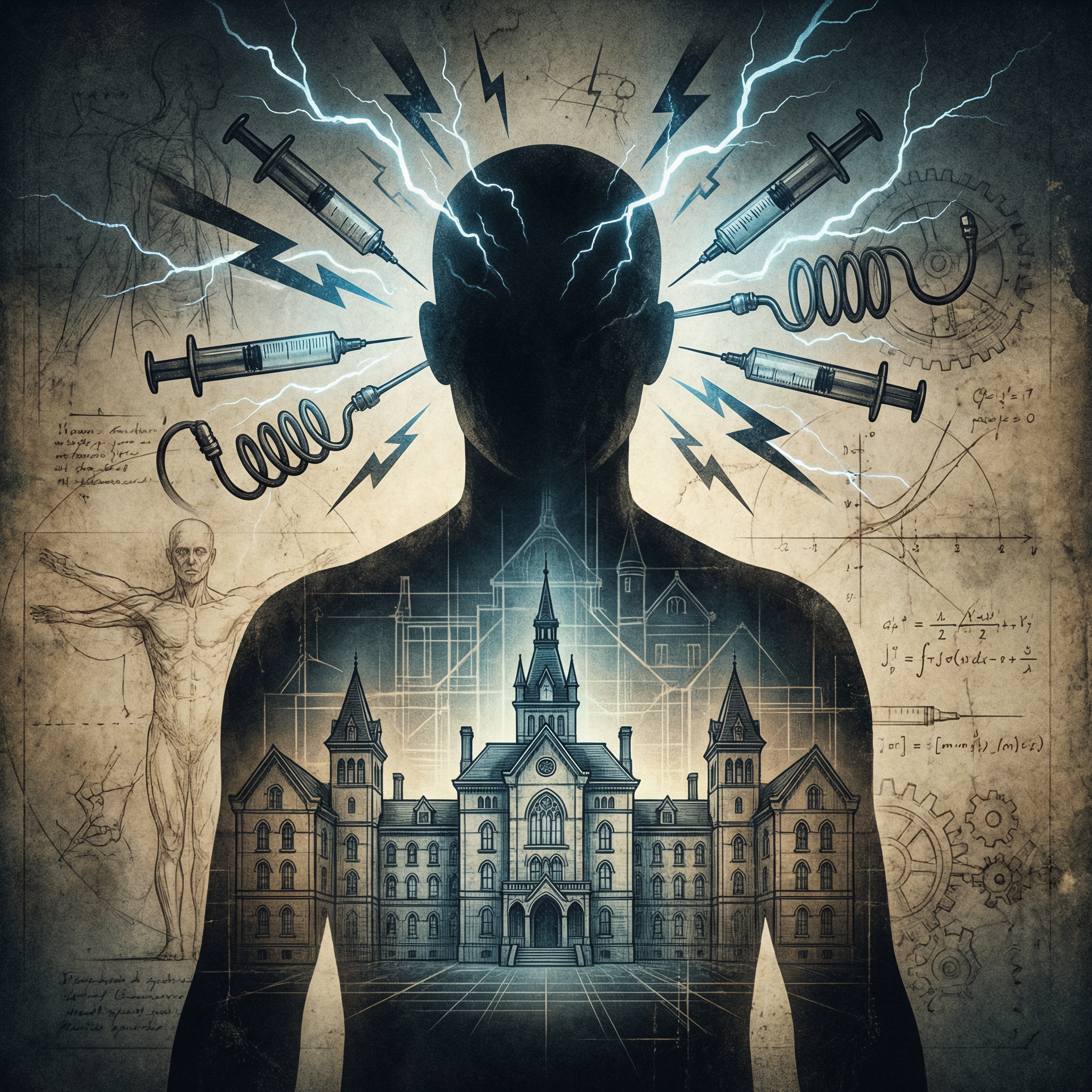
It is a classic case of what researchers sometimes call a deathbed coincidence or a crisis apparition. Daniel mentioned this elderly couple where the husband passed away in the hospital, and his wife, who had been struggling with severe Alzheimer's for years, somehow just knew. She told her caregiver, I know he is gone, even though no one had told her yet.
That is the part that gets me. When you have a condition like Alzheimer's, your connection to the present moment, to names, faces, and current events is often so frayed. And yet, in that specific moment, she had this crystal clear realization. Daniel also mentioned his own experiences with his grandparents, feeling that sudden coldness in the air, like the breath was being sucked out of the room.
It is something that people have reported for centuries, Corn. And while it is easy to dismiss it as just grief or coincidence, there is actually a surprising amount of documented research into these occurrences. It really forces us to look at the nature of consciousness and whether it is truly confined to the three pounds of gray matter inside our skulls.
That is exactly where I want to go today. We are on episode four hundred thirty-two, and we have touched on some of this before. I remember back in episode three hundred sixty-two, we looked at paranormal data and ancient lore, but today I want to focus on the modern research. What does the science actually say about these intuitive connections at the moment of death?
Well, to start, we have to talk about the sheer scale of these reports. The Society for Psychical Research, which was founded in London back in eighteen eighty-two, actually conducted one of the first major scientific inquiries into this. It was called the Census of Hallucinations. They surveyed seventeen thousand people and published their findings in eighteen ninety-four. They found that a significant number of people had experienced a vivid vision or a sense of a loved one's presence at the exact moment that person died, despite being miles apart.
Seventeen thousand is a huge sample size for the late nineteenth century. What was the takeaway? Did they find a statistical significance beyond what you would expect from random chance?
They did. The researchers, including people like Edmund Gurney and Frederic Myers, calculated the probability of seeing a vision of a person on the same day they died by pure chance. They found that the number of reported coincidences was actually four hundred forty times higher than what chance would predict. Even if you account for people misremembering the exact timing, that is a massive statistical outlier that suggests a real, non-local connection.
So, it is not just a few spooky stories. It is a recurring pattern in human experience. But how do we move from people saying they felt something to actual modern research? Because I know there are clinics and university departments that look into this now.
Exactly. One of the most prominent figures in this field today is Dr. Bruce Greyson at the University of Virginia. He is part of the Division of Perceptual Studies, or D O P S. They have been documenting these cases for decades. They look at near-death experiences, of course, but also what they call shared death experiences.
Shared death experiences. That sounds like what Daniel was describing with the husband and wife. Is that when a healthy person feels like they are participating in the dying process of someone else?
Precisely. Dr. Raymond Moody, who actually coined the term near-death experience back in the nineteen seventies, wrote an entire book on shared death experiences. He found that bystanders, often family members or hospice nurses, report seeing a light in the room, or feeling the spirit of the dying person leave the body. Sometimes they even report seeing the life review of the person who is passing away.
That is wild. It is one thing for the person dying to have a subjective experience, but for a second, healthy person to witness it? That suggests there is something objective happening in the environment, or at least a shared mental state that goes beyond individual imagination.
And that brings us back to Daniel's story about the wife with Alzheimer's. There is a specific phenomenon called terminal lucidity. This term was actually popularized by the researcher Michael Nahm. It describes when patients with severe cognitive impairment, like late-stage dementia or even those in comas, suddenly become completely clear and rational shortly before they die. They might recognize their children, have a deep conversation, and then pass away shortly after.
I have heard of that. It is almost like the brain's hardware is broken, but the software suddenly finds a way to run perfectly for a final few minutes. How does mainstream neuroscience explain that? If the neurons are physically degraded, how can the consciousness reappear so vividly?
The short answer is, it cannot easily explain it. If you believe that the brain produces consciousness like a radiator produces heat, then when the radiator is broken, the heat should be gone. But if you look at the brain as a filter or a receiver, like a radio, then terminal lucidity makes more sense. If the radio is damaged, you get static. But maybe at the end of life, the connection to the physical body loosens, and the consciousness is able to bypass the broken filter for a moment. Recent research by Alexander Batthyany suggests this points to an indestructible core of personhood that remains intact even when the brain is failing.
That is a fascinating analogy. It reminds me of some of the things we discussed regarding non-local consciousness. If our minds are not just in our heads, but are part of a larger field, then it would explain how a wife could know her husband died miles away. It is like two particles being entangled.
You took the words right out of my mouth, Corn. Quantum entanglement is the go-to analogy here. If two particles have interacted in the past, they remain connected regardless of distance. If you change the state of one, the other changes instantly. Albert Einstein famously called this spooky action at a distance. If human consciousness has a quantum component, which some physicists like Roger Penrose and Stuart Hameroff suggest in their Orchestrated Objective Reduction theory, then maybe deep emotional bonds create a kind of entanglement.
So, when that bond is physically severed by death, the other person feels the snap, so to speak. But Herman, let's be the devil's advocate for a second. A skeptic would say that we only hear about the hits. We do not hear about the thousands of times someone felt a chill or had a bad dream and their loved one was perfectly fine. Is there any way to filter out that confirmation bias?
That is the big hurdle. But the researchers at D O P S try to focus on cases with verifiable details. For example, Dr. Greyson often tells a story about a patient who had an out-of-body experience during a suicide attempt. She accurately described a spaghetti stain on his tie that he had been trying to hide all day. He was in a different room when she was unconscious, yet she saw it. When those details match up perfectly with a reality the person could not have known, the coincidence argument starts to fall apart.
Right, the specificity is the key. It is not just I feel sad, it is I know he passed at four fifteen p m and there was a blue vase on the table. When you get that level of detail, it becomes much harder to dismiss.
And we are actually getting better at measuring the biology of this. There was a major study called A W A R E two, led by Dr. Sam Parnia at N Y U Langone, which was published recently. They monitored the brain waves of patients during cardiac arrest and found that even when the heart had stopped for up to an hour, some patients showed spikes in brain activity associated with higher mental functions. They were seeing markers of hyper-consciousness, not just random firing. It suggests the brain might actually become more active as it transitions toward death.
That really challenges the materialistic view of reality, does it not? If these experiences are backed by electrical signatures in a flatlined brain, then the afterlife is not just a religious hope, but a potential biological or physical transition. It suggests that consciousness is something that can exist independently of the body.
That is the ultimate implication. If you can perceive things without your physical senses, and if you can communicate without physical means, then who we are is not defined by our physical form. It is a terrifying thought for some, but incredibly comforting for others. It means that the connection we have with people we love is not just a chemical reaction in our brains, but something more fundamental to the fabric of the universe.
I think about that story Daniel told about the husband and wife. Imagine the comfort that must have brought the family, even in their grief. To know that even though her mind was failing her, her heart, or her spirit, was still perfectly tuned into him. It suggests that the essence of a person remains intact, even when the brain is struggling.
And it also makes you wonder about the evolutionary purpose of such a thing. Why would we have the ability to feel a loved one's death from afar? Is it just a byproduct of our social nature, or is it a survival mechanism? Or perhaps it is just the way the universe is wired, and we are only now beginning to develop the tools to measure it.
Well, that is the thing. Our tools are still very primitive when it comes to consciousness. We can measure brain waves, we can measure blood flow, but we cannot measure the content of a thought or the depth of a feeling. We are basically trying to understand the ocean by looking at the ripples on the surface.
That is a great way to put it. And it leads to some interesting second-order effects. If we accepted these phenomena as real, how would it change our healthcare system? How would we treat people in hospice? Right now, we often sedate people who start having visions because we think they are experiencing delirium. But if those visions are actually a meaningful part of the transition, we might be interrupting something incredibly important.
Exactly. We might be medicating away the most profound moment of a person's life. I have read accounts where people were terrified of dying until they had one of these experiences, either themselves or through a loved one. It completely removes the fear of death. And if you remove the fear of death, you change how people live.
That is the real takeaway. It is not just about what happens at the end, but how it informs the middle. If we are all connected in this non-local way, then how we treat each other matters even more. Every action, every word, might be echoing in a field that we all share.
It is a lot to chew on. I want to go back to the research for a second, though. Have there been any attempts to induce these states or to measure them in a lab? I know there is the whole work with psilocybin and end-of-life anxiety, but what about the telepathic aspect?
There have been Ganzfeld experiments, which try to test for extra-sensory perception by putting people in a state of sensory deprivation. They have shown some statistically significant results over the years, though they are still controversial. But the most compelling evidence still comes from those spontaneous cases. You cannot really replicate the emotional weight of a loved one dying in a laboratory setting. That raw, intense bond seems to be the catalyst for these events.
It is the signal strength. A laboratory test is like trying to pick up a radio station from three states away with a coat hanger. But the death of a spouse is like being right next to the transmitter. The energy of that moment is what makes the signal break through the noise of our everyday lives.
Right. And most of the time, our brains are busy doing exactly what they were designed to do, which is to keep us focused on the physical world. We have to find food, we have to avoid traffic, we have to pay the bills. Our brains filter out all the extra noise so we can survive. But in those moments of extreme crisis, the filter drops.
This really connects back to what Daniel said about being superstitious. Maybe what we call superstition or magical thinking is just our intuition trying to make sense of these underlying connections that we do not fully understand yet. We label it as weird or supernatural because it does not fit into our current textbook of physics.
Exactly. Remember, a hundred years ago, the idea of wireless communication would have seemed like magic. Sending your voice through the air to be picked up by a box on the other side of the world? That is a shared death experience for someone from eighteen hundred. We just happened to find the physical mechanism for it. Maybe one day we will find the physical mechanism for consciousness-to-consciousness communication.
I hope we do. It would certainly make the world feel like a less lonely place. But until then, we have these stories. And I think it is important that we keep collecting them. If any of you listening have had an experience like this, where you just knew something had happened before the phone rang, we would love to hear about it. You can reach out through the contact form at myweirdprompts.com.
Yes, please do. The more data points we have, the clearer the picture becomes. And honestly, it is just fascinating to hear how these moments have impacted people's lives. It is one of the most human things we can talk about.
It really is. Now, Herman, before we wrap this section up, is there any specific case from the D O P S archives that really stands out to you? Something that even a skeptic would find hard to ignore?
There is a classic case involving a woman named Red Wing. She was a Native American woman who had a very close relationship with her daughter. One day, she was sitting in her house and she suddenly saw her daughter standing in the room, looking distressed and covered in water. She knew immediately that her daughter had drowned. She even told her husband the exact time it happened. It turned out her daughter had been in a boating accident miles away at that exact moment. The detail of the water is what makes it so striking. It was not just a feeling of dread, it was a visual representation of the physical reality of the death.
That is incredible. And it perfectly mirrors Daniel's point about the air being sucked out of the room. It is a physical manifestation of a distant event. It makes you wonder if we are all just swimming in the same soup and we only notice the temperature change when someone leaves the pool.
That is a very Corn analogy, but I like it. We are all part of the same fluid system.
Well, I try. So, let's talk about the practical side for our listeners. If someone is going through this, or if they have a loved one in hospice, what should they take away from this discussion?
First, I would say, trust your intuition. If you feel a sudden urge to call someone, or if you have a strange dream, do not just dismiss it. Even if it turns out to be nothing, the act of reaching out is valuable. And if you are with someone who is dying and they start talking to people you cannot see, or if they seem to have a sudden moment of clarity, lean into it. Do not try to correct them or tell them they are hallucinating. Just listen. There is often a lot of peace to be found in those moments if you allow them to happen.
That is great advice. I think we also need to be more open about these experiences. There is a lot of shame or fear of being called crazy, which prevents people from sharing these stories. But as we have seen today, these are not isolated incidents. They are a documented part of the human experience.
Absolutely. We need to normalize the mystery. Just because we cannot explain it with our current science does not mean it is not real. It just means our science has more room to grow.
I love that. Normalize the mystery. That could be the tagline for the whole show, really.
It really could. And speaking of the show, we have been doing this for over four hundred episodes now, and the feedback from you all is what keeps us going. If you are enjoying these deep dives into the weird and the unexplained, we would really appreciate it if you could leave us a review on your podcast app or on Spotify. It genuinely helps other people find the show and helps us keep these conversations going.
Yeah, it really does. Every rating and review makes a difference. And if you want to dig into our archive, head over to myweirdprompts.com. You can search for topics like near-death experiences, quantum consciousness, or even that episode three hundred sixty-two we mentioned earlier.
We have covered a lot of ground over the years, but I feel like we are still just scratching the surface of what is out there.
I agree. There is so much more to explore. Daniel, thanks again for sending that prompt in. It really sparked a great conversation today. It is nice to have a housemate who keeps us on our toes with these kinds of questions.
Definitely. Though I might be a little more careful next time I feel a draft in the house. I will be wondering if it is just the old Jerusalem stone or something more.
Knowing this house, it is probably both.
Fair point. Well, this has been My Weird Prompts. I am Herman Poppleberry.
And I am Corn. Thank you all for listening, and we will catch you in the next episode.
Until then, keep an eye on the ripples.
And keep questioning the soup. Goodbye everyone.
Bye.
So, Herman, I was thinking about one more thing before we totally sign off. You mentioned the energy transfer. Do you think there is any connection to the actual physical laws of thermodynamics? You know, energy cannot be created or destroyed, it only changes form.
It is a classic argument in the spiritual community. If consciousness is a form of energy, then where does it go? The law of conservation of energy would suggest it has to go somewhere. The problem is, we do not have a way to define consciousness as a physical energy yet. We can measure the electricity in the brain, which does dissipate as heat after death, but is that all there is? Most of these researchers would say no, there is a non-physical component that we just do not have the math for yet.
It is like trying to solve an equation when you do not know what half the variables are.
Exactly. We are working with a very incomplete set of equations. But that is what makes it exciting. We are the explorers on the edge of the map.
And the map is getting bigger every day. Alright, for real this time, thanks for listening.
Take care, everyone.
We will see you next time on My Weird Prompts. Check out the website for the R S S feed and the contact form. We really do read everything you send in.
We do. Even the really weird stuff. Especially the really weird stuff.
Especially the weird stuff. Goodbye!